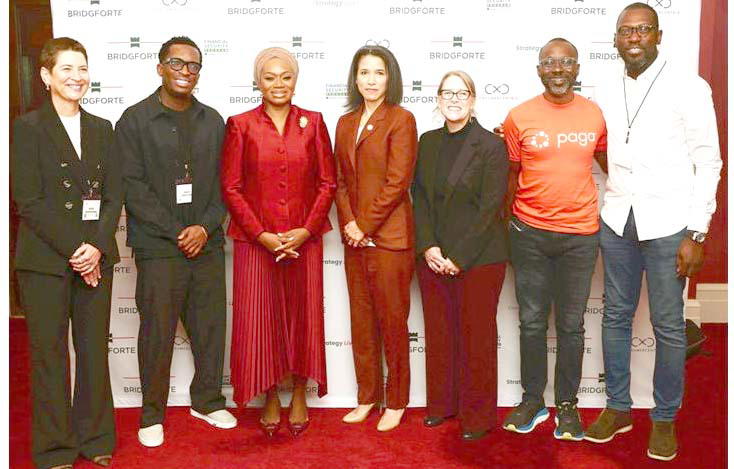
L-R: Anna Gincherman, Partner, Consumer Centrix; Shola Akinlade, Co-founder/ CEO, Paystack; Aishah N. Ahmad, CFA – Convener, Bridgforte Dialogues, Soniya Asusu Nupe; Adrienne Harris, Superintendent, New York State Dept. of Financial Services; Kate Griffin, Director, Inclusive Financial System, Financial Security Program, Aspen; Tayo Oviosu, Founder/ CEO, Paga; Olugbenga Agboola, Co-founder/ CEO, Flutterwave at the inaugural edition of BridgForte Dialogues on Financial Inclusion held in Harvard Club of New York on the sidelines of UNGA 80, New York.
By Moses Nosike
Philanthropists, policymakers, regulators, innovators and private sector leaders have emphasised that the most effective way to address the challenges of financial inclusion is for the government and the private sector to collaborate in co-creating policies, jointly monitoring outcomes, and establishing incentives for long-term commitment. They insisted that there is a need to chart actionable pathways for inclusive and resilient financial systems.
These were the major takeaways from the inaugural Bridgforte Dialogues Roundtable held on the sidelines of the 80th United Nations General Assembly (#UNGA80).
The programme with the theme: ‘Financial Inclusion Towards 2035: Shifting Power, Shaping Systems,” held at the Harvard Club of New York City was convened in collaboration with the Aspen Institute Financial Security Programme and ConsumerCentriX.
Superintendent of the New York State Department of Financial Services, Adrienne Harris, said that the role of New York is to protect consumers and ensure an inclusive financial system.
According to her, the mission of New York is to globally maintain a thriving marketplace for both traditional institutions and innovators.
The Emir of Kano, Sanusi Lamido Sanusi, while reflecting on Nigeria’s long journey toward financial inclusion, said that despite the push for a cashless Nigeria, 65 percent of transactions are still in cash.
The former Central Bank of Nigeria Governor urged the participants to reckon with this gap amid the global push toward digital economies.
Soraya Hakuziyaremye, Governor, National Bank of Rwanda, in his virtual contribution at the programme, charged all stakeholders to co-create policies, monitor outcomes together, and build incentives for long-term commitment
Mohammed Umaru Bago, Governor of Niger State, called for stronger government leadership.
According to him, the government must lead on financial inclusion with sound policies, resilient infrastructure, and above all, investor protection. Clear laws and strong regulations, he said, are essential to ensure durable policies and lasting confidence.
Contributions from private sector leaders’ perspective, Shola Akinlade (Paystack) and Gbenga Agboola (Flutterwave) highlighted Africa’s opportunity to break down borders through digital innovation and Bola Adesola (Ecobank Nigeria), who emphasised the role of trust and partnerships in advancing inclusion.
Participants proceeded to curated table discussions to identify blind spots in current strategies and co-create practical recommendations. The dialogue culminated in a plenary exchange, where perspectives from regulators, entrepreneurs, and philanthropists converged on the urgency of cross-sector collaboration to dismantle systemic barriers.
Commenting on the partnership, Ida Rademacher from the Aspen Institute Financial Security Programme said the roundtable was an exciting step to align private, public, and philanthropic leadership and consumer-centred insights to build a more responsive, beneficial financial infrastructure for the future.
Aishah N. Ahmad, CFA/ convener of the Bridgforte Dialogues, closed with a call to action: “Today we proved the power of an unusual conversation, candid, cross-sector, and bold. We tackled trust, the government’s role, disruptive technologies like DeFi, and the leadership needed for true transformation. Facilitating this dialogue has been a privilege, but the real work begins now, and I am committed to carrying it forward with urgency and resolve.”
The Bridgforte Dialogues align with UNGA 80’s theme “Better Together” and anticipate the upcoming Second World Summit for Social Development, reinforcing that the future of inclusion lies in ensuring historically underrepresented voices are at the center of shaping global agendas.
Disclaimer
Comments expressed here do not reflect the opinions of Vanguard newspapers or any employee thereof.