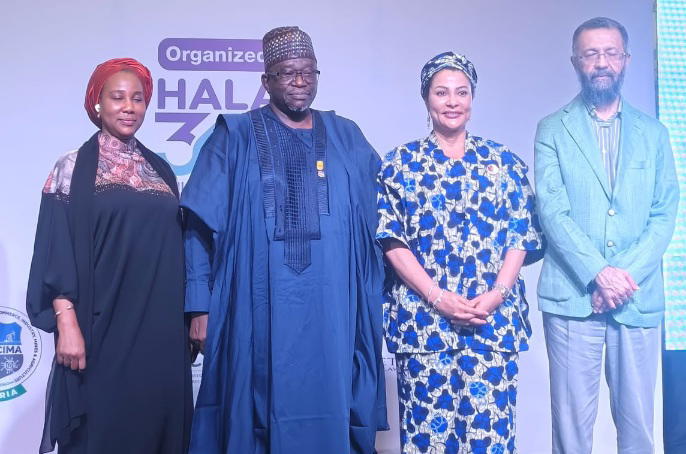
L-R: The Managing Partner of The Metropolitan Law Firm and Coordinator of the Lagos Halal Leadership Reception, Ummahani Ahmad Amin; The National President of NACCIMA and member of the Board of Directors of ICCD, Engr. Dr Jani Ibrahim; The Minister of State for Budget and Economic Planning, Dr Doris Uzoka-Anite represented Vice President, Senator Kashim Shettima and The Secretary General of ICCD, HE Sheikh Yousef Hassan Khalawi during the Halal 360 Leadership Reception 2026 at Eko Hotel.
By Esther Onyegbula
The Federal Government has set its sights on securing a significant share of the estimated $7 trillion global halal economy, with Vice President Kashim Shettima declaring that Nigeria must move beyond rhetoric to concrete investments, production and exports.
Shettima said the administration of President Bola Ahmed Tinubu was determined to position the halal economy as a major driver of economic diversification, non-oil exports, investment and job creation.
The Vice President spoke on Wednesday in Lagos at the Lagos Halal Leadership Reception 2026, organised by Halal 360 in partnership with the Islamic Chamber of Commerce and Development, ICCD; Halal Products Development Company, HPDC; Nigeria Halal Economy Strategy Implementation Committee Secretariat, NHESICS; The Metropolitan Law Firm and the Nigerian Association of Chambers of Commerce, Industry, Mines and Agriculture, NACCIMA.
Represented by the Minister of State for Budget and Economic Planning, Dr Doris Uzoka-Anite, Shettima said Nigeria possessed the market size, agricultural resources, manufacturing capacity and entrepreneurial strength required to compete effectively in the rapidly expanding global halal market.
He, however, warned against a situation where Nigeria would remain largely a consumer of halal products while other countries captured the greater economic value generated from the sector.
According to him, the halal economy had evolved beyond food and beverages to include Islamic finance, pharmaceuticals, cosmetics, tourism, logistics, manufacturing and digital commerce.
“Government is determined to move Nigeria beyond discussions about the halal economy to concrete investment, production and export outcomes,” he said.
Shettima said Nigeria’s large population, agricultural and livestock resources, growing private sector and strategic position within Africa gave the country a strong competitive advantage, particularly with the implementation of the African Continental Free Trade Area, AfCFTA.
He said the Federal Government had consequently incorporated the halal economy into the Renewed Hope Agenda, particularly its focus on diversifying the economy, expanding non-oil exports and creating jobs.
The Vice President recalled that the Nigeria Halal Economy Strategy Implementation Committee was inaugurated on March 3, 2026, with a mandate to coordinate the development and implementation of the national strategy.
He disclosed that the committee’s four workstreams had been activated, while the Secretariat had consolidated its implementation plan into 13 delivery clusters with defined milestones and a target of mobilising more than $12 billion in investment.
He added that the Federal Government had taken the initiative to the National Economic Council, with Osun, Katsina and Kano states already indicating interest in domesticating the strategy.
Shettima also disclosed that Nigeria was deepening international partnerships with institutions including the Islamic Development Bank, Arab Bank for Economic Development in Africa, BADEA, the D8 Halal Forum and other international bodies.
He said proposals were also being considered for Nigeria’s Halal Accreditation and Verification Platform to serve as a model for the continent.
According to him, discussions were further advancing on the establishment of a regional capacity-building centre in Nigeria in collaboration with international partners.
He said the Federal Government was working towards presenting the Governance Framework, National Halal Mark, Halal Accreditation and Verification Platform and related fees architecture to the Federal Executive Council.
But Shettima stressed that policies and partnerships would amount to little without businesses, investments, exports and jobs.
“Policies and partnerships will have little impact without actual businesses, investments, exports and jobs,” he said, urging the private sector to remain at the centre of Nigeria’s halal economy drive.
He called on manufacturers, financial institutions, logistics operators, farmers, tourism businesses and technology entrepreneurs to see halal certification, traceability and conformity assessment as tools for accessing international markets rather than regulatory burdens.
The Vice President also identified non-interest financing as a critical component of the strategy, citing Nigeria’s experience with Sukuk as evidence that alternative financing instruments could be deployed on a large scale to support infrastructure and productive economic activities.
Earlier, the Managing Partner of The Metropolitan Law Firm and Coordinator of the Lagos Halal Leadership Reception, Ummahani Ahmad Amin, said the gathering was conceived as a policy and stakeholder engagement platform rather than a commercial event.
She said stronger coordination was required among government, regulators, investors, financial institutions, businesses and professional bodies to convert Nigeria’s halal potential into sustainable economic value.
In his opening address, the National President of NACCIMA and member of the Board of Directors of ICCD, Engr. Dr Jani Ibrahim, said Nigeria must urgently move from discussions about the potential of the halal economy to policies capable of driving investment, trade and market access.
Ibrahim said NACCIMA would collaborate with government and other stakeholders to position Nigerian businesses to benefit from emerging opportunities in the sector.
He stressed that halal should be viewed as a trade and investment opportunity rather than merely a certification issue.
Also speaking, the Secretary General of ICCD, Sheikh Yousef Hassan Khalawi, said Nigeria had an opportunity to secure a much larger share of what he described as one of the world’s fastest-growing economic sectors.
Khalawi cited Nigeria’s dominant position in shea butter production, arguing that the country could generate significantly more economic value by developing local processing, branding and manufacturing capacity instead of exporting raw materials.
He said Nigeria’s challenge was not merely to increase production but to ensure that the economic value generated from its resources reflected the country’s production strength.
According to him, the development of strong local industries would be critical to achieving that objective.
Delivering the vote of thanks, the President of the Non Interest Financial Institutions Association of Nigeria, NIFIAN, and Chairman of Arthur Group, Dr Basheer Oshodi, said the non-interest finance industry was ready to provide the financial architecture needed to support Nigeria’s halal economy strategy.
Oshodi said the industry had moved beyond being an emerging sector, pointing to Nigeria’s non-interest banking framework, Sukuk market and growing Islamic finance ecosystem as evidence of its capacity to support investment, manufacturing, exports and financial inclusion.
He called for closer coordination among financial regulators, standards bodies and halal institutions to develop an integrated ecosystem capable of financing production from the factory floor to international markets.
Oshodi said the ultimate measure of the country’s halal strategy should be tangible economic outcomes.
He listed such outcomes to include export-ready Nigerian companies, increased investment in manufacturing and processing, stronger international market access and more jobs for Nigerians.
The event attracted senior government officials, regulators, financial institutions, investors, manufacturers, exporters, diplomatic representatives and business leaders.
Participants agreed that Nigeria’s competitive advantage in the global halal economy would depend not only on its population and natural resources, but on its ability to establish credible standards, mobilise capital, develop local industries and build globally recognised Nigerian halal brands.
Disclaimer
Comments expressed here do not reflect the opinions of Vanguard newspapers or any employee thereof.