By Kenneth Oboh
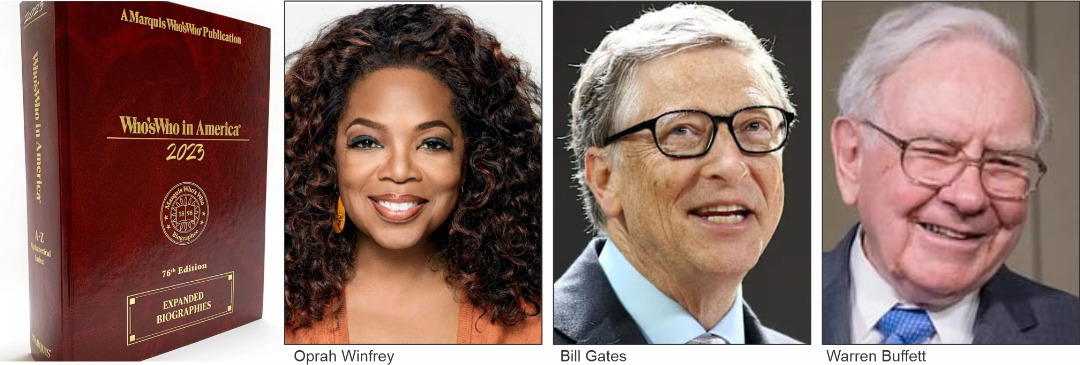
It has chronicled achievements, but not just ordinary achievements. These achievements have to be extraordinary. No wonder listees have included Bill Gates, Oprah Winfrey, and Stevie Wonder. It is clearly more than a vanity list.
For 125 years, Marquis Who’s Who has catalogued the lives of leaders and innovators across the world, becoming what librarians, journalists, and researchers widely regard as the gold standard in biographical reference.
This iconic publication began in Chicago in 1898 when Albert Nelson Marquis, a young publisher with a belief that the achievements of the most accomplished individuals should be documented for posterity, conceived the idea of Who’s Who in America. The first volume appeared in 1899. At the time it contained fewer than 9,000 entries, but it immediately distinguished itself from ordinary directories by adopting a clear editorial principle: inclusion was not purchased but earned.
Today, Marquis has published more than a century of volumes, branching out into specialized titles such as Who’s Who in the World, Who’s Who in Medicine and Healthcare, and Who’s Who in Science and Engineering. Its database now contains over 1.6 million biographies spanning leaders in government, business, academia, science, the arts, and public service.
The Standard of Selection
The enduring prestige of Marquis lies in its selection process. Unlike countless “who’s who” directories that appeared in the twentieth century and offered paid listings, Marquis has consistently emphasized editorial review. Candidates are identified in three principal ways: nomination by peers, inclusion in rosters of professional associations, and research carried out by Marquis’ own editorial staff to track individuals of high profile.
The evaluation is centered on what Marquis calls “current reference value”. This means that candidates must have achievements of significance that researchers, journalists, and institutions would find valuable to reference. Leadership roles in significant organizations, major educational attainments, published works, inventions, community impact, and national or international recognition are key factors.
Erica Lee, Chief Executive Officer of Marquis Who’s Who, explained in a 2018 interview that inclusion involves more than sending in a résumé. “There is an application and a phone interview,” she said, describing the verification process. “There is no cost to be considered. Qualified listees receive a complimentary listing.”
This point is crucial because it separates Marquis from less credible directories that sell recognition to anyone willing to pay. While Marquis does offer commemorative products such as plaques or certificates, the editorial decision to include or exclude a candidate is made independently of any purchase.
A Resource with Influence
The significance of Marquis Who’s Who extends far beyond prestige for the listees themselves. Over the decades, the reference has been widely used in libraries, universities, media houses, corporations, and government offices.
Journalists use Marquis to confirm background information. Recruiters consult it to verify credentials and assess experience. Academics and students reference it for reliable biographical data. Even Forbes magazine once used Who’s Who in America as part of its U.S. college rankings methodology, an acknowledgment of Marquis’ reliability in identifying accomplished alumni.
Librarians often highlight the trust attached to the name. Because Marquis’ volumes are updated regularly and the digital database is refreshed daily, researchers know they can find accurate and current details about leading figures across disciplines. In an information age crowded with unverified online profiles, Marquis stands as a vetted source.
The Caliber of Listees
The individuals profiled in Marquis Who’s Who represent a broad spectrum of human achievement. Bill Gates, co-founder of Microsoft, is listed for his transformative impact on technology and philanthropy. Oprah Winfrey appears for her global influence in media and her groundbreaking role as one of the most successful women in entertainment history. Stevie Wonder is profiled as both a legendary musician and a humanitarian whose influence has crossed continents.
Historical figures also appear in Marquis’ historical series, which has profiled Abraham Lincoln, Elizabeth Blackwell, Jackie Robinson, and Andy Warhol. These profiles serve not just as biographical sketches but as educational resources that place individual achievements within the broader story of human progress.
Across diverse fields of human endeavor, certain figures stand as quiet pillars, shaping lives and thought through decades of dedicated work. Frank Mann, the award-winning artist, educator and writer behind the Frank Mann Studio in New York, has poured more than forty-five years into a practice that blurs boundaries between art and life, leaving behind a body of work that continues to inspire. In the same spirit of enduring commitment, Susan Matorin has spent over five decades in psychiatry, teaching as a senior lecturer on social work in psychiatry at Weill Cornell Medicine and guiding generations of professionals with both knowledge and compassion.
Raymond K. Mays exemplifies another form of leadership, one rooted in entrepreneurship and vision. As chief executive officer of the Eye Centers of Tennessee in Crossville, he has built an institution that serves its community with precision and care. A different sort of stewardship defines the work of Dr. Rob Moir, the scientist and advocate who has championed environmental protection as executive director of the Ocean River Institute in Cambridge, Massachusetts, since 2007.
The stories continue in equally distinct registers. Olga L. Morales, founder and chief executive officer of VIBRANT FC, brings to her work more than twenty-five years of expertise in residential care, shaping spaces of safety and dignity. Dr. Joan A. Muir has given a quarter century to clinical psychology and, since 2007, has directed the Brief Strategic Family Therapy Institute at the University of Miami’s Miller School of Medicine, bringing both rigor and innovation to the field of family care.
Industry, too, has its exemplars. Joan Marie Price, owner, chief financial officer and safety director of Custom Installers of Colorado, is respected in the commercial millwork industry for her multifaceted leadership. In mental health, Dr. Hans Jorg Stahlschmidt stands out as both clinician and thinker; as senior core faculty at the PACT Institute, he is known for his forward-looking treatment methodologies.
History itself is honored in the work of Mary V. Thompson, research historian emerita at George Washington’s Mount Vernon, whose four decades of scholarship on early America have deepened public understanding of the nation’s origins. And in Germany, Dr. Martin Wächtler carries forward a long career in medicine as internist and infectiologist for the City of Munich, where his expertise in internal and public health has become a touchstone for colleagues and patients alike.
It is through the careful preservation and illumination of such stories that Marquis Who’s Who has carved its place in American cultural life. Established in 1898 to chronicle excellence across professions, it has served not merely as a registry but as a beacon of recognition. Warren Buffett, the celebrated investor and business mogul, once testified to its influence on his own journey. “To be able to read about the lives of these people that have been through so much … it’s so extraordinary; the lessons, the discouragements they’ve faced, everything about them,” he reflected, underscoring how the lives captured within its pages offered him both guidance and inspiration.
Buffett’s acknowledgment reveals what ties all these individuals together: the understanding that achievement is never only about personal triumph but about charting a path others might learn from. Whether in art, medicine, education, or history, their legacies endure precisely because they embody the very ethos Marquis Who’s Who has long championed—the celebration of perseverance, excellence, and the capacity to inspire future generations.
Yet the true strength of Marquis lies in its breadth. It lists not only household names but also thousands of less-publicized achievers. Doctors in rural communities who have pioneered new approaches to patient care, scientists whose inventions are embedded in everyday technology, professors whose research has reshaped entire academic fields, and public servants who have improved governance at local and national levels are all recognized.
Guarding Against Impostors
The reputation of Marquis has also made it a target. Over the years, scammers have impersonated Marquis staff, offering guaranteed listings in exchange for payment or promoting vanity awards. AARP and other consumer watchdogs have issued warnings about such schemes, reminding professionals that legitimate Marquis consideration is free of charge.
Erica Lee has also been vocal in cautioning the public. She has explained that Marquis never charges a fee for inclusion, and that genuine candidates go through the editorial review and interview process. The existence of impostors ironically reinforces the prestige of the brand, since it demonstrates the value people attach to being associated with it.
Tradition and Innovation
While Marquis remains rooted in its historic red-bound volumes, it has also adapted to the digital age. Its online platform now provides powerful search tools, branding services for listees, and networking opportunities. The aim is to make the database not just a static record but a dynamic resource for connection and professional growth.
This dual approach has kept Marquis relevant. The print volumes maintain a sense of tradition and permanence, while the digital ecosystem allows professionals, corporations, and institutions to access up-to-date profiles at any time. For many listees, the inclusion is not only recognition of past achievements but also a platform for future opportunities.
Why Inclusion Matters
For individuals, being listed in Marquis is an acknowledgment of career achievement and public contribution. It provides a permanent record that can be referenced in professional contexts, academic research, and even in legal or governmental verification.
For society at large, it serves as a chronicle of progress. Each profile is a piece of a larger mosaic showing how knowledge, culture, technology, and governance have evolved. By cataloguing the lives of achievers from every field and from around the world, Marquis creates a living archive of excellence.
125 years after its founding, Marquis Who’s Who continues to uphold the principle established by Albert Nelson Marquis: that excellence deserves to be recorded. The editorial standards may have evolved with the times, but the core mission has not changed.
In an era where recognition is often fleeting and achievements can be drowned out by the noise of social media, Marquis provides a different kind of acknowledgment. It is not based on popularity or trend but on substance and impact.
As Erica Lee has said, “To be listed is to be recognised as having shaped one’s field and to be preserved in the historical record.” For professionals who devote their lives to innovation, leadership, and service, that permanence is the highest form of recognition.
Excellence may take many forms: a groundbreaking scientific discovery, a powerful work of art, a lifetime of teaching, or a career of public service. Marquis Who’s Who has become the record keeper of these varied forms of excellence. To be listed is not merely to be known. It is to have one’s contributions placed within the enduring story of human achievement.
In that sense, the title is fitting. Excellence is indeed the other name for Marquis Who’s Who.
Disclaimer
Comments expressed here do not reflect the opinions of Vanguard newspapers or any employee thereof.