File phorto
BY VICTOR AHIUMA-YOUNG
EVERY May 1, Nigerian workers join their counterparts in other parts of the world apart from the United State of America, USA, to mark workers’ day otherwise known as May Day. As part of the activities marking this year’s celebration, Amalgamated Union of Public Corporations, Civil Service Technical and Recreational Services Employees, AUPCTRE, organized a seminar in Lagos to mark the day.
In a paper, General Secretary of the union, Comrade Philip Agbonkonkon, explained the significance of May Day. He said May Day celebrations were not meant as mere celebrations by way of public holidays and merriment, rather occasions of reminding workers of past bitter struggles carried out in the world and in Nigeria for trade union rights including the right for a better society, free from exploitations and denials – political, economic, etc.
According to him, “this is why workers continuous agitation (struggles) and unity constitute the main message of May Day, i.e. 1st of May celebrations. Historically, May Day celebration derives from the persecution of leaders of workers in Chicago in 1886 as a result of their protest against long working hours, i.e. 18 hours per day and other forms of injustice and deprivation.”
He said the persecution led to the hanging of the leaders of the Chicago workers viz: August Spies, executed; Albert Parsons, executed; Adolph Fischer, executed; George Engel, executed; Louis Lingy, died in prison; Samuel Fielden, served life imprisonment; Michael Schwab, served life imprisonment and Neebe, served 15 years prison sentence.
AUCPTRE General Secretary, the executed leaders had two options in confronting their travails to either beg and compromise with the employer and government or remain principled and justify their struggle for better working conditions, saying their statements and speeches during trials conveyed their exemplary leadership qualities and courage.

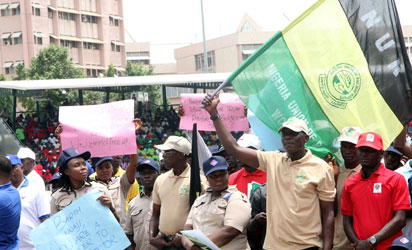
MAY DAY RALLY— A cross section of workers during the 2012 May Day Rally at the Eagle Square, Abuja,
He said, “In the Nigerian circumstance, May Day and its significance were recognised by the labour movement in the pursuit of trade union and workers right long before independence. Our founding fathers like late Chief Michael Imoudu, H. P. Adebola, W. O. Goodluck, S. U. Basey, S. O. Oduleye, Gogo Chu Nzeribe, L. L. Borha, Okei Achamba, Ibrahim Nock, Inua Dogo, Ahmed Jalingo, V.I.M. Jack, E. U. Ijeh, Baba Alajo, Abubakar Abutu, N. Chukwura, Ramos, Ishola, F. N. Kanu, Ayoola Adeleke, etc. Others are Comrades J. O. James, Ben Obua, etc. who are still living. These constitute the first eleven of labour movement.”
Today’s challenges
“They were epitomes of courage, knowledge and selfless leadership. However, while they all did not espouse the supremacy of capitalism, they were either socialist to the core or social democrats. This informed and empowered them to struggle for a genuinely democratic Nigeria and social justice most importantly regional sentiments and consideration, faith-divide and ethnic cleavages were strange to them as leaders of our labour movement.
They engage employers and governments (colonial, post independence civilian/military) without compromising working class interests and ethics. The inheritors of our founding fathers true to type portray their legacies in alliance with allies of the labour movement in the face of obnoxious Labour Decrees, sustained trade union unity and resisted being incorporated by employers and government and consciously avoided their subversive generosity”.
Speaking on the modern day’s challenges of the labour movement, Agbonkonkon said these include “widespread, deepening and un-mitigating poverty side by side with repulsive affluence and wealth without visible entrepreneurship on the part of a tiny minority; massive unemployment in the midst of an ever increasing pool of skilled and educated graduates; widespread corruption in public and corporate governance which has become an obstacle to economic development and purposeful governance; inability of democratic governance to guarantee basic needs to all; promote and sustain national unity and stability and invasion of the Nigerian market by foreign goods in pursuit of neo-liberal policies”.
Others are “inability of Federal and State Governments to meet their pension obligations promptly and regularly and the looting of pension funds which has further pauperised pensioners and led to the untimely death of pensioners; inability of governance to arrest infrastructural decay in particular, essential ones like water, electricity, health, education, housing caused by inability to implement policies; denial of and limited trade union rights in some public sector establishments; disorientation and dysfunctional party system in Nigeria which has reduced them to mere electoral platform without commitment to set of ideals (ideology) that determines predictable governance.”
Disclaimer
Comments expressed here do not reflect the opinions of Vanguard newspapers or any employee thereof.