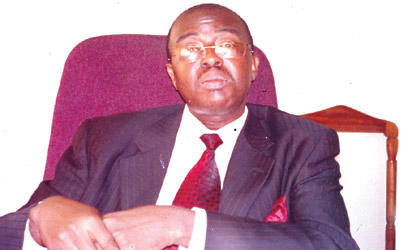
*Oshinowo…if the reason government is borrowing is to put on ground infrastructure that will make our economy grow so that we can record higher GDP…that is good
By VICTOR AHIUMA-YOUNG
Segun Oshinowo is the Director-General, Nigeria Employers Consultative Association, NECA, the umbrella body for private sector employers in the country. In this interview with Financial Vanguard, he examines the socio-economic situations in the country including the January 1, petrol price hike and the reintroduction of subsidy in the revised 2012 budget among others and declared that Nigeria has surrendered its economy to social and political imperatives.
Excerpts:
Since January when the pump price of petrol was increased, how has it affected the business operations of your members?
Talking of the operating environment in terms of the conduciveness, you cannot predicate it on just one factor. It is the totality of factors which equally have their gestation period. So, it is rather too early in the day. The only thing you can say is that, on an account of the partial removal, there is inflation. That is the truth about it. So, some companies will have to compensate their workers because they have lost purchasing power and probably they now find it more difficult to come to work.
That will translate into higher cost of operations and higher cost of production for those businesses. So, you expect inflation spiral from that kind of thing because they have to recover it through price increase. So, you should expect such things to happen.
The issue of fuel subsidy removal is just one out of so many other much bigger issues that even if there is a removal of fuel subsidy and the government is on top of those bigger issues, the impact of the removal will not be as significant as the gains which companies will derive from the big issues that employers and businesses are looking up to government to fix.

*Oshinowo...if the reason government is borrowing is to put on ground infrastructure that will make our economy grow so that we can record higher GDP...that is good
Government has revised provisions for 2012 budget, and about N888 billion has been set aside for subsidy. What do you make of it?
By that pronouncement, the government has simply demonstrated that it is taking into account, political and social sensitivities that arose on account of its initial decision to fully deregulate the downstream sector.
By coming out now to say that they are providing N800 billion to continue to fund the importation of fuel, simply means that government has partially surrendered to the wish and will of the people. In which case, the government has allowed social and political imperatives to override economic expediency.
But we must be wary of that kind of decision because in one breath, we are talking about the economic expediency of that deregulation which will ensure that somewhere down the line we no longer import fuel, and we will be sure that private investors will come in and set up refineries, which will in turn create some other benefits including jobs.
And now government has begun to send the signal that they are no longer going ahead with deregulation. That is the way I will interpret it. Government is simply saying that they have abandoned the deregulation policy by accepting to continue to subsidize.
What is the economic implication of that?
First, we won’t be able to boost our capacity to refine fuel because under a regulated atmosphere, which is being further consolidated by this policy statement, investors will be asking themselves if they will be able to recover the cost of their investments. But government has not come out to really tell Nigerians what they are going to do to ensure that new refineries come upstream.
One would have expected a situation where as the government is saying that they will continue to run a deregulated downstream sector, in the same vein, they will be saying these are the incentive package we are putting together that will ensure that those who have been given licences to establish refineries will do so.
We have not seen that. Secondly, under the dispensation of regulation, what is going to happen to the four refineries that government is running for which we have been doing turn around maintenance time and time again?
So, for me and for us, we are simply postponing the evil day. We have surrendered to social and political imperatives and on account of that decision, there is going to be damning economic fall-out. Is the government postponing this economic fall-out and the consequence for a future government? It is like a banana peel.
May be the government has finally come to the realisation that we don’t want to be the ones that will step on this banana peel. Let somebody else come and do it. But the fact is that in the medium and long-term, that decision will not be in the best interest of this economy.
Secondly, if the government is saying that they have set aside N800 billion to subsidize the importation of fuel, they must understand the dynamics that actually govern the subsidy issue as far as petroleum products are concerned. First, your borders are porous.
So, the price of fuel in your country will still be lower than the price in the neighbouring countries. Some of the fuel you will be importing based on the subsidy of N800 billion will be finding their way into neighbouring countries.
You do not have control over the neighbouring countries in view of the incentive for smuggling. So, what you set aside as N800 billion at the end of the day might be far higher than that. That is one dimension to it. The other dimension is the price of crude oil.
May be at the point in time when government was saying we have set aside N800 billion, they would have taken account of what the international price of crude oil is likely to be on the average this year.
If that assumption fails; for example, if the price of crude oil which the government has used to benchmark the provision of this subsidy goes much higher than what government had in mind, it is going to throw up a larger amount on subsidy than government has made provision for.
These are variables that government has no control of and which might make it difficult at the end of the day for government to say specifically that they will not go beyond N800 billion.
From which source do you think they will fund this subsidy?
Well, nobody has put that on the table. The various activities, projects and programmes that government had initially incorporated into the SURE project were predicated on deregulation – outright deregulation. That is not the case now.
So nobody should hold the government accountable to the delivery of all those things that have been articulated under the Subsidy Re-investment Programmes, SURE project, because the government will not have the funds to support it. The funds were to come from outright removal of subsidy.
So, the scope of impact on account of SURE will be limited as a result of partial subsidy. In terms of where the funds will come from, the government will have to do some pruning and take the knife through its expenditure profile and make sure that the much they are spending on subsidy is coming from savings that they must have made by pruning other expenses. That is what I suspect government is likely to do.
From your understanding of this development, is it going to have impact on the current price of petrol?
No, what I could really make out of this is that there won’t be any increase in the prices of kerosene and PMS this year because the government has set aside the fund to cater for the full increase that would have come as a result of deregulation.
Government is telling us indirectly that it has abandoned its deregulation policy because we are still operating under the regime of regulation. Also, the government will still need the so-called cabal. They are the operators in this business. And the fact is that this country is not doing them any favour. These are businessmen that have seen opportunities in this line of business and have gone into it with all the risks that are involved.
They are simply taking opportunities of business environment in the country. In which case, we still continue with the dispensation of marketers importing fuel even though we realise that somewhere down the line, the various guidelines were abused where portfolio importers were given licences.
Now that we know that we are still going ahead with regulation, may be, this is the time to prune the portfolio of importers and pay attention to the major marketers that really have substantial investment in the downstream sector and other players including the indigenous downstream players who equally have significant investments in the downstream sector to avoid a situation where we are giving licences to portfolio importers.
What is your view of the current probe going on in the House of Representatives and the Senate on activities of oil magnates in the downstream petroleum sector?
The government has set up agencies to discharge well articulated responsibilities. If those responsibilities were well taken care of, we would not be talking about cabals or corruption. There are organs that have been set up to ascertain that people actually brought in the quantity of fuel that they have been given licences or are being paid for. So, all the fingers eventually point to government. They are the ones funding the subsidy; they have the structures on ground in terms of inspection, supervision and the standard of fuel that is being imported. Why are those organs not operating? The second issue which nobody is talking about is the fact that there are Nigerians who have been given the responsibility to make sure that those organs work.
I have not seen much focus on those people in the current probe that is going on. They are culpable, they should be held liable. They should tell Nigerians why they were unable to perform their duties and responsibilities. They can’t just walk away; they have been given responsibilities to discharge. If for any reason they were unable to do that, they should tell Nigerians. We should turn and beam our searchlight on these people and ask them these basic questions. ‘These are the responsibilities of your agency, if these responsibilities were discharged, there wouldn’t be corruption. Why didn’t you do that?’ I think it is important we hear what they are going to say. I know it will be ground-shaking in this country.
President Jonathan has asked for approval to borrow about US$7 billion from about five multinationals and countries. Taking into account where we are coming from, especially the issue of debt burden in Nigeria, do you it is okay?
Well, I think that we should not examine this issue purely from the perspective that the government wants to borrow. We must bring it to the dimension of the reason propelling government’s decision to borrow. What is the purpose of the borrowing? What is the money going to be used for?
If a man wants to embark on a project and the man realises that the fund he has at hand will not finish that project, the man will have to examine the various options that are open to him for getting the difference. He might decide to sell some of his assets to raise the difference. If he doesn’t have such assets, in that case, he will have to borrow.
He might have to run to family and friends to come to his aid if those family and friends are rich. Another option will be, he might want to look at the angle of friends and associates to come and take equity. In which case, he will not have to borrow money but he will rather assure them of good returns on their investment. The final option is, if all those ones fail, he will have to go to the bank. If he goes to the bank to borrow, the bank will charge him interest.
The ability of the man to honor his obligation to the bank will be a function of how successful the project for which he borrowed the money for is. If the project is generating enough income, he has no problem, as and when necessary, he will pay the principal and the interest on the money.
It will only be a question of time before he pays everything back and the asset becomes his and he continues to derive the benefits from that perpetually. The same thing applies to the decision government wants to take. The issue is not so much about the fact that government wants to borrow, but what the government is borrowing for. We all know that there is huge infrastructural deficiency in this economy.
The fact is that the Government does not have the resource required to bridge our infrastructural deficiency. So, if the reason the government is borrowing is to put on ground infrastructure that will make our economy grow so that we can record higher gross domestic product that will position our economy to be able to pay back those debts, that is good.
So, the questions we ought to be asking are: ‘What are these projects we want to borrow for? How are we going to ensure that the money that has been borrowed will go into this project? What checks and balances do we really have on ground?’
Those are the questions we really should be asking instead of critically approaching it from the angle that we don’t want you to throw us into more debts. America is highly indebted but it has not negatively impacted on the livelihood of America. So, America knows why it is borrowing.
Part of the loans is to fund the power sector and government is also saying that before the end of the year, the power sector is going to be privatised.
Honestly, I do not understand that dimension of what specifically they want to use the money for. I thought they were selling those power plants as they are and will not require further investments. So, except government has other reasons why they want to do that.
But for me, if I want to sell an old car, why will I bother myself on panel- beating the car or servicing the engine? How am I sure I am going to get the exact cost from the person that wants to buy it?
I will just put it in the market and get the money I can get and just move on. I do not fully understand government’s reason for that. They might have their reasons, maybe because they have not made the details available, that is why we are asking these questions. But from a principled and rather a simplistic perspective, you are selling off, there is simply no basis for you putting money back into the business.
There have been fresh wave of retrenchments in the banking sector to the extent that two banks alone have sacked over 3,000 workers. One fallout of the sack is that the workers are complaining and protesting underpayment of benefits and un-procedural disengagement.
As one that represents the umbrella body of the employers, how will you look at this current wave of retrenchment in the banking sector and issues being raised by the affected workers?
You see the “K” legged man has a load on his head, the observers are telling this K legged man that the load on your head is tilted, but the K legged man is telling the observers that ‘why don’t you take a look at my legs before you make your observation.’
I think that is simply the story of some banks. What we are talking about today is simply the fallout of the structures, practices and values which these banks have embraced over time from which some of these employees that have been asked to go have benefited from.
They never knew that a time would come when they would have to part ways with their employers and they had not ensured that appropriate policy, appropriate package was in place to manage that eventuality.
The truth is that when you are acquiring a business, when you are merging a business, you are rightsizing, employees will go and our laws, in fact, had anticipated this which is why in the Labour Act, you see the procedures for redundancy and retrenchment, which equally recognises the need to pay redundancy benefits to such staff.
But the government will not go from one bank to another to make sure that the workers and the employers meet to negotiate and have redundancy benefits agreement. So, what have these workers been looking at all along?
They had assumed that the good time will continue. So, in their contract of employment, there wasn’t anything like redundancy benefits and if the employer is now asking them to go, the employer will have to prepare completely on the existing terms and conditions of employment.
They would not have to go outside that except maybe they want to be a little generous. But you cannot fault those companies or banks on account of decisions they have taken, first to ask them to go, secondly to pay them based on their existing terms and conditions of employment.
The workers will only have a point if they can clearly demonstrate that, ‘look, in our company, we have this agreement, these terms and provisions in our letter of employment which the employer has not met.’ If that is the case, then that is why we have the National Industrial Court, NIC.
Some of them probably do not even know that an organ like the NIC exists because all along, it didn’t really matter to them. So, honestly speaking, it is not an issue of throwing stones at those employers. But even within the same industry, we know of banks that have come a long way and they have all these things in place.
If you go to First Bank, they have all these things in place in their terms and conditions of employment and it is not possible for a bank like First Bank to ask some of its employees to go today. Even in Union Bank, the policies and the benefits are clear.
Most of the things that are happening in this respect are seen in the so-called new generation banks which actually did not see the need for it and their employees on account of the good pay they were enjoying then, did not see the need to press their employers to institute policies like this and back it up with package.
As employers body, are you not concerned about the growing rate of unemployment and restiveness in the country?
You see, for us as employers, there are two dimensions to that. The first dimension is our market. The market is determined by the purchasing power, the number of people that are in the middle class. From that perspective, it is a problem to us because those unemployed are potential consumers of our products and except they are in employment, they will not be able to actually translate their desire into real demand for our products.
From this perspective, yes, we are concerned. The second aspect is that of security. When you have a country that is parading large number of unemployed, it is a question of time before that translate into social insecurity and insecurity for businesses. Again, to that extent, we are also concerned.
To preempt your next question in terms of if you are concerned, what are you doing about it? Again, there are two dimensions to it in terms of what we are trying to do about it. First, we strongly believe that the medium to long terms solutions to unemployment is good governance at all levels of government and secondly, a growing economy. A growing economy should naturally throw up job opportunities.
If you have a government that is committed to good governance, in the course of delivering good governance, they will throw up job opportunities. When you take a look at Lagos as an example, you will discover that the decision of Lagos State Government to green the environment and make the environment friendly, has thrown up the need for horticulturists even low earned skilled work like cleaners on the streets.
That is one example of how good governance will throw up job opportunities and it will go on and on. Take the evacuation of waste also, from Lagos State Government. Government commitment to keep the streets clean, has also thrown up job opportunities and these are not high skilled jobs, you remember.
So, if we can have replication of good governance all over Nigeria, it will throw up job opportunities in the country. In fact, I am one of those who seriously believe that Nigeria as a developing country, with all the opportunities, all the challenges, all the works to be done to become a developed economy, has no business talking about unemployment, If we can get our government at all levels firing all their cylinders, living up to their responsibilities and delivering on good governance.
As employers, we have taken up quite a number of initiatives to showcase to government some of the things they should be looking at in order to tackle the hydra headed monster of unemployment. Take for example, our programme in promotion of technical and vocational education, we are using technical training schools of our members to train more Nigerians to acquire technical and vocational skills so that they can parade skills which the market is really looking for.
We are in collaboration with Industrial Training Fund, ITF, in providing funds to expand the training facilities of these private sector companies. It has been a huge success for us.
Now we expect government in the light of the huge manpower gap we have in Nigeria as far as technical and vocational education is concerned to take note of the success story we have recorded and put more resources into technical and vocational education; equip our schools, review curricula and re-educate the instructors. These are basic things we have done at our own level.
The other dimension to it is that we have equally realized that to address the scope of unemployment we are talking of, we should not expect all youths to end up as employees. There are some of them that want to embrace entrepreneurship and we have in-house programmes, the purpose of which is to teach these youths how to run their own business. So, as employers of labour, these are basically the social responsibilities we are discharging as far as unemployment is concerned.
Recently you were quoted as saying that before any economic reform that will be beneficial to the citizens could take place, there should be a political reform. As at today, has anything happened to change that position?
Honestly, my question for Mr. President is that, you share with us your economic vision; you share with us your transformation agenda, what is your political agenda for the country? Mr. President is well informed enough about the problems of this country and the truth is that, our political structure plays an important role in the current situation we are today.
We cannot continue to run an economy where all roads lead to Abuja every month. We cannot continue to promote a sharing culture. We must jettison sharing culture for a distributive formula, a distributive dispensation where rather than draw from the centre, we expect the various components to contribute to the centre. Let us turn around the equation.
Let the contributors determine the much they want to contribute to the centre to maintain national assets and national legacies. But now, the centre takes everything and then distribute to the states. So, what is the motivation for the federating states to work or explore what they have under their soil?
I think we need to change that and I believe that in changing that, we require political restructuring of this country. If we have to go the whole breadth of resource control, what is wrong with that? It will not be out of place for us to say that, ‘look, we have given ourselves a moratorium or a notice that all levels of government- local government, state government- from2015 or 2016, we are no longer going to share oil money; we are going to put all our monies into sovereign wealth.
So, whatever you are going to get between now and 2015, start focusing your mind as how you are going go use it to discover what you will be able to find out in your soil or environment that will now bring regular income from it.’ I think we need that kind of radical change.
Disclaimer
Comments expressed here do not reflect the opinions of Vanguard newspapers or any employee thereof.