By Ebunoluwa Sessou
Aquaculture has been identified to provide an average of 45 percent animal protein and nutrients for Nigerians and expected to expand by 500 percent between 2020 and 2050 to meet up with local demands.
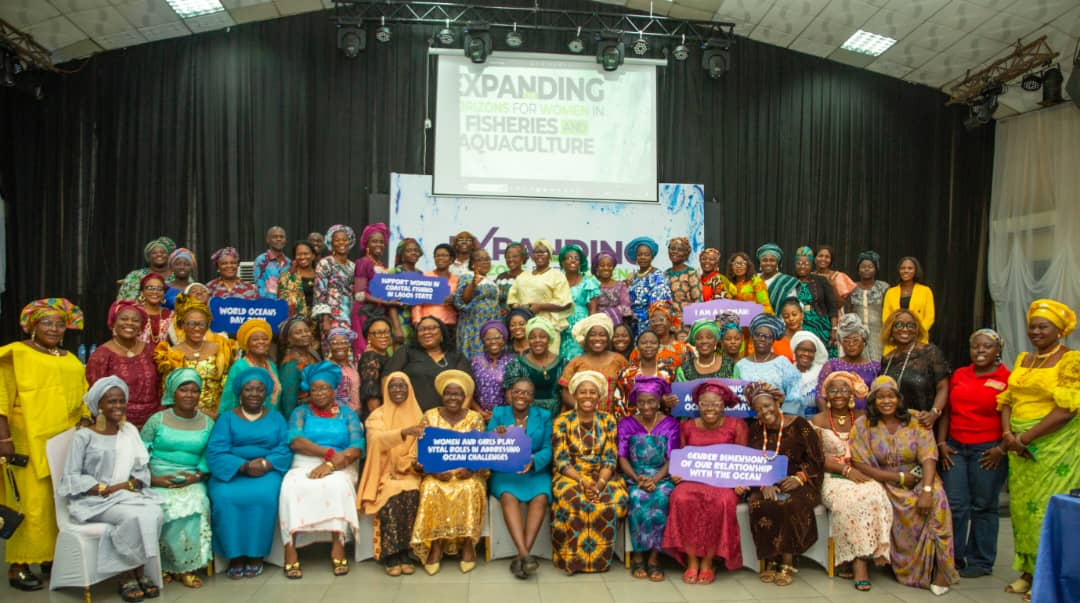
This was disclosed at the just concluded 2024 Gender and the Blue Economy Conference: Expanding the Horizons for Women in Fisheries and Aquaculture organized by the Centre for Gender Economics in Africa and funded by Africa Centre for Energy Policy, as stakeholders within the sector gathered to brainstorm on the need to increase aquaculture production by 7.0kg per person per year to meet domestic demands.
With the theme, “Women empowerment in Coastal Fisheries in Nigeria: Increasing Resilience to Climate Change Adaptation Through Films and Dialogues”, the founder of CGE Africa, Uchenna Idoko, disclosed that women in coastal fisheries face many challenges that impede their ability to thrive in this crucial sector, such as limited access to resources and climate change impacts like rising sea levels and fish migration shifts, endangering their livelihoods.
The Annual Blue Economy Conference which is held every June 8 according to the organiser was to bring together stakeholders from diverse sectors including women working in coastal fisheries, researchers, and government officials to discuss and address the unique challenges faced by women in the fisheries and aquaculture industries. Adding that the event was aimed to highlight the contributions of women in these sectors, share insights from research, and formulate actionable recommendations to support and empower women in fisheries and aquaculture.
Speaking, on the theme, Enhancing Women’s Representation in Coastal Fishing and Aquaculture in Nigeria: Challenges and Opportunities, Professor Jameelah Yaqub , disclosed that, the current productive capacity of the sector threatens food insecurity, and further dampens poverty levels.
Aquaculture, which is currently at 13kg per person per year according to the stakeholders, needs to meet up with exportation to contribute significantly to the global fish supply.
According to him, there is a need for some considerations for enhancing female participation in fisheries and aquaculture to ensure equal access to land ownership through gender-friendly mortgage and investment schemes.
Yaqub maintained that, “There is a need to enact a gendered transformative approach in exposing female fish farmers to technical knowledge on the highly productive segments of the value chain. Adding that adequate representation in leadership positions by mandating over one third representation of women into elective posts in fishers associations.
“Mentorship sessions on aquaculture extension training, financial management, leadership skills, increase fishery departments in the Nigerian universities and encourage girl-child admission especially on technological adoption, feed production and other technical oriented sub-units.
“Enact gender-inclusive policies on coastal security management, integrated data management system with specific gender-dis-aggregated database, access to aquaculture venture capital and private equity and govt grants rather than high interest loans.
“Institute gender responsive support system where female farmers could seek mental and psychological support to assist in identifying early stressors in post traumatic stress disorder”, he said.
Yaqub lamented that, “Nigerian patriarchy system poses threat to land ownership and tenure system leading to limited opportunities for accessing credit schemes, insurance and investments as well as resulting to alternative informal access to financial services with huge capital cost.
“Women are more engaged in processing and retail fish trading activities with lesser representation in importation, wholesale, input supply business due to its capital intensive nature.
In her contribution, the Chief Fisheries Officer of the Ministry of Marine and Blue Economy, Federal Department of Fisheries and Aquaculture, Abdullahi Hafsat Ochuwa, said, “The Blue economy holds tremendous promise for sustainable growth and prosperity but its full potential can only be realized through embracing inclusiveness by harnessing the strengths of all individuals especially the women.
According to her, “The conference was a beacon of the commitment to creating equitable opportunities where women’s contributions are recognized and valued.
“By expanding their horizons we empower women to become leaders, innovators of key drivers of change in the blue economy. The role of women in fisheries can never be overemphasized.
However, Idoko frowned that women struggle with a lack of climate information and gender inequalities, hindering their participation in decision-making.
According to her, “Financial exclusion further constrains their resilience. Collaborative efforts involving government, civil society, and international support are crucial to empower these women and promote sustainable adaptation in coastal fisheries and sustainable livelihoods”, she said.
She said, the event is expected to bring about increased awareness among policymakers and the general public about the significant role women play in fisheries and aquaculture, and an enhanced understanding of the specific challenges faced by women in these sectors, including socio-economic, environmental, and policy-related issues.
“Strengthened networks and partnerships among stakeholders, leading to potential collaborations and support initiatives. Dissemination of relevant research findings to a broader audience, including policymakers and practitioners.
“A set of clear, actionable recommendations presented to government officials to improve support for women in fisheries and aquaculture.
“Secured commitments from government officials and other stakeholders to support the implementation of the recommendations to improve support for women in fisheries and aquaculture”, she said.
Disclaimer
Comments expressed here do not reflect the opinions of Vanguard newspapers or any employee thereof.