By Fortune Eromosele
The Convener of the For the Love of Country symposium, Atinuke Odjenima, has urged Nigerians to look beyond ethnic and religious differences to achieve national development.
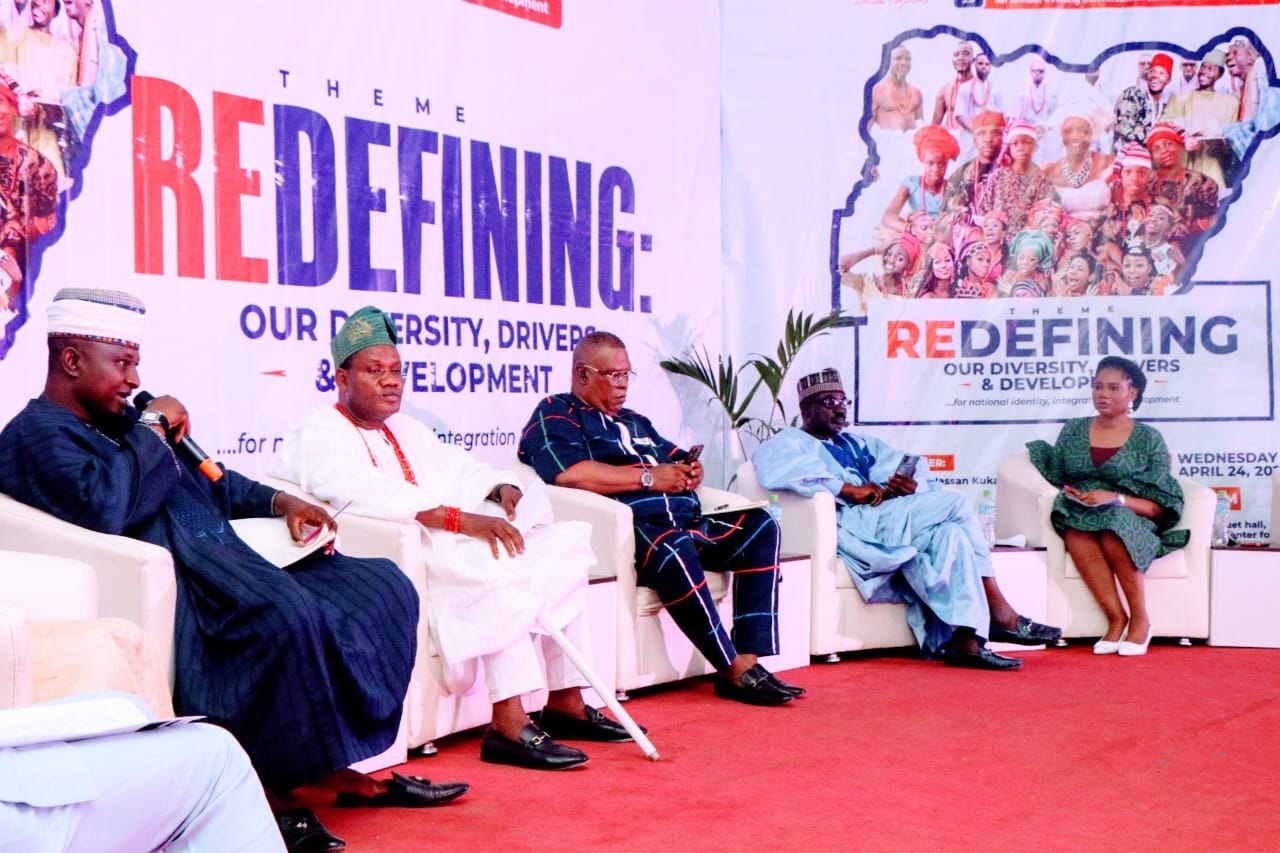
The third edition (3.0) of the symposium, is an annual evening conversation on national development. The event had the theme: “Redefining: Our Diversity, Drivers, and Development for National Identity, Integration and Development” held at the women centre in Abuja.
Odjenima stressed that Nigeria’s diversity should be a strength, not a weakness and that citizens should prioritize competence, character, and compassion when selecting leaders.
Odjenima noted that elections in Nigeria are often determined by ethnic and religious lines, rather than by a candidate’s qualifications.
She encouraged Nigerians to focus on the values that unite them, such as respect, love, and honesty, and to work together to build a better nation.
According to her, “I am the convener of this symposium, an evening conversation on national developments for the love of country. And so just the way it is for the love of countries is why I’m putting up this symposium because I believe that as active citizens, which I think that every Nigerian should be about, is active participation in governance and in issues that have to do with our progress and our development as a nation.
“So for the love of country symposium is an annual gathering that is expected to bring in professionals, experts, technocrats, governments, people from the government and citizens, on conversations around our issues. So this year, we’re talking about the theme, of redefining our diversities, drivers, and developments.
“Our diversity, because we all know that Nigeria is a multi-ethnic country because we are not yet a nation. We can only become a nation when we’ve agreed and accepted and we are living together, coexisting together in love and in harmony. So that’s the only time when we can really say that we’re a nation. But now we are just a country, a country of about 350 ethnic groups and over 500 languages.
“So coming together and these are the things that are bringing about what’s called religious conflict, tribal differences, tribal conflicts and all of that. We’ve seen elections in Nigeria being determined on religious basis and also on ethnic lines.
“We see people voting along ethnic lines, and then you ask yourself if we’re choosing the people to lead us based on Igbo, Hausa, and all those different tribes based on my own person, our own people, it’s our turn, let’s get there, how then can we really move forward as a nation, not considering people with selecting our leaders by character, selecting our leaders by competence, by capacity by compassion, and which I think is most important.
“Like I shared while I was on the panel when we were going to the hospital to go for surgery or for medicine, you ask who is the best doctor or where’s the best hospital to go to, not where the hospital is from or where the doctor is from. So I think that when we bring this to the conversation, what really matters is to push us forward as a nation so that Nigeria can truly take her place in the global affairs of things. Then we need to look beyond our differences in terms of religion, in terms of tribe, and in terms of social class.
“To really say what matters is who is capable, who can, who can get the job done, and most importantly, so we are able to live amongst ourselves regardless of where we come from, and see ourselves first as human beings and human beings who deserves to be respected, who deserve to be honoured, who deserve to be catered for like I always say that poverty has no tribe, has no religion, has no social class. So if that is the case, then why can’t we come together to hold ourselves on things that bind us together? Things that hold us together, rather than things that differentiate us.
“Like I always say, again, that our differences are nothing compared to things that we have in common. So why can’t we take on those things that we have in common, you know, as a strength, so that we can move forward as individuals, as a people, as a society, as a country, then ultimately, as a nation, my desire?
“So every year, I intend that this symposium will bring about renewed hope truly in the lives of people. It would inspire hope in people, it would also trigger or ignite passion that would cause people to run on a specific action towards nation-building. These are the things that I desire and most importantly, a platform where nation builders can come together, reason together, network, and find one another, to collaborate and do greater work for the nation.
“So drivers are those things that will drive us to development, that will take us away from those things that separate and differentiate us to those things that unite us. So drivers are those things that we need to do, to bring about development.
“Drivers like what: our values, this is where national orientation agency comes in, our values, our values like respect, mutual respect for all, our values like love, like care, our values like honesty. Those values that make us feel that yes, we are first appreciated and respected as individuals, and then together we can coexist as a nation. So what are the national values that we must have, in order to move us to a better place as a country.”
Speaking in the same vein, the President of the Christian Association of Nigeria (CAN), Rev. Daniel Okoh, emphasized that conflict arises from deficiencies in character and attitude.
Okoh, who was represented by CAN’s National Director, National Issues and Social Welfare, Abimbola Ayuba, urged Nigerians to recognize and address the obstacles that exist within their society, including ethnicity, religiosity, and contest for resource control.
He said, “God created man in his own image and likeness and that is captured everywhere in the good books. The issue of conflict came in as a result of certain deficiencies in character and also in attitudes of people.
“Looking at our Nigerian society is built on unity in diversity, whether we like it or not this is the foundation upon which this country has been built. I like to say when we remove certain obstacles which exist within our fabrics, we must not pretend, they revolve around ethnicity, religiosity, and contest for resource control.”
Also, Director of Public Affairs and Communication, Federal Character Commission, Dr. Fred Chuks Okoli, urged politicians to rid themselves of selfish interests and fix their gaze on making lives better for its citizens and Nigeria at large.
Disclaimer
Comments expressed here do not reflect the opinions of Vanguard newspapers or any employee thereof.