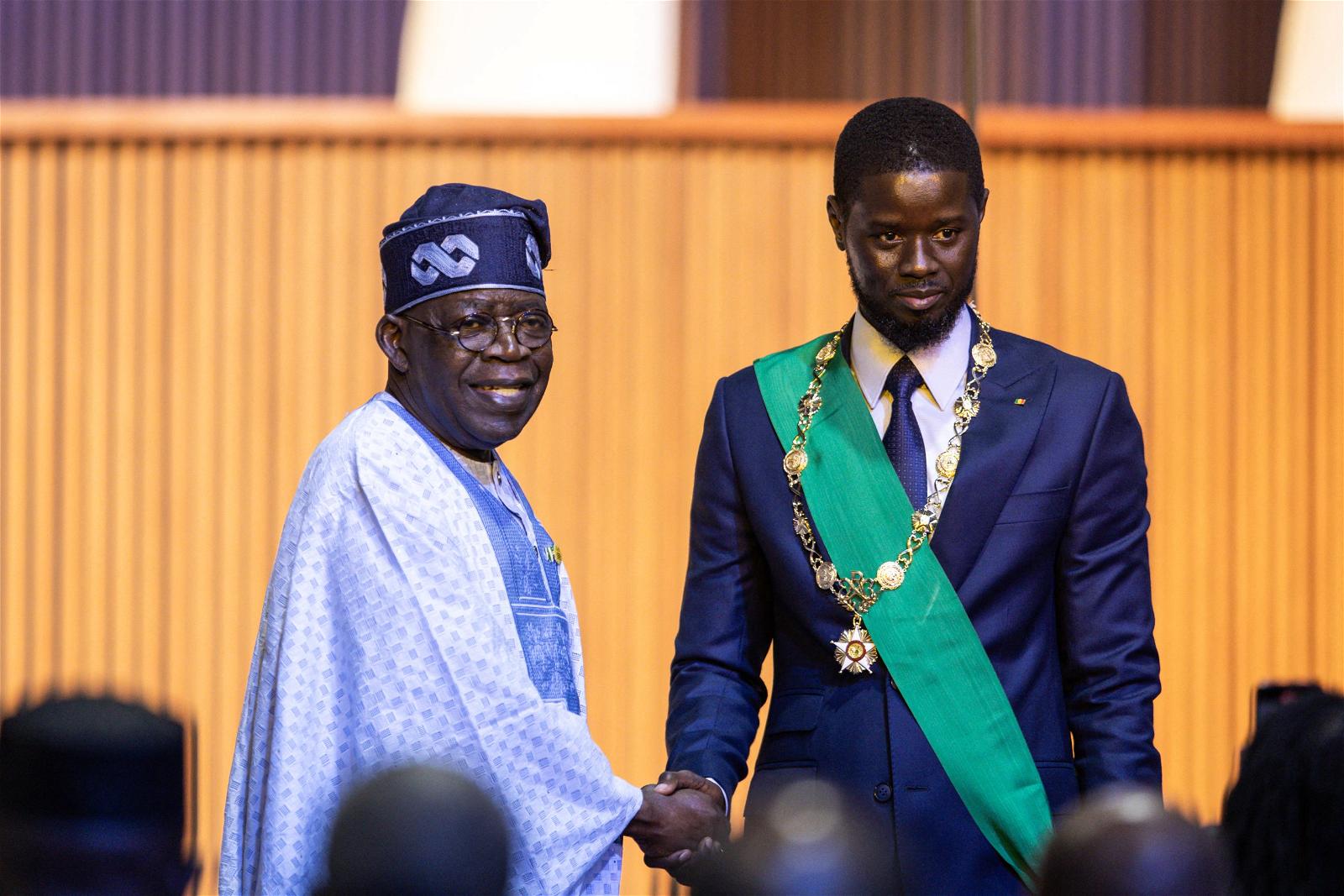
Bassirou Diomaye Faye (C) and President of Nigeria, Bola Ahmed Tinubu (L) pose for images after his swearing in as Senegal’s President at an exhibition centre in the new town of Diamniadio near the capital Dakar on April 2, 2024. – Bassirou Diomaye Faye was sworn in on April 2, 2024 as Senegal’s youngest president after sweeping to a first-round victory on a pledge of radical reform 10 days after he was released from prison. (Photo by JOHN WESSELS / AFP)
Senegal remains the beacon of democracy, especially in West Africa, the coup-prone region in the world. In the past couple of years or so, no fewer than five countries – Guinea, Chad, Niger Republic, Burkina Faso and Mali – experienced successful military interventions in governance, signalling that coups were back in vogue in Africa’s largest regional bloc.
Indeed, concerns were already rising when the outgoing President of Senegal, Macky Sall, tried to extend his constitutional stay in power. He also postponed the presidential election which was formerly fixed for February 25, 2024 to December. But these antics were rebuffed by the people, whose series of mass actions forced Sall to call a quick election penultimate weekend.
The most outstanding feature of this year’s election was the victory of the candidate of the opposition Pastef Party, Bassirou Diomaye Faye, over the rest of the other 16 candidates. These included Amadou Ba, former Prime Minister and the flag bearer of President Sall’s ruling coalition, Alliance for the Republic Party, APR.
Ba, as the ruling party’s candidate, had campaigned for continuity. But, 44 year-old Faye, who had recently been released from detention along with his party leader, Ousmane Sonko, buoyed by massive support of the youth, tuned into the revolutionary themes of the Sahel coup leaders: a total break with the France dependency syndrome. Faye was supported for the election by Sonko who was barred by the courts from standing for election this year due to a criminal conviction. Sonko threw his weight behind Faye, and their campaign which leveraged hugely on their social media clout, cruised to victory.
Senegal thus achieved through the ballot box what the five other fellow Sahel entities had to resort to military change in order to obtain. The Pastef leadership’s overflowing fervour for total freedom from France is sparking speculations that they might find in the Sahel “brotherhood” handy comrades to build a strong coalition with in order to succeed.
Much kudos goes to the country’s Constitutional Court which overruled President Sall’s decision to postpone the elections. President Sall also deserves some commendation for bowing to the orders of the court, releasing the Pastef detainees, carrying out an election that swept his party out of power and congratulating the winner. It would have been a different story if he had tried the kind of state capture that has become the hallmarks of elections in Nigeria.
Nigerian youths have to learn from their Senegalese colleagues never to be dampened when entrenched power fights back. The Senegal youth fought for their future rather than capitulate to the intimidation of incumbency.
We hope President Faye will justify the trust reposed in him and faithfully implement his campaign promises. He should learn from Sall’s mistakes and virtues.
So should the rest of Africa.
Disclaimer
Comments expressed here do not reflect the opinions of Vanguard newspapers or any employee thereof.