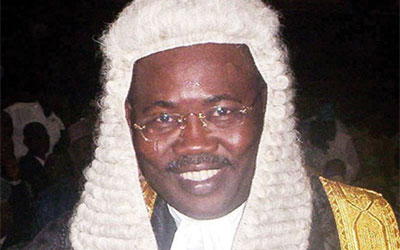
Mohammed Adoke, Justice Minister
By Innocent Anaba
Recently, the International Society for Civil Liberties and the Rule of Law, Nigeria, released a report, in which is noted that Nigeria was in a state of war, as no fewer than 54,000 Nigerians died outside the law since 1999.
The report released to mark the 63rd Anniversary of the United Nation’s Human Rights Day, noted that Nigeria’s human rights problems during the year (2009) included the abridgement of citizens’ right to change their government; politically motivated and extra-judicial killings by security forces, including summary executions, vigilante killings, abductions by militant groups, torture, rape and other cruel, in-human or degrading treatment of prisoners, detainees and criminal suspects.
Others are hash and life-threatening detention center conditions; arbitrary arrest and prolonged pretrial detention, denial of fair public trial, executive influence on judiciary and judicial corruption; infringement of privacy rights; restrictions on freedom of speech, press, assembly, religion, and movement; official corruption and impunity; domestic violence and discrimination against women; the killing of women suspected of witchcraft; female genital mutilation; child abuse and child sexual exploitation; societal violence; ethnic regional and religious discrimination, trafficking in persons for the purpose of prostitution and forced labour; discrimination against persons with disabilities; discrimination based on sexual orientation and gender identity; and child labour.
According to chairman of the group, Mr Emeka Umeagbalasi, at the launch of the report, “today, we are zeroing down on Nigeria against the backdrop of rising unlawful killings since 1999. Taking a critical look at the above – summarized 2009 US Department of State Report on Nigeria’s Human Rights Records.
“It is very clear that nothing in that Report has changed since 2009. Instead, bombing, arson and mass-murder associated with Boko-Haram terror as well as ethno-religious or sectarian violence has swollen the long list of the Nigeria’s rights abuses. In other words, all the rights so mentioned are still observed in grievous breach.
“In the area of the “citizens’ right to choose and change their leaders”, for instance, its violation appears unabated especially in the Local Government Council (LGC) administration, which constitutionally is supposed to be democratic at all times.
“In States that have conducted local government polls, it was “very glaringly” shambled LGA polls are the “second-degree” violators, while Lagos State, which recently conducted “glaringly” shambled polls into its LGA System, is the “third-degree” violator. The Constitution of Nigeria, 1999 (as amended), which failed in its Section 7 to clearly stipulate the autonomy of the LGA system in Nigeria, is the “grand violator” of this vital political right.
“In this report, the sources of information are derived from credible open sources such as the United States Department of State, the Human Rights Watch (USA), the Amnesty International (UK), AFP (France), Associated Press, Reuters, Bloomberg, CNN (USA), Aljezeera (UAE), BBC (UK), authoritative local and international online media, Nigeria’s print, audio and audio-visual media, the Department of Criminology & Security Studies of the National Open University of Nigeria (NOUN), NOPRIN (Nigeria), ERA (Nigeria), OSIWA, Black’s Law Dictionary -2009 edition, Uche-Wisdom Durueke Law Firm, Owerri-Imo State, eye-witness accounts, on-the-spot findings and the Intersociety’s library, as well as de-classified security reports from the State Security Service, the Police and the Army. We are immensely grateful to them.
How over 54,000 unlawful deaths were recorded since 1999
According to recognized war dictionaries, war is simply an inter-state or intra-state violent conflict that claims over 999 lives. With the foregoing definition, Nigeria is truly in a state of war against herself and her over 150 million population (intra-state war) with over 54,000 citizens killed since 1999 outside the law. This type of war clearly goes beyond norms guiding wars, contained in the international laws of war or the Geneva Conventions.
These shilling killings can best be described as “genocide” and “crimes against humanity”. On April 8, 2003, the leadership under this writer in then Anambra State CLO estimated that over 18,000 Nigerians died outside the law since 1999.
On August 5, 2009, we in the Intersociety estimated that over 30,000 unlawful deaths took place in Nigeria since 1999, a period of ten years, and on 17th March 2010, we reviewed it and concluded that the number might have increased to 34,000 as a result of the further rise in the killings. Our latest findings, however, indicate that these figures may have been under-calculated, hence the latest figure in the neighborhood of 54,000 illegal deaths.
Unconstitutionality of the killings
The over 54,000 unlawful deaths in Nigeria since 1999 had arisen from ethno-religious and inter-communal/intra-communal conflicts, vigilante killings, politically and other socially motivated assassinations, abduction-for-death killings, election-related killings, extra-judicial killings (those killed outside the law by security forces), and involuntary disappearances (those abducted and presumed killed usually by State and non-State actors).
These killings are unknown to Section 33 of the Constitution of Nigeria, 1999 (as amended) and other sub-regional, regional and international rights instruments recognized by the Federal Republic of Nigeria such as the African Charter on Human & Peoples’ Rights of 1981. The deaths are also a clear sign of failure of the State to ensure the security and welfare of the citizens.
Vigilante killings
In the vigilante killings, the periods of 1998 and 2002 were the bloodiest era for the Nigerian States of Anambra and Abia, followed by Lagos, Imo, Ebonyi and Enugu. Apart from mass-murder openly recorded in those States, their Houses of Assembly, particularly those of the five Eastern States passed legislations, indirectly sanctioning summary executions, abductions, false imprisonment, rape, torture, forceful possession of properties, etc through “trial by ordeal”, which is considered repugnant to Nigeria’s written criminal laws, equity and good conscience, all in the name of “fighting crime”.
In all, it may be correct to say that vigilante killings in Nigeria since 1999 accounted for over 15,000 unlawful deaths.
Deaths arising from police crackdown on MASSOB activists
Those who died since 1999 as a result of several crack downs by the Nigerian security forces on innocent members of MASSOB – Movement for the Actualization of the Sovereign State of Biafra other than some of them, the break-away members, who turned militants and took up arms against their fellow citizens, are believed to be in the neighborhood of 2,000.
The bloodiest crackdown is believed to have resulted from several invasions of the Okwe headquarters of MASSOB in Imo State by the Nigerian security forces led by the Nigeria Police Force and the 2006 Federal Government’s military action in Onitsha, Anambra State against the break-away militant MASSOB activists, which led to the death of scores of uninvolved MASSOB activists as well as innocent civilians.
Deaths arising from Inter-communal & Intra-communal conflicts
In the Ezza-Ezillo inter-communal conflicts of 2008 and 2010, over 300 unlawful deaths were recorded owing to the failure of the State to effectively manage the conflict.
Other inter-communal and intra-communal conflicts in Nigeria since 1999 such as Ife – Modakeke inter-communal conflict in 1999/2001, Hausa/Yoruba in Sagamu, Ogun state and Igbo/Yoruba (Alaba Market & Lagos Wharf) clashes in 2001, Umuleri – Aguleri inter-communal conflict in 1999/2000, Owerre – Ezukala/Ogbunka inter-communal conflict in 2011, Umunya intra-communal conflict, Akpu – Ajali inter-communal conflict, Fulani – host farmers’ clashes in Nasarrawa LGA, Nasarrawa State, which killed at least 50 people, etc have resulted in over 1,000 unlawful deaths or summary executions since 1999.
Deaths arising from military invasion of Nigerian hostile communities
It is estimated that over 4,000 civilians were killed outside the law by the Nigerian security forces led by the Nigerian Army during the military invasion of the Odi community in Bayelsa State in 1999, Zaki-Biam community in Benue State in October 2001 (over the abduction and killing of 19 soldiers), Gbaramatu community in Delta State in May 2009 and other troubled areas in the South-south or Niger Delta region between 1999 and 2009.
Ethno-Religious/sectarian killings
Judging from several media and rights groups’ reports, over 16,000 Nigerian civilians might have been killed in ethno-religious/sectarian violence in Nigeria since 1999. As of March 2010, it may be correct to say that over 13,500 civilians particularly women, children and the elderly were killed. Over 5,000 civilians may have died in Jos crises since 2001. In the 2000, 2001 and 2002 Kano and Kaduna ethno-religious violence alone, over 3,000 deaths were reportedly recorded. In the ethno-religious violence that hit Jos in September 2001, at least, 1,000 people lost their lives (Human Rights Watch).
In May 2004, over 700 lives were lost in Yelwa, Plateau State. Therefore, it may be correct to say that up to 1,000 unlawful deaths have been recorded in Jos in 2011 alone.
Other Sectarian Killings (i.e. Boko-Haram)
According to media reports monitored by the Intersociety, following the Yelwa sectarian violence of 2004 that led to the death of over 700 people, some of them Muslims, the reprisal killings that took place in Kano in 2005 resulted in the death of over 200 Christians, who were mostly Igbo traders and in the reprisal killings that took place in early 2006 in Anambra State, over 80 people, many of them Muslims were killed.
The Boko-Haram violence in Nigeria, which started in 2002 in Borno State, may have killed over 3,000 innocent citizens. The Islamic Sect abhors “western education” and opts for the strict application of the Sharia Criminal Law as a State law governing Nigeria. The late Ustaz Yusuf Mohammed and Alhaji Fuju Foi, a former Commissioner for Religious Affairs in the Government of Borno State, who reportedly resigned in 2008, led it. Both of them are university graduates.
Police Extra-Judicial Killings:
It is widely believed that the Nigeria Police Force carries out an average of 1,500 extra-judicial executions annually in Nigeria since 1999, resulting from custody and roadblock killings. There are also unlawful killings by the Police Force, which are associated with torture, highhanded crowd control and conflict management. Many, if not most of these killings originate from the Special Anti Robbery Squad (SARS), the Joint Taskforce (JTF) and the Anti-riot Police Personnel (Mobile Police).
The latter mount roadblocks on Nigerian roads and engage in killing and maiming those who resist their extortionist and other graft activities. Torture, which is nicknamed “discipline” by the Nigerian Army, is also common among various departments of the Nigeria Police Force, particularly its Special Anti-Robbery Squad (SARS) and SCID or SCIB operatives.
Rights groups have also recorded many deaths arising from torture and unlawful detention. Comrade Ifeanyi Onuchukwu of the Humane Justice International in Nnewi, Anambra State, Nigeria on November 4, 2004, at the Central Police Station, Awka, Anambra State, Nigeria, witnessed the mass killing of 20 innocent detainees, who had been held for months without trial in the Station by the Special Anti-Robbery Squad of the Anambra State Police Command.
According to Comrade Onuchukwu, who was also detained in the SARS cell from November 4-19, 2004 when he was granted bail, one of the Police officers handed a sheet of paper with a pen to one of the detainees to re-compile their names and their States of origin and at around 7:15pm same day, they were taken out of the cell.
Report Analysis:
The chilling killing of over 54,000 innocent Nigerians outside the law since 1999 depicts the failure of the Nigerian security system and gross inability of the Nigerian State to protect innocent citizens. Nigeria is a party to many sub regional, regional and international treaties meant to protect citizens’ rights. Sadly, Nigerian citizens
have continued to die unnaturally. The Nigerian security system seems terribly sick.
There are over 600,000 security operatives bearing arms in Nigeria with the Nigeria Police Force accounting for 371,800 (Wikipedia Internet Encyclopedia, 2011), yet their security approaches have remained grossly out-dated and anti-social. The vigilante security system in Nigeria particularly in the Southeast States of Anambra and Abia is a time bomb, waiting for explosion! Today, there may be over 2,000 armed vigilante groups operating in the two States with little or no effective regulations over their sources of arms and numbers.
Also, there may be over 500,000 small arms in the wrong hands in the zone and the number increases steadily. It may be correct to say that unless extreme care is taken, otherwise, the vigilantes of today will be transformed into armed robbers, kidnappers and assassins of tomorrow. Nigerian history tells us that one of the reasons that led to dissolution of the various Police forces in the 60s maintained by regions, Emirs, Obas and LGAs, which gave room for a unified Nigeria Police Force of today, is hyper proliferation of arms and gross rights abuses.
Communal, ethno-religious, election, sectarian, and Boko-Haram-related killings are barbaric, highly political and deeply religious. The political, religious and security leaders in the Northern part of Nigeria are directly and indirectly responsible for the unlawful killings. Apart from using and dumping, deceiving and misleading their people, they have done little or nothing in terms of effective infrastructural and human capital developments of their zones.
Other than their capital cities, other important parts of their States are nothing to write home about, thereby spiraling rural-urban migration and incessant urban violence. While their children are sent to the best schools in Arab and Western capitals, they continue to play ostrich with Western education.
They siphon billions of Naira meant for their people and turn round to propagate strict adherence to Islamic Criminal Law, which they apply with utter discrimination. We are not in the know of any child of these leaders who has participated or got killed in any of the holy wars.
Recommendations
It is our considered view that the first step towards remedying the rot in the Nigeria Police Force is a total purge of its top command structure. To this effect, the President & Commander-in-Chief of the Nigerian Armed Forces, who is also the Chairman of the Police Council of Nigeria should, by a presidential directive cause the retirement with benefits of all serving Commissioners of Police holding “State command positions” and those not holding such positions, who are 50 years and above and all the serving AIGs, DIGs and IGP.
This directive should concurrently run with an immediate approval for mass promotions in the Force to fill the vacancies left by them. Among the newly promoted senior officers, an intelligence egg-head, who is also a modern technology expert, could be made the next IGP in line with Section 215(1(a) of the Constitution of Nigeria 1999 as amended, which states: “an Inspector General of Police who, subject to Section 216(2) of this Constitution shall be appointed by the President on the advice of the Nigeria Police Council from among serving members of the Nigeria Police Force”.
* It has been observed that most, if not all the senior police officers are “enemies of modern technology”, which is the bedrock of modern policing. They constitute a serious threat to e-policing and e-investigation. Also, there is gross lopsidedness in terms of geopolitical equity with respect to the promotion and appointment of CPs, AIGs and DIGs, which is contrary to Section 14(3) of the Constitution of Nigeria 1999 as amended.
Among the present 37 CPs of the 36 States and the FCT, Abuja about 25 of them are from the North. Among the 21 AIGs in the present NPF, 13 are from the North. While among the seven DIGs, four are from the North (Source: Laws & Facts Guiding Nigeria’s Elections, published by the Policy & Legal Advocacy Center (PLAC) 2011). Therefore, these anomalies should be corrected.
* It is our recommendation that the Nigeria Police Force should return to intelligence -based crime management. To this end, the NPF Detective College in Enugu, which offers programs in Detective, Anti-Fraud, Fingerprint, Modus Operandi, Prosecution, Photographic, Criminal Intelligence, Scene of Crime and Criminal Records & Statistics, should be technologically overhauled, expanded and elevated to the status of “the Nigeria Police Detective University”, while modern technologically advanced Police detective colleges should be established in each of the Nigeria’s six geo-political zones.
* The age-long monopoly enjoyed by the NPF in the field of criminal investigation and criminal prosecution should be clearly broken. An Act of the National Assembly should be enacted for registration and regulation of private detectives and/or investigators as well as to ensure the citizens’ right to seek alternative avenues for criminal inquiries, if unsatisfied with Police handling of a criminal complaint. The Coroner Law in the country should also be thoroughly updated in line with the international best practices as part of the new alternatives.
* On the same note, the right of every Nigerian to effective criminal prosecution should be ensured. The powers of the Federal and the State Attorneys-General to grant fiats to interested citizens according to their dictates should be liberalized and translated as a right into legislation with laid down conditions, so as to stamp out any form of abuse. The constitutional powers invested on the Federal and the State Attorneys-General to “continue” or “discontinue” any criminal proceedings in Courts, which are now subject of abuse, should be reviewed as well.
* On the issue of “holding charge” or “committal proceedings”, which is unduly used by the Nigerian Magistrates, there should be an effective disciplinary body akin to National Judicial Council to sanction these “junior juries”, who technically assume jurisdiction over serious criminal matters that are clearly outside their jurisdiction.
There should be “practice directives”, as a takeoff, to be issued by the States and the FCT Chief Judges and an Act of the National Assembly, later on, barring Magistrates from allowing the commencement of criminal charges that are outside their jurisdictions in their Courts. Criminal prosecutors should be made to take their suspects or defendants to the appropriate Courts.
* The 6,651 field Police formations in Nigeria should be fully computerized and adorned with sound database. There should be a central computing and control system digitally linking the 6,651 field Police formations in Nigeria, which should be situated at the Force Headquarters of the NPF. Specifically, the art of criminal investigation in the Force should be professionalized and removed from the hands of quacks.
To this end, the Divisional Crime Offices and the SCIDs/SCIBs of the Force nationwide should be overhauled and computerized; peopled with more competent hands and retrained on regular basis in technological criminal intelligence and investigation.
* Offices of the NPF legal departments, which appear to exist only at the 12 Police Zonal Commands and the 37 State and FCT Police Commands, should, as a takeoff, be established at all the 127 Area Commands and later extended to the 1,129 Police Divisional Commands in Nigeria so as to eliminate congestions associated with rising number of criminal cases in the country.
To this end, more lawyers with experience in criminal law should be recruited by the Force and the existing O/Cs-Legal in the above mentioned police formations, should be absorbed into such legal departments. The Investigating Police Officers, who must be trained in modern criminal intelligence, biometric, ICT technologies and human rights, should keep their legal departments updated on their investigations, which must be devoid of torture and crude inferences.
* The Federal and the States’ Attorneys-General should overhaul their Directorates of Public Prosecution nationwide and put effective disciplinary measures in place to monitor and curb their corrupt practices including their poor attitudes to work. There shall be established the Federal DPP offices in the 109 Senatorial Districts in Nigeria to ensure timely and diligent criminal prosecutions in matters of federal jurisdiction.
There shall also be established in the 774 LGAs in Nigeria the States’ DPP offices for effective access to criminal justice in Nigeria in matters of States’ jurisdiction, with more qualified lawyers and criminologists recruited to man them. The recruitments and promotions as per the personnel of the DPP should be based, strictly, on merit. And the police criminal investigators should be made to duplicate their files and forward to the Directorates of Public Prosecution before the arraignments of the accused persons or defendants in courts.
* Police prosecutors should be barred from preferring charges with capital punishments and other charges that are outside the magisterial jurisdictions of the magistrate courts against the accused persons in any magistrate courts in Nigeria.
Only qualified police lawyers should be allowed to prosecute capital offence cases in the appropriate Courts, not Magistrate Courts and police investigators should duplicate and send their files to the DPP before prosecution. There must be an end to the investigation of criminal matters in Nigeria. To this end, where the accused persons are at large, such investigations may continue, but where they are in custody or not at large, their investigations must be brought to an end within a specific time frame. An Act of the National Assembly may be required in this case.
* We further recommend that the National Assembly of Nigeria should re-enact a new Nigeria Police Act and Regulations. The present Act is outdated and antithetical to modern intelligence, protective and preventive policing. The infamous “Order 237” of the NPF, which permits a Police officer to shoot any person suspected or detainee “trying to escape” or “avoiding arrest” should be reviewed, if not abolished. It has become a “license to kill” for the personnel of the NPF.
* In view of the rising proliferation of vigilante groups and small arms in Nigeria particularly in the Southeast, we recommend that the Federal Government of Nigeria should take steps to effectively put them under tight checks forthwith before it becomes too late. Also, disciplinary measures should be taken against personnel of the NPF who failed to attach their service uniforms and numbers while on duty. Some of them now wear bathroom slippers, pyjamas and rags while on road duties, thereby degrading the NPF and making it difficult for citizens to differentiate them from criminal-citizens.
* Nigeria should aggressively pursue national intelligence, external intelligence and foreign counter-intelligence policies with human rights consciousness. To this end, the Acts setting up the Police, the SSS, the NIA and the DMI (Army) should be over-hauled and expanded to clearly define the new intelligence security roles as per internal intelligence, external intelligence and foreign counter-intelligence.
This is because the intelligence roles by these bodies seem blurred. To add life to this, the Nigeria’s Criminal Reforms Bill lying unlegislated before the National Assembly should be passed into law immediately. Also the Nigeria’s trans-sahelian highway to Dakar, Senegal and to Algeria as well as the Nigeria – Nigerien and the Nigeria -Chadian borders, which have become “the routes of terrorism”, should be properly policed so as to check the Boko-Haram violence and other homicidal activities.
* There should be massive investment by the Federal Government in intelligence security and intelligence policing. To this end, selected departments of criminology & security studies, pathological science, psychology, sociology and criminal law of selected Nigerian universities(like NOUN-National Open University of Nigeria) should be designated as intelligence priority list, equipped and funded properly to serve as research grounds for countering the steady intra-state violence in Nigeria.
* It is obvious that Mr. President has not demonstrated enough political will to nip this recurring unprovoked sectarian violence in the bud. His “Commander-in-Chief” status appears under-utilized particularly as per bringing those responsible for these abominable killings to justice. To this end, President Jonathan should re-organize and re-shuffle his security chiefs including the leadership of the Police Service Commission and take full charge of the security of the nation.
* While commending Mr. President for his recent presidential directive, ordering the release of all MASSOB members detained unjustly across the country, which led to over 98% of them being released, we wish to draw Mr. President’s attention to the continued detention of S2 of them including three juveniles in Umuahia, Abia State and four of them in Asaba, Delta State since September and November 2011 respectively by the Nigeria Police Commands of the two States. We demand for their immediate release in compliance with the presidential directive (we just got information that they have been released).
* It is our recommendation that a day should be set aside every year with a national holiday for the remembrance of those killed outside the law. A posthumous national highest honour of the GCFR should collectively be bestowed on them to be hung around a statue dedicated to them at the FCT, Abuja. Further steps should be taken by Mr. President to ensure that these senseless killings are nipped in the bud, through effective security and conflict transformation.
* Lastly, it is our recommendation that the Prosecutor for International Criminal Court and the UN Raporteur on Extra-judicial Killings should carry out extensive investigations into these unlawful killings, including finding out what measures, if any, the Government of Nigeria have taken to ensure that those responsible for the killings are brought to justice. If in their opinions, the measures are insufficient, and then relevant UN Charters should be invoked so as to bring those responsible to account for their crimes against humanity.
Disclaimer
Comments expressed here do not reflect the opinions of Vanguard newspapers or any employee thereof.