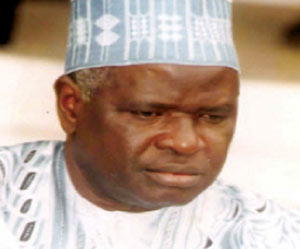
Late Umaru Shinkafi
BY DAPO AKINREFON
ALHAJI Umaru Shinkafi was head of the Nigerian Security Organization (NSO) during former President Shehu Shagari’s administration. In this encounter, he bares his mind on the activities of the Boko Haram sect and how insecurity can be tackled. Excerpts:
What, in your view is responsible for growing insecurity in the country?
This time around, there is no more mystery about the cause of insecurity, and there is no more mystery about the solution. And the polity gets provoked and protests take the kind of dimension of violence that we witness.
So, nowadays, there is no secret about the security issues in the country. The security issue is virtually speaking for itself.
But many see it as having an ethic correlation. Do you support this view?
I don’t think so. Each outbreak of protest is traceable to decisions, invariably of government in the state or the federal level, which always becomes the excuse while people protested. In my view, a lot of the protests are not deep grassroots origin.
When one day a governor decides on something, people react to paralyse the system and those in authority would want to coerce the protesters to submission. And people would react to the coercive forces and that would be it.
As a former security chief, what solution would you proffer?

Alhaji Umaru Shinkafi
Well, the leadership should appreciate that nowadays, decisions are capable of causing confusion which can affect development, affect investment, affect peace, and therefore, wholesomeness and transparency in governance is of ultimate importance.
Somebody in authority takes a decision which generally leads to pent-up emotion that causes anger. Unless we realise that the fundamental causes of these things had been bad governance, we will never get to the bottom of the problem.
Somewhere along the line, we should sit down and talk. Even the Vietnam crisis did not stop on the battle field. It stopped on the negotiating table. One of the most serious and the most devastating battles in modern history didn’t stop on the battle field.
How do you see the proliferation of arms and ammunition in the country?
You, the media have the duty of educating the society. Now, in this region, the civil war ended when the Biafran army disintegrated. There was no formal surrender of arms; there was no formal handing over of war equipment. It was just disintegration. And now, we are going back to the 1970s. We are almost turning into Liberia. And it looks like a lot of them came towards the south west of Africa. So, how can we be surprised about the sophistication of the arms and ammunition in the hoodlums’ hands in places like Niger, Nigeria or Chad?
I understand that in Somali today, you can buy a gun the way you buy a packet of cigarette. So what are we talking about?
How do you react to the planned removal of fuel subsidy?
The decision about fuel subsidy needs education. It needs enlightenment. People must understand why it was there and why it should be removed and there again, a lot of suggestions are coming at the instance of vibrant media.
A lot of good suggestions are coming about how to approach the removal if it is imperative that subsidy should be removed. It should not be done at one fell swoop but by graduated decrease over a period so that the consequential effect on the economy and the pain that it will cause can reduce.
What is your view on the current effort to review the 1999 Constitution?
What the constitution requires is redoing, not reviewing. The draft constitution we used in 1979 was one of the best constitutions in the world. During one conference that was held in Canada in the 70s that reviewed constitutions of the world, the Nigerian constitution of 1979 scored a very high mark in that conference. And I know we can’t go back to it. In going back to it, there have been a lot of contributions by the political class such as the need to restructure the presidency away from the regimented military kind of concept of heading a federation.
Why are you in Lagos?
Anyway, I am mourning our grandmother, and our mother-in-law who passed away here in Lagos last week. That is why we are here to mourn her and the processes started last Tuesday and this is one phase of the programme.
What will you miss about the deceased?
I will miss her conviction. She had a very strong conviction. Like those of them who became adults in the 1940s. Born in 1922, by 1940s, she was an adult and the standard they espoused in those days was quite high and novel.
You are Muslim leader. How come you married a Yoruba Christian?
There are good qualities in her. The decision about matrimony is founded on affection and the rule on marriage doesn’t prohibit that.
Disclaimer
Comments expressed here do not reflect the opinions of Vanguard newspapers or any employee thereof.