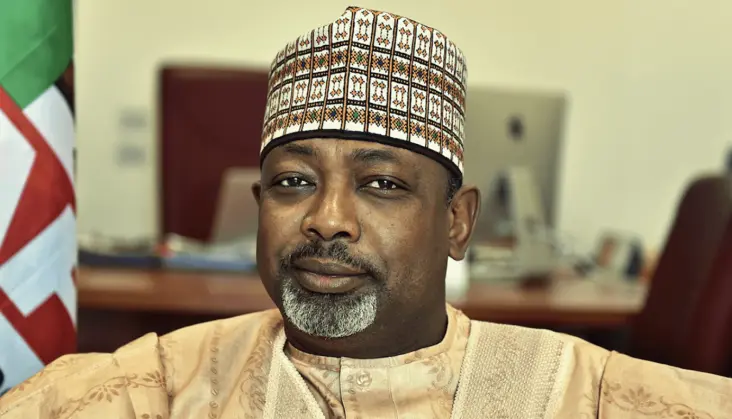
Agric Minister, Abubakar Kyari
…Targets over 70, 000 hectares for wheat production
…We’ll not disappoint Nigerians, President
By Gabriel Ewepu
ABUJA – With current high food prices across Nigeria, the Minister of Agriculture and Food Security, Senator Abubakar Kyari, Friday, raised the hope of over 200 million Nigerians by unveiling strategic plans, policies, projects, and programmes to boost food security and agricultural activities.
Sen Kyari disclosed this during a press conference tagged ‘On the Way Forward for Nigerian Agriculture Towards Delivering on the Renewed Hope Agenda of President Bola Ahmed Tinubu’.
He said: “It gives me a great sense of duty to brief Nigerians today and our friends and partners in the Agriculture and Food Security sector on our way forward towards delivering on the Renewed Hope Agenda of President Bola Ahmed Tinubu GCFR and our strategies of operations over the next four years.
My colleague, the Honourable Minister of State, and I are totally committed to providing the desired leadership direction to steer the agriculture and food security sector towards the attainment of the key priorities of the President’s 8-point Agenda.
“The immediate priority actions – ongoing to the end of 2023: The most pressing actions we are currently handling is preparation for the next dry-season farming beginning from November 2023.
“To this end, some preparatory activities have been carried out, and many others are at the advanced stage, viz: Certification of available planting materials for some food security crops in readiness for dry-season farming.
“Aggressive promotion and preparations for dry season farming, which commences from November this year.
“Implementation of the dry season wheat production starting in November 2023 as part of the National Agricultural Growth Scheme and Agro Pocket (NAGS-AP) projects funded by the African Development Bank.
“Under this scheme, the target is to: produce wheat over 70, 000 hectares across the wheat production zone of the country with an expected yield of 875,000 metric tonnes for our food reserve; blending of appropriate fertilizers to support this year’s dry season farming while making provisions for next year’s farming season well in advance.
“Providing Train-the-Trainer for extension agents involved in dry season farming in collaboration with wheat-producing states and other partners such as flour mills.
“Furthermore, arrangements are also at an advanced stage for dry season farming of rice, maize, and other horticultural crops; Hold the National Agriculture and Food Security Summit in November 2023 to bring all stakeholders together for the development of National Action Plan for Food Security with an implementation and sustainability strategy.
“Hold the National Council for Agriculture and Food Security (NCAFS) meeting in Cross River State in November 2023 to develop a strategic operational plan for Federal-State-Local Government joint implementation plans and strategies.
“Review the mechanisms and processes for delivering fertilizers and agro-pesticide input to farmers under a transparent and accountable regime.
“This will be part of the main agenda at both the Summit and the NCAFS meetings in November this year: distribute pasture seeds and cuttings for dry-season pasture and fodder development for livestock productivity beginning November 2023.
“Short-term priority actions (2023–2024) Agriculture and Food Security Stakeholders’ analysis and mapping; Make a significant investment in animals feed-crop, fodder, and pasture production as an antidote to the farmers and herders clashes by focusing on the development of paddocks, foliage, and fodder estates equipped with necessary facilities for all-year-round production.
“Strengthen agriculture and food security institutions, repositioning them for the tasks ahead; reform the National Agricultural Research System to serve as the engine of growth for innovative solutions to strategic value chains; increase productivity and yields of our food security; and export crops, livestock, and fisheries.\
“Establish two new national gene bank facilities, each for crop and animal, respectively, to conserve our fast-eroding genetic resources for food security.
“Fast-track the take-off and operations of the National Agricultural Development Fund; develop a national framework for proper coordination and alignment of all ongoing and future development partners’ projects to our national priorities.
“Develop innovative communication, monitoring, evaluation, learning, and accountability platforms that guarantee continuous interface among all the critical stakeholders to ensure 24/7 engagements and field reporting.
“ICT tools will be deployed to support these platforms for the facilitation of e-extension services at scale. Develop a stakeholder engagement and communication strategy for agriculture and food security.
“Develop a new strategy for strengthening agricultural infrastructure and providing support to our new farm types (which shall be unveiled before the end of the year).
“Prepare a Joint Action Plan with the Federal Ministry of Water Resources to unlock the huge irrigation potentials of the River Basins Development Authorities and other flood plains in the country to guarantee year-round food production.
“It is very important to note the directives of Mr. President when he declared the national state of emergency on food security, thus: “There must be an urgent synergy between the Ministry of Agriculture and the Ministry of Water Resources to ensure adequate irrigation of farmlands and to guarantee that food is produced all year round.”
He also assured that “the Ministry shall make strategic investment in renewable irrigation solutions like solar-powered irrigation pumps for small-holder farmers.
“Conduct a comprehensive review of all existing agricultural laws and legislation to fast-track necessary amendments and enactments to support farmers’ welfare and private sector participation in agriculture and food security; develop a standard framework and guide for ‘Ease of Doing Agriculture and Food Security (EDAFS)’ operations/projects/business in Nigeria.
“Identify all available vacant farmlands in various Federal Government Institutions (Universities, Polytechnics, Colleges of Education, Unity Schools, and federally owned regimented areas like the military, police, and paramilitary allocated vacant arable lands) to bring them into food production to enhance our food security indices.
“Collaborate and partner with states to revive secondary school farms to enhance food security and agri-business enterprises; promote urban agriculture that is technology-enabled and especially driven by innovations and the passions of our teeming youths; and enhance the implementation of the National Livestock Transformation Plan for increased productivity and job creation.
“Deepen engagement between farmers, herders, traditional institutions, and communities to promote peaceful coexistence and conflict resolution.
“Develop and promote a performance-based agricultural extension system; promote the establishment of agricultural marketing incubation centres (Agribusiness Development Centres) for youth and women across the six geo-political zones.
“Capacity building to strengthen the farm inputs regulatory functions to enable them to play their regulatory role to checkmate the infiltration of adulterated farm inputs, i.e., fertilizers, pesticides, herbicides, etc; Institutionalization in the Ministry; and consolidation of Nigerian Food System Dashboard for informed quality planning, policy decisions, and information dissemination on the state of food and nutrition in the country.
“Ensure the development of a robust and sustainable innovation ecosystem, a call for application for agronnovation enterprise and venture development competition targeting Nigerian youths is being developed.
“Medium-term actions – 2024-2026 Development of a digital/ICT Mobile-based Agro-industry System and E-extension platforms to support farmers through the establishment of the national centres in the six agro-ecological zones of Nigeria, while the command and control office will be here in Abuja; Meat, dairy, eggs, fish, and other protein from animal sources will receive our special intervention to increase productivity target of an annual growth rate of 10 percent year on year.
“Our interventions will accelerate the uptake of Minimum Viable Products from our institutions and agencies in agricultural mechanization and implement production space in Nigeria for full commercialization by the private sector investment. Development of comprehensive soil fertility mapping and soil information system for food security.
“Development and implementation of the National Farmers Soil Health Card Scheme to increase productivity; up-scaling and out-scaling of various agricultural value chain projects in crops, livestock, fisheries, and support services under the annual appropriation and special interventions; using Fintech solutions, wallets shall be created for all financial disbursements to deliver directly to the targeted end users.
“Priority shall be given to the use of digital and DEFI solutions to reform Bank of Agriculture and the Nigerian Agricultural Insurance Corporation, among others; Conduct standard feasibility and viability studies for commodity board operations in Nigeria; set up world-class accredited laboratories in our Research Institutes that will receive and be governed by international standard organization -ISO certification and other regional, continental and international permits to validate the quality of our exports and certification before shipment.
“Develop a new intergovernmental partnership framework for the implementation of mutually beneficial agricultural projects between Federal, State, and Local governments; strengthen the commodity exchange for agriculture in collaboration with the Federal Ministry of Industry, Trade, and Investment.
“Revive and promote home economics and food and nutrition knowledge transfers and practices at the state and local government levels under the watch of the First Lady of the Federal Republic and First Ladies at state levels for food and nutrition security; development and promotion of cooperative models for impactful agricultural development across the various agriculture value chains; promotion and strengthening of Agro-Rangers to include other paramilitary to assist in solving the problems of civil insecurity at the farm level.
“Long-Term actions 2024–2027 Development of a national agricultural database for the planning and implementation of agriculture and food security programs and initiatives.
“We are committed to working with relevant MDAs, private sector and international development partners to co-create a functional digital transformation platforms that will facilitate data driven precision farming, climate resilience and smart agricultural practices including e-extension services; Carryout technology/ICT enabled farms and farmers enumeration and mapping in collaboration with states, local governments and development partners; Repositioning the Universities of Agriculture, Veterinary Medicines and Faculties of Agriculture and Veterinary Medicines to play key roles in our agricultural transformation through the development of practical approaches for production and mechanization.
“We are set to unlock the job creation potential of cold chain systems by encouraging private sector participation in community cold chain enterprises.
“The target is to incentivize the establishment of new food storage ventures across the country with direct and indirect new job creation. Reform and remodel the Federal Colleges of Agriculture (FCAs) and the Agricultural and Rural Management Training Institute (ARMTI) to focus on vocational skills development and management training for agriculture and food security issues.
“Development of a critical mass of agricultural breeders (crops, livestock, and fisheries) and other emerging knowledge areas in ICT for agriculture (smart agriculture) to position our agricultural production system for the challenges of feeding an increasing population under scarce and challenged resource base.
“Provide support for acquiring advanced laboratories equipment to drive a new One health approach for veterinary practices while ensuring collaboration with human health practitioners and researchers to achieve Nigeria’s One Health.
“Establishment of new agrotourism hubs where our farms and national agricultural heritage can be made to create new wealth and jobs.
“Our target is to strengthen existing investments and encourage the youth and the practitioners and investors in the hospitality industry to establish new agro tourist centres across the country.”
Disclaimer
Comments expressed here do not reflect the opinions of Vanguard newspapers or any employee thereof.