BY AYO ADEWUNMI
The theme Horizon of Hope was chosen for the 2011 Life in My City Art Festival (LIMCAF) with the intent that young Nigerian artists will give visual interpretations to the socio-cultural, economic and political situations of their immediate environment. This theme has a broad view and allowed artists to express themselves on almost any subject matter they may choose to engage.

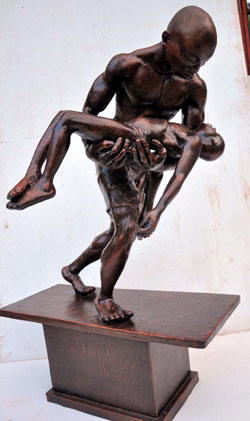
*1st Prize: Save The Child, Save the World by Eyo Emem Effiong, Uyo Zone.
Life in My City focuses on life in Nigerian communities. The artists are expected to use their artwork to comment on their environments. The culture of art as an instrument for campaign and commentary has a long tradition. In Nigeria art has been used to bring about significant transformations: socially, economically and politically from the traditional era to the present time.
Therefore, LIMCAF 2011 Grand Finale focused on contemporary national issues bordering on the nation from various cultural and individual perspectives.
In the end, a total of about 800 entries were received for the 2011 edition of LIMCAF at the various LIMCAF Zones and Collection Centres (Lagos, Ibadan, Enugu, Kaduna, Jos, Abuja, Auchi, Uyo, Port Harcourt and Calabar ). It is important to observe that a quarter of these were received from Enugu Zone.
Two factors are likely to be responsible: one is the high LIMCAF awareness in Enugu Zone and second, the delay in announcing the 2012 festival, which was as a result of the prolonged period of 2011 national elections.
At the end of the second stage of the competition at the zones, the following numbers of selected entries were received by the organizers for the Grand Finale: Lagos – 5, Ibadan – 10, Enugu – 20, Abuja, Kaduna/Jos – 10, Uyo – 11. Calabar – 5, Port Harcourt – 7, Auchi – 15
Selection for the Grand Finale cuts across all genre of art – Painting, Photography, Textile, Graphics, Sculpture, Drawing, Ceramics, and Installation. Medium and styles of most of the artworks reflected, to a greater extent, the artistic background of the artist vis a vis the art school attended. This is not unusual, as younger artists tend to emulate the styles of their teachers and instructors until such a time they are able to determine their own artistic identity and direction.
The overall impression one gets, having seen the exhibited artworks is that, young Nigerian artists are endowed with excellent creative ability and if given the enabling environment, they will not only attain self reliance, but will be able to contribute to national development.
In some of the works, thoughts and ideologies were translated to visual images. Impressionism as a style was rekindled, as observed in some of the paintings. Emotions were depicted with textures and with aggressiveness noticed in method colour application, “Ardent Devotee” by Sen Sor is a good example.
Some of the artists who have found new love in the use of reusable materials presented their works in installation format, example is Boko Haram by Onyejegbu Basil. There are others who incorporated in their artworks unconventional painting medium, Okechukwu Eze’s painting, titled “Individual Light”, with cigarette lighters used as pigment is unique in this direction.
Jacob Ani wood burning, “Life Line” which ordinarily would have been classified as a simple wood-burning drawing, has in the lower right corner a rope that leads the figure in the drawing out, beyond the frame, hence, altering the medium identity; from drawing to mixed media.
In general, considering the quality of most of the works at the LIMCAF Grand Finale exhibition, it is clear that the creative ingenuity of young artists in Nigeria are yet untapped and could be said to be largely undiscovered.
Disclaimer
Comments expressed here do not reflect the opinions of Vanguard newspapers or any employee thereof.