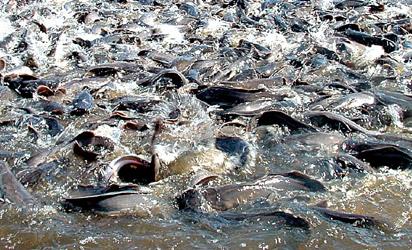
Catfish
… launches ‘Strategy on African Catfish Value Chain’
…as fish farmers express joy, hope over intervention
By Gabriel Ewepu
THE Food and Agriculture Organisation, FAO, Thursday, hailed Nigeria’s catfish production as it launched Strategy on African Catfish Value Chain’ through FAO flagship programme, the FISH4ACP.
In an address of welcome by the Country Director, FAO, Fred Kafeero, stated this while explaining that the project Fish4ACP, funded by the European Union and the German Federal Ministry of Economic Cooperation and Development (BMZ), is an initiative of the Organization of African, Caribbean and Pacific States (OCAPS) to contribute to food security and nutrition, economic prosperity and job creation, by ensuring the economic, social and environmental sustainability of fisheries and aquaculture in the aforementioned states (OCAPS).
Kafeero described the launch as milestone in the technical cooperation existing between FAO and the Federal Republic of Nigeria.
According to him, the strategy development process benefitted from a sector-wide dialogue involving public and private sector stakeholders.
He said: “As you all recently witnessed, FAO and the GoN signed the FAO’s Country Programming Framework (2023-2027) and immediately embarked on its joint implementation;
“The launch of the Africa catfish value chain strategy, through FAQ flagship programme, the FISH4ACP, is therefore an excellent opportunity to reiterate our commitment for a blue transformation of the catfish sub-sector, which no doubt, is vital for food security, the economy and people’s livelihoods.
“For those who may not know, the FISH4ACP is a global fish value chain development programme set up by the Organization of African, Caribbean and Pacific States (OACPS); it is implemented by FAO; and funded by the EU and the German Federal Ministry for Economic Cooperation and Development (BMZ).
“For us at FAO, Nigeria is a very important and strategic member state in the Development and upgrading this value chain. Besides being Africa’s most populous nation, Nigeria is also the world’s largest producer of African catfish, with an estimated annual production of 1m tons (in 2021), worth around USD 2.6billion.
“Additionally Nigeria has an estimated 285 000 producers of which small-scale farmers represent over 60 per cent. The catfish value chain itself offers employment to some 1 million people. This is data according to the value chain analysis conducted by FISH4ACP and the Federal Ministry of Agriculture and Rural Development, which underpins the strategy we are launching today.”
In a keynote address, the Permanent Secretary, Federal Ministry of Agriculture and Rural Development, Dr Ernest Umakhihe, said the Ministry’s goal is to achieve self-sufficiency in fish production by formulating policies and strategies that create an enabling environment for enhanced fish production.
Umakhihe said: “I wish to reiterate that the fisheries sector is very strategic to Nigeria because of the increasing demand for fish production/consumption and its contribution to employment. About 40 per cent of Nigeria’s protein intake is from fisheries.
“The nation has made remarkable achievements particularly In catfish production, establishing itself as one of the major catfish producing nations globally.
“Catfish represents approximately 90 per cent of Nigeria’s fish farming activities and our aquaculture production has grown from 22, 000 tonnes in 1999 to over 300, 000 tonnes in 2017.
“Moreso, catfish production alone generates an estimated 1 million direct and indirect jobs throughout the value chain with these figures increasing overtime.
“The Federal Department of Fisheries & Aquaculture is committed to further increasing aquaculture production by an additional 250, 000MT in order to meet domestic demands and reduce fish import.
“Therefore, the Fish4ACP project is a welcome development as it aims to unlock the immense potential of sustainable fisheries and aquaculture in Nigeria.”
Meanwhile, he expressed optimism that, “The project will analyze the catfish value chain, create business and employment opportunities. foster capacity development, facilitate access to business investment. promote environmental sustainability, and enhance competitiveness in the sector.”
He added that, “Fish4ACP seeks to stimulate Nigeria’s catfish sector by supporting policies driven by the government and private sector.”
The European Union, EU, in a remark assured its commitment to supporting Nigeria and other African countries in achieving their Sustainable Development Goals, as it promised We continued provision of technical assistance, capacity building, and financial resources to ensure the success of the African Catfish Strategy and other initiatives in the fisheries sector with the aim to create an enabling environment for sustainable investments, job creation, and inclusive growth in Africa.
Speaking on behalf of the EU Delegation to Nigeria, the International Partnerships Officer, EU Delegation to Nigeria and ECOWAS, Urszula Solkiewicz, said, “Fisheries and aquaculture play a significant role in Africa’s economic development, food security, and poverty reduction. The African Catfish Strategy, developed under the Fish4ACP Programme, reflects our joint commitment to supporting sustainable and inclusive growth in the fisheries sector. This strategy focuses on promoting the development of catfish value chains. enhancing productivity, improving market access, and ensuring environmental sustainability.
“The EU and the German Government have long recognized the importance of investing in the fisheries sector, both as a means of livelihood for communities and as a contributor to the overall economic growth of the continent. Through the Fish4ACP Program, we aim to strengthen the capacities of African countries to sustainably manage their fisheries resources, enhance the competitiveness of the sector, and foster regional cooperation.
“By supporting the African Catfish Strategy, we strive to address the challenges faced by catfish farmers and entrepreneurs in Nigeria and beyond. This strategy aligns with our vision of promoting sustainable agriculture and rural development, creating employment opportunities, and improving food security. It also promotes the principles of social inclusiveness, gender equality, and environmental protection, ensuring that the benefits of the fisheries sector reach all segments of society.
Solkiewicz added that, “However, implementing a comprehensive strategy like this requires the collective efforts of all stakeholders. It necessitates strong partnerships between governments, international organizations, research institutions, civil society, and the private sector. Together, we can overcome the existing barriers and unlock the full potential of the African catfish industry.”
Meanwhile, in another remark, the German Federal Ministry of Economic Cooperation and Development, BMZ, represented by its Head of Project, Nigeria Competitiveness Project, Ana Vinambras, said, “We believe this collaboration will allow FISH4ACP to achieve even a higher impact than the ones that were stated in the law firms.
“So once again, we are really enthusiastic to start this partnership and collaboration and we look forward to your implementation for commencement of activities.”
The National President Fisheries Society of Nigeria, FISON, Dr Ebinimi Ansa, in goodwill message said, “We want to see different products that will add value to our food base and to the income of the millions of people working in this industry, and this will help for food security and economic growth that we need at this time in Nigeria.
“The launch of this strategy marks a significant milestone in our collective efforts and we really look forward to interacting with all the stakeholders.”
Disclaimer
Comments expressed here do not reflect the opinions of Vanguard newspapers or any employee thereof.