The UNESCO Chair in Energy for Sustainable Development at the Politecnico di Milano in Italy and other global stakeholders are canvassing for leeway to address energy crisis in Africa.
The stakeholders, including the African Union, insisted that knowledge sharing remains a key factor to build capacity in the continent and ensure that Africa increase access to sustainable energy.
The stakeholders stated this at a virtual colloquium organised by the UNESCO Chair in Energy for Sustainable Development at the Politecnico di Milano in commemoration of the 10th Year anniversary of the Chair.
Assistant Director General for Education, UNESCO who is a former Minister of Education, Universities and Research in Italy, Stefania Giannini, who was the Keynote Speaker at the Colloquium noted the need for education in improving education to raise the human capital required to address the global interconnected challenges.
Speaking at the programme themed “Science Diplomacy: EU-AU University Collaboration for Just and Sustainable Transition,” Gianninin noted that COVID-19 and the current war going on in Ukraine has further shown the need to collaborate and co-create a better future.
She noted that the development, which could be championed through higher or university education, must be designed to address society’s pressing needs amidst climate change challenges and energy poverty.
According to her, knowledge must be seen as a commodity to be shared across borders in the interests of the common good.
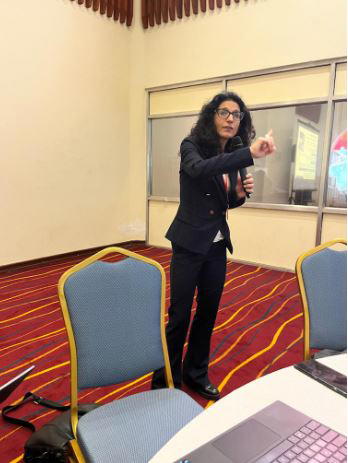
Speaking at the Colloquium which was attended by representatives of African Union and the European Union, the Chairholder Prof. Emanuela Colombo emphasised emphasised the need for multidisciplinary and transnational research, collaborations by leveraging on partnerships and sharing know-how, facilities, innovative teaching and learning methods between EU-AU universities.
Colombo, stated that energy remains a crucial to development especially in Africa. The International Energy Agency (IEA) had noted that over 600 million people, standing at 43 per cent of the total population, lack access to electricity, especially in sub-Saharan Africa.
“But we really need to understand what is the long term impact; positive and negative on the use of energy in different ways,” she stated.
Colombo noted that education must therefore be designed in a manner that students would understand how to go beyond technological development.
She empahisased that the peculiar challenges in Africa must be understood when dealing with energy transition considering the current level of raw material.
Disclaimer
Comments expressed here do not reflect the opinions of Vanguard newspapers or any employee thereof.