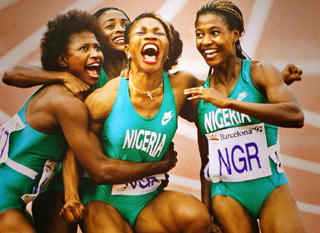
Beatrice Utondu, Faith Idehen, Mary Onyali and Christy Opara Thompson celebrating after winning bronze in the Women’s 4x100m Relay at Barcelona ’92 Olympics
Some years before independence, only few Nigerians had taken the international sports field by storm.. The likes of Emmanuel lfejuna who won a gold medal in high jump during the Commonwealth Games in 1954, Hogan Kid Bassey who became the world featherweight boxing champion in 1957 and Dick Tiger who won the middleweight crown and later the world light heavyweight crown, readily come to mind.
50 years after independence the story is different, Nigerian sportsmen and women have entrenched Nigeria’s name firmly on the map of great sporting nations.
Sports began to take serious roots in the country in 1963 when the National Sports Commission (NSC) began to function under Abraham Ordia as secretary. The 60s was a period of laying foundations and the only visible achievement was the qualification of Nigeria’s Green Eagles for the Olympic Games held in Mexico in 1968.

Kanu
In 1973, Nigeria hosted the 2nd All-Africa Games in Lagos and also introduced the national sports festival as a way of discovering athletes to represent the country try in continental and international meets. The first meeting in Lagos attracted about 6,000 athletes.
The 1970’s also witnessed tremendous achievements. Nigeria’s senior football team won a gold medal in the 2nd All-Africa games while the country’s contingent to the Games came second on the medals table. 1976 and 1977 saw the country earning victories in continental championships through IICC Shooting Stars and Rangers International of Enugu in the Cup Winners Cup Competition.

Chioma Ajunwa
The country’s record of achievements continued in the 1980s with series of achievements especially in football. The bronze medals won in 1976 and 1978 in the African Cup of Nations were improved upon in 1980. The Christian Chukwu led Green Eagles won the Cup for the first time at the National Stadium in Surulere. In 1984 and 1988, Nigeria again got to the finals of that championship but lost to Cameroon on both occasions.
Nigeria’s Flying Eagles qualified for the first time to represent Africa in a Junior World Cup in Mexico. They did not go beyond the first round having lost 3-0 to Brazil, but they defeated USSR 1-0 and held Holland to a barren draw.
Nigeria’s heroics continued to soar through the 80s and 90s with numerous accomplishments, especially in football. The Golden Eaglet, made up of player below the age of 17, won the Kodak U-17 World Cup, now known as FIFA U-17 World Cup, in China in 1985 and the Flying Eagles, almost did the same at the Saudi ‘89 U-20 World Cup, losing in the final to Portugal.

Beatrice Utondu, Faith Idehen, Mary Onyali and Christy Opara Thompson celebrating after winning bronze in the Women's 4x100m Relay at Barcelona ’92 Olympics
Nigeria also won silver and bronze medals in the male and female categories of 4 x100m at the Barcelona Olympics in 1992.
The heroics of Nigeria’s U-23 Dream Team at the Atlanta ‘96 Olympics, where they won gold medal in the football event cum Chioma Ajunwa’s glorious feat by winning a gold medal in long jump, put an icing on the cake for Nigerian sport at the world’s stage.
Other landmarks recorded by Nigeria in international sports, such as Eaglets’ triumph in Japan ‘93 and Eagles’ qualification for the World Cup for the first time in USA ‘94 cannot be overlooked.
Above all, Nigeria’s top position at the 2003 All Africa Games, stands the country out as a land that is blessed with human talents and natural resources.
The nation has also produced great sports stars like Hakeem Olajuwon in Basketball, Nduka Odizor in lawn tennis, Mike Okpara, a former world wrestling champion, Atanda Musa, Rashidi Yekini, Stephen Keshi and Richard Owubokiri who have made the nation proud these 50 years.
In spite of these success stories, the country has suffered setbacks. Nigerian football suffered a major failure in 1977 when a Godwin Odiye’s own-goal stopped the country from attending her first World Cup in 1978. Other disappointments were in 1981 and 1989 when Nigeria was stopped by Algeria and Cameroon respectively under painful circumstances.
In 1989, FIFA hammer fell on the country and she was subsequently banned for two years from participating in junior competitions due to discrepancies in ages of players who had played for Nigeria.
The Seoul Olympics of 1988 was another disaster for Nigerian athletes. Like in 1980, the athletes came back without a single medal. Worst still was the Green Eagles team which had gone to the Games as favorite but completely lost out. The death of Dele Udoh, Nigeria’s most promising 400m gold medal hope in 1979 took the sports fraternity by surprise. He was killed by the police in a checkpoint in Lagos when he came to participate in an athletics meeting from the USA.
Also in 1979, a clash between supporters of UCC Shooting Stars FC of lbadan and Bendel Insurance of Benin after a Challenge Cup (now called Federation Cup) semi-final match in Lagos in which the Benin team lost 2-0 led to the death of 26 persons. Another tragedy that hit the soccer world was the death of a Sam Okwaraji who slumped and died at the National Stadium in Lagos, during a World Cup qualifier against Angola. It was a horrifying experience as Nigerians had begun to appreciate not only the football skills of the late player but his patriotic zeal which were unparalleled.
Last year, Nigeria failed to reach the finals of the Nations Cup and only this year, the setbacks continued when Team Nigeria emerged third at the 10th All Africa Games held in Maputo, Mozambique. In athletics, the country’s contingent to the World Athletics Championships in Daegu, South Korea, returned without a single medal.
Despite the setbacks of Nigerian sports these past 5i years, the country has remained a darling nation to sports lovers at the global stage
Disclaimer
Comments expressed here do not reflect the opinions of Vanguard newspapers or any employee thereof.