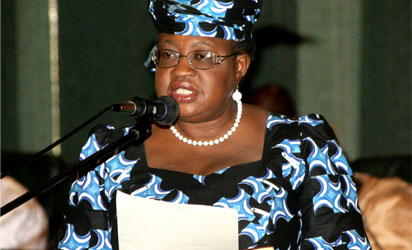
Ngozi Okonjo-Iweala, Former finance Minister
By Omoh Gabriel, Business Editor
The Board of Directors of the Overseas Private Investment Corporation (OPIC), the US Government’s development finance institution, has approved $250 million in financing for two American firms to invest and recapitalise Union Bank of Nigeria Plc.
A statement from OPIC said the project would result in better management and new technology to enable Union Bank reach the unbanked segments of the Nigerian population.
Union Bank was one of eight banks to receive a capital injection from the Central Bank of Nigeria (CBN) following the global financial crisis in 2009. In early 2010, the CBN auctioned the right to recapitalise and restructure the banks; to a consortium of investors that includes the American sponsors, African Capital Alliance and ABC Holdings which won the bid to recapitalise Union Bank on the basis of a plan to improve its corporate governance, risk management, credit standards and customer service.

Ngozi Okonjo-Iweala, Finance Minister
The US sponsors, Keffi Group Ltd. and Discovery Global Citizens Capital Partners, and their consortium according to the statement, will use the OPIC financing to introduce new financial products, including mobile banking technology that will enable Union Bank to reach unbanked segments of the population, thereby increasing the availability of credit in Nigeria.
The project will establish an objective performance evaluation system to create opportunities for advancement, identifying needed training and tying staff performance to rewards.It will also create a Union Bank Academy to provide in-depth training in customer service, credit analysis and risk management; and an institutional support office to act as a resource pool for bank management for specialised banking such as foreign exchange management, agricultural credits, factoring and other specialized skills.
“With the participation of its experienced investment team, this project will encourage the adoption of best international practices of corporate governance; increased transparency; strengthened credit and risk management procedures; and improved customer service, through the participation of an experienced investment team,” OPIC President and CEO Elizabeth Littlefield said. “In doing so, the project reflects Nigeria’s serious commitment to reform its banking sector and restore investor confidence.
“Union Bank of Nigeria serves close to a million depositors and hundreds of businesses – many of them small businesses – so the more efficient and profitable UBN becomes, the better it will be to fuel economic growth in Nigeria,”
Ms. Littlefield said. “We are particularly pleased that the project will result in greater availability of credit to ordinary Nigerians. Union, founded in 1917, is the fourth largest bank in Nigeria based on deposits, and the sixth largest based on total assets. It has more than 400 branches throughout the country.
The Keffi Group Ltd. is a private investment firm based in New York City and founded by Jide Zeitlin, a former partner and Global Chief Operating Officer of Goldman Sachs’ investment banking businesses. Discovery Global Citizens Capital Partners is an investment vehicle established by Discovery Capital, a U.S.-based hedge fund manager.
Meanwhile, existing shareholders in Union Bank will own 21 per cent of the bank’s shareholding at the end of its recapitalisation exercise. The deal will also give a group of institutional investors led by ACA private equity a 60 per cent stake, while the Asset Management Corporation of Nigeria (AMCON) will own the remaining 19 per cent.
Addressing newsmen recently, Deputy General Manager, Treasury, Abayomi Oluyomi, explained that under the arrangement, the choice of a consortium of core investor to inject fresh funds into the bank as against the options of merger and acquisition or nationalisation was to protect the interests of all the stakeholders. He said that the disadvantages of other options far outweigh the disadvantages.
Listing some of the benefits for the shareholders, he said that the recapitalisation would bring in international reputable companies as part shareholders, adding that some part of the existing shareholding would be salvaged and saved.
“As you can see, this is the best arrangement that adequately protect the interests of shareholders, staff, customers and others. Unlike other arrangements where the shareholders either lost their investment or get a paltry sum, in our case they still own 21 per cent. This is certainly a good deal” he said.
Disclaimer
Comments expressed here do not reflect the opinions of Vanguard newspapers or any employee thereof.