By Dele Shobowale
“We believe that the private sector will handle things better than the public sector. But the whole story about privatization has not been as successful as Nigerians expected it to be”.
Vice President Namadi Sambo, THE NATION, August 5, 2011, p 11.
Just as relevant is the related question: What is now Federal government policy on privatization or intervention in businesses? The second question, given the forced nationalization of three banks and government’s open disenchantment with privatization return us to the total absence of economic or social ideology in the manifestoes of our political parties.

It is inconceivable that a Republican President in the United States or a Conservative Prime Minister in Britain could have nationalized even one bank without causing a major uproar even within his own party. It is simply not the policy of conservative governments to tamper with private property which is held to be sacrosanct.
Even a Democratic President or Labour Party Prime Minister will need to gather a great deal of support from within his own party as well as the opposition party before he could take such a fundamental step. Yet, in 2011 Nigeria, the Governor of Central Bank had taken, with consummate ease, a step which heads of government elsewhere would tremble to take.
And remarkably, there has been no reaction from the President whose prerogatives had been trampled upon or the Minister of Finance who has also been sidelined. Yet, this measure will have the profoundest effect on the economic well-being of our nation for years to come.
Politically mature nations
In more politically mature nations, government policy invariably reflects the general ideology of the ruling political party and that means the majority of its members. Here in Nigeria, we have experienced the imposition of economic policies, based on underlying ideologies, which are not disclosed and which might not even approximate the beliefs of the majority members of the ruling party – perhaps not even the President himself. So, who is in charge? And to who do we address ourselves?
The Vice President made his announcement a day before the Central Bank of Nigeria announced the take over of three private banks in a manner whose precedents would take us back to the nationalization of private property under Communist regimes in the early parts of the last century.
The closest we have come to what economists refer to as collectivization occurred in the middle 1970s under the military government of General Murtala Mohammed.
Operating under the Indigenisation decree which was hastily promulgated, the Federal Government forced multi-national firms, including banks, to sell shares to Nigerians. Those old enough to recollect would remember that what we now recognize as First Bank was then called Bank of British West Africa; Union Bank carried on its business under the global name of Barclays Bank.
With forced indigenization, and with the Federal Government taking lion shares, the banks went under the control of the Federal Government and appointments and promotions were invariably politicized. Nestle Foods became Food Specialties for several years before the repeal of indigenization allowed the world’s largest food marketer to return to its original name.
Collectivisation, as government policy came to an end, or so we thought, with the introduction of the Structural Adjustment Programme, SAP, by military President Babangida or IBB. By then, three events have occurred forcing a reversal of the policy of government intervention in businesses which, according to technocrats, could be better handled by the private sector.
First, led by the Organised Private Sector, whose unchallenged leader was Chief Shonekan of the UAC of Nigeria, which was also, at the time, the nation’s largest conglomerate with over 35 divisions, the technocrats, meaning conservatives, who strongly believe in a private sector led economy had gained ascendancy in the corridors of power against leftists who hold to the notion that government still has an important role to play; especially in key sectors of the economy.
Second, Nigeria whose military Head of State, General Yakubu Gowon, had boasted in the 1970s that “Money is not our problem, but how to spend it”, had not only run out of cash but was heavily in debt to the Western European countries, whose enterprises, (UAC, Leventis, CFAO, SCOA , BP, etc etc) had been indigenised.
They knew as well as we did, that we had mismanaged our first windfall of oil money and like Shylocks, they wanted their pounds of our flesh. So they proposed and proceeded to use the technocrats to force SAP on us – notwithstanding the face-saving announcement by IBB, that the programme was “our own initiative.” It was not. And the reasons are not too difficult to discover.
The 1980s witnessed the rise to power in the United States and Britain two of the most conservative leaders the Western world had known in a long time – President Ronald Reagan in the US and Margaret Thatcher as British Prime Minister. They were soon joined by other conservative leaders in France and Germany.
Those were the most powerful voices in the World Bank, the International Monetary Fund, IMF, and even the African Development Bank, ADB, all of which Nigeria turned to for assistance when we ran out of cash. Those blessed with long memories would remember our Minister “Triple A”, Alhaji Abubakar Alhaji, Minister of budget but who spent virtually all his time begging for Nigerian loan repayments to be rescheduled – at increasingly punitive rates as interest was again capitalized and added to existing balance each time our wish was granted.
By the time the military left in 1999, the first loan of $2.8 billion taken, on the advice of the technocrats (naturally) by Obasanjo in 1978, with widespread assurance that it would be easily repaid, had ballooned to $36 billion, which Dr. Okonjo-Iweala had to pay off in 2003.
The difference between what we experienced then and now lies in the fact that, like it or not, Nigerians knew who was in charge. The Governor of the Central Bank hardly made major policy statements. Even unelected Presidents took responsibility for economic policy decisions because economics is life. Today, policy is being made without an overarching road map and sometimes surreptitiously.
One day private sector operators were being accused of ineptitude; the next day the most private of all private enterprises was taken over several weeks before the deadline given to the owners (shareholders), whose control of their business had been vitiated by the Central Bank of Nigeria, CBN, had been given the opportunity offered to rescue their banks. To call the measure unprecedented would be a waste of time.
To term it bewildering would amount to understatement. Ultimately, to pronounce it reckless and counter-productive would be more appropriate for several reasons.
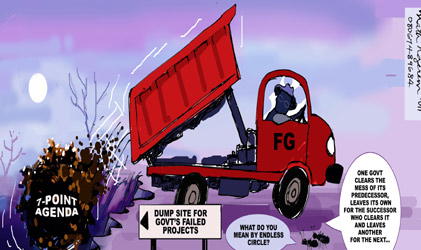
The President in that speech read on his behalf also said that “The feeling is that a number of enterprises that have been privatized by the Federal Government are not doing too well”. Nobody would dispute that observation by the President. But, the speech stopped short of telling the global community if that signals return to government intervention in businesses.
However, when on the very next day, the CBN announced government take-over of three banks and further disclosed that three new banks had been registered to replace them, each bank having been provided a complete Board and Management structure, names, logo, MOU etc, without a hint to the shareholders of the obviously liquidated three banks, then the nation is faced with a novel method of announcing a major policy reversal which could be disastrous for several reasons.
To start with, the Federal Government never had any investment in any of the three banks taken over. Of the eight distressed banks taken over by Sanusi, Union is the only one in which government previously had interest. Second, there is an existing announcement that the shareholders had until September to re-capitalise.
Obviously, the CBN has unilaterally thrown that into the dustbin without a thought to the signal that has been sent to the stakeholders of the remaining five and investors in general.
Thirdly, even a novice knows that several weeks are required to perfect the registration of a new company, most especially a bank because they are the only enterprises which can create money. So, the move to nationalize the banks must have started before July.
Meanwhile, the CBN and the banks were sending out all sorts of confusing signals to stakeholders.
One thing is certain. The CBN will have to rescue the remaining five because few depositors will keep their money there and fewer shareholders would want to hold on to the shares. The private sector might be awful, but the government is worse!!!
Disclaimer
Comments expressed here do not reflect the opinions of Vanguard newspapers or any employee thereof.