By Presca Sam Duru
Nigeria’s ace cartoonist and multi-award winning fine artist Albert Chigozie Ohams is exhibiting his body of works alongside print master Bruce Onobrakpeya and other notable Nigerian visual artists at the ongoing exhibition holding at Brunei Gallery, SOAS, Russel Square, London.
The exhibition reflects the visual articulations of politics in Nigerian art and entitled” In A Pot Of Hot Soup” (Artop). The Artop project coincided with the presidential elections of 2019 which led to conversations with artists in Nigeria about art and politics that formed the basis of this exhibition.
The project began since 2019 and being organised by Dr. Paula Callus (Bournemouth University) a leading animation expert and Dr. Charles Gore (SOAS University) artist and a leading world expert on southern Nigerian arts, having lived in Benin City for two years, and funded by Arts And Humanities Research Council UK (AHRC). It presents key Nigerian contemporary artists from a spectrum of media and practice, including painters, sculptors, photographers, cartoonists, animators, video and mixed-media artists. The organizers disclosed that the title “In a Pot of Hot Soup,” was inspired by a comment made by the artist Jerry Buhari who was the curator of his exhibition Zaria Art Society: Celebration of Legacies adding that Buhari discussed the social and political impact of the art society with its founding members Bruce Onobrakpeya, Yusuf Grillo and Demas Nwoko.
“Following Nigeria’s independence from British colonial rule in 1960, one occasion, Nigeria’s social, political and economic landscape has been unpredictable and, as Buhari explained, many artists like himself and the artists known as the ‘Zaria Rebels’ could find themselves “in a pot of hot soup”. “Cooking also uses a mix of elements – the ethos of this exhibition which presents digital and non-digital Nigerian art as commentaries on politics. Although official party politics was an inevitable starting point for the research, it soon became apparent that politicking in Nigeria pervades society.
“Nigerian artists creatively respond to, and promote positive change so as to benefit Nigerian citizens. The exhibition is organised around four key themes, although many more could have been chosen, to underscore how artists respond to the challenges and issues that shape social environments in Nigeria.”
The organisers said that there were 4 themes of the exhibition listing them to ‘The Struggles of Everyday Life; Gendering of Art; Envisioning the Environment; and The Art of Politics.’
“The project outcomes are this exhibition, but also an animation documentary and an open source digital archive funded for ten years, imaging Nigerian art and documenting artists discussing their art and practice which focuses on Nigerian voices and viewpoints and to challenge eurocentric narratives of Nigeria,” the organisers noted.
Explaining the 4 themes to the exhibition, beginning with ‘The Struggles of Everyday Life.,’ they said, “the exhibition space begins by inviting the viewer to a Lagos bus stop and a video artwork by Ayo Akinwande which is part of everyday experience in Lagos and its environs, an emergent megacity with a population that exceeds 17 million. Typically standing by the bus-stop, such as the one on Oga Bello Junction in Lagos, is a news stand. Looking over the newspapers of the day (The Punch, Vanguard, Nation, Guardian), the crowd that gathers there regularly gist about the daily struggles and challenges of the value of the Naira; the relentless traffic and its proverbial go slows (traffic jams); the power shut downs from the National Electric Power Authority (NEPA); whose moniker is “NEPA take light” as the hum of generators starts, the University strikes or the cost of garri (casava flour) and groundnut. Beside them, the artist Ayo Akinwande records this cacophony of voices to create an archive of the political landscape through musical conversations.
They note that Nigerian artists have been able to capture everyday life as a site of political struggle, or for inspiration for their own artwork and draw from these shared lived experiences.
The organisers narrate. “The photographic collective 1884 and associated emerging photographers, such as Omoregie Osakpolor and his peers, articulate the ongoing struggles facing the young and old, from the EndSars protests against police brutality of 2020, to the private and personal spaces where pensioners sit after many years of waiting to receive their state pension.
“The protests of 2021 and the past are echoed in Bruce Onobrakpeya’s print Protesting Youths and this is carried on by later generations of artists.
Jerry Buhari’s reflections on the constant interruptions to electrical power supply in his work the 368 Journals of NEPA , to the present day, are both a comment on NEPA but also the struggles artists faced in accessing resources at the time.”
They observed in Gendering Art that “the opulent posters featuring politicians, that can be pasted on every conceivable surface within a street during election periods, herald a new dawn in the political space. However the posters show only a small splattering of images of women participants, revealing that
the face and organisation of formal politics in Nigeria still resides very much in the hands of men.”
This attitude, the organisers explain pervades not just the formal political scene but is replicated in many spheres of life in Nigeria. Yet, women had been key players in the political circles of many pre-colonial societies in Africa, holding esteemed positions as kings in both Yoruba and Benin cultures.
“Women distinguished themselves as market leaders wielding great economic power, as they still do to the present day.
In leading protests against social issues both in the colonial and post colonial period, women’s voice have been strong and deliberately forceful to bring about changes in their societies. Both Onobrakpeya’s artwork Ancestral Nudes and Protest and Sokari Douglas Camp’s sculpture Underskirt Protest highlights female modes of protest through which they publicly shame male political leaders in female mass demonstrations, sometimes with the threat to disrobe to increase the shame directed at such men.”
Professor Peju Layiwola on her part directs her attention to the gendered labour that women provide, exploring new innovative possibilities by referencing the longstanding practices of women”s indigo dyeing, especially
the tradition of adire as part of Yoruba gendering.” Meanwhile Peju Alitse in her artwork both celebrates aesthetically the consumption of African printed fabrics that are worn throughout Nigeria and mourns the loss of its local production as factories in India and China undercut their prices and put Nigerian factories out of business.
The organisers notes that in the twenty-first century, female artists have gained a more central role offering artistic approaches that equal and even surpass those of their male colleagues.
Ngozi Schommers’ installation and performance If Not For A Child, they tell the viewer responds to the societal pressures of motherhood by evoking the celebratory Igbo practice of Omogwo. Meanwhile, a new generation of emerging artists recontextualize gender through their own artistic lens: The Nigerian-born Mikael Owunna further informs of queer African identities in the diaspora in his Four Queer Women Defying the Snow. In her self portrait Kehinde Awofeso’s art addresses the visible norms and concealments of the body, capturing fluid conceptions of gender, whilst Tyna Adebowale’s video work Tell Me as You See Am gives voice to individual experiences of gender.
With the rapid changes surrounding urban and rural spaces in Nigeria, the artists in envisioning the environment engage with and document these environments in creative ways. These environments we are told are shaped by the politics of resource distribution and acute disparities of wealth and poverty. “Oil rich Nigeria is the biggest economy in Africa after South Africa. It is home to an expanding and predominantly youthful population of some two hundred million plus inhabitants.
Lagos, its former coastal capital, is identified as an emergent mega city. The exhibiting artists explore the impact of these challenges on both its diverse and unique environments and the new ways of living that mega cities and their footprints demand.”
Jerry Buhari in his body of work highlights the pervasive impact of oil extraction in the Delta with the pollution of the unique mangrove rich swamps of the ecosystem and the poisoning of its local fishing economies. This has resulted in mass protests and insurgency across the Delta, even as the sculpture by Sokari Douglas Camp attests. In its public transgression, this act shames men and articulates female demonstrations against the national and international oil companies while Ayo# Akinwande’s artwork Ogoni Clean-up, is filmed in the Ogoni area of the Delta, where Ogoni leaders were brutally executed in 1995 and oil extraction highlights international corporate exploitation. The video presents a metaphor for the recurring conditions incurred by oil extraction and spillage, destroyed livelihoods and an oil wealth that does not benefit very much local communities.
Christopher Obuh Nelson on his part draws fine grained attention to the step by step transformation of Bar Beach in Lagos into the Eko Atlantic development. This urban site has become home to an elite gated city of skyscrapers and resulted in a disproportionate impact on the marginalised communities affected directly by the ocean surges. In contrast, plastic waste permeates Lagos and highlights how the expanding population of Lagos overloads its infrastructure capacity.
Omokeko Olufela’s Egungun masquerade made of plastic waste, in a video installation by Busu Ogisi, and commissioned by the NGO hFactor, campaigning against plastic waste, articulates this overload. The artist mediates this by a surface beauty, a celebration of local culture and creativity that memorializes in performance ancestral forebears in performance.
The Art of Politics is another one of the 4 themes of the exhibition. Politics in Nigeria is competitive and is highly visible on billboards, posters, digital advertising and textiles that supporters wear and parade at political rallies and on the streets, access to the resources of the state permeates social life and its environments. Reciprocity between politicians and their supporters is crucial to being elected. Political campaigns subject the public in the streets and thoroughfares to intense creative visual bombardments.
These dynamic iconographies it was revealed mark out the politicians’ presence in photographic imagery which is transcribed to posters and imprinted on cloth, plates, cups and other forms of memorabilia and are given out sometimes together with food stuffs and other material goods otherwise called stomach infrastructure.
This competition also engenders creative visual plays on these political iconographies to advance the political party and the politician seeking election. “These images can also undermine that of their rivals through visual puns and references to their past record or predilections. Moreover, the Nigerian public is often highly critical of politicians and their use of the national resources for personal gain.
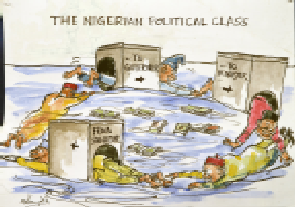
“Sharp retorts and observations are given about particular politicians and their political parties, particularly in cartoons that feature as part of longstanding newspaper political commentary and more recently in social media. Ohams through his cartoons offers humorous critiques of formal politics such as the greed of politicians but also of the daily struggles within Nigeria’s various communities. “Politicians, despite decrying the commentaries that cartoons offer, feel that they are so important that they should feature, thereby validating their political status,” the organisers revealed.
Performance artist Jellili Atiku ran for presidential office in 2019, garnering strong support in his home community of Ejigbo in Lagos. He presented a campaign accompanied by posters featuring a youthful portrait of himself to contrast with the elderly politicians who gain political power. In addition, the artist shared a political manifesto that highlights the self advancement of politicians at the expense of the public that voted for them.
In an interview with Journalists before his departure from Nigeria to London for the exhibition which has been extended until September 3rd Albert Ohams said that he was really excited to be part of the Artop project.
He said that Nigeria had many talented cartoonists but he was chosen based on his style of cartooning which infuses humour into critical and combating issues using his brush strokes and ink.
“As you notice there are different categories of artists selected to participate in the show and these are artists who have distinguished themselves in their chosen styles and areas of specialization. So I feel good being part of the project,” he added.
Ohams who is an author of two comic publications revealed that the advent of new media into the visual art has created a remarkable impact in the creative genre adding that many artists were now using different softwares to paint, draw, animate and do comical art. He said, “So many art selling in different platforms like the Non-Fungible Tokens (NFTs) are products of digital art. The best are yet to come in this digital revolution and artists will have a smile soon as art collectors are yearning for more creative works.”
Disclaimer
Comments expressed here do not reflect the opinions of Vanguard newspapers or any employee thereof.