By Osa Mbonu-Amadi
UK-based Nigerian visual artist, photographer, and creative director, Iyanu Taiwo integrates psychology, photography, and sculptural installation in reimagining the psychosocial realities of man.
Through photographic art, Iyanu explores images as dynamic rather than static subjects in frames that showcase appearance as a guidepost in determining identity, psychosocial pressures, and emotional progression.
The work exposes the gap that exists between people’s appearance and their state of mind. Using portraitures, textiles, gestures, reimagined environments, and sounds, the artist creates emotionally resonant figures tied to diverse conceptual frames.
In each frame, Iyanu unveils the persona’s state of mind, transforming it into engaging tactile experience that resonates with diverse audiences.
The artist’s background in digital media, photography, image-making, and visual communication, provides him a strong footing to produce works that viewers find not only visually entertaining, but emotionally engaging.
Iyanu stages the series as a journey, leading visitors through a structured sequence of movements. At each stage, the viewer encounters images depicted through photography, sound, reflection and live performance in an environment where they combine to form a coherent visual narrative.
By employing the journey framework, the artist literally engages the viewers in a guided visual tour, making their movement part of the art.
The artist conceptually captures diverse states of emotional disposition through a sequential five-stage photographic display. The approach helps to unveil various dimensions of emotional disposition such as when one is under pressure, overwhelmed, facing difficulties or experiencing pleasure.
The five-stage portrait series features images like footlights on display under the following subtitles: Mask of Normalcy, Weight Underneath, Breakdown, Noise Beyond, and Acceptance.
Beginning with its revealing title, Mask of Normalcy conveys a sense of disguise. The persona’s outward composure contrasts with the emotional state. While the figure appears calm outwardly the inner disposition is concealed, depicting a theme of pretence.
In Weight Underneath, the artist explores individual responsibilities and societal expectations metaphorically as “weights”. Through Breakdown, he mirrors themes of psychological weight, disorientation, and restrictions while using Noise Beyond as an interlude to relieve tension, showing vulnerability as a tactile experience. In the last frame, Acceptance, the artist creates a visual balance, resolving the inner conflict and signaling a new direction.
Iyanu’s visual language is restrictive. He uses tight framing and contrast to reveal accumulated thoughts, unresolved conflicts, or unmet expectations.
Iyanu also employs the fine art photography medium to creating compositions that resonate with his target audience. By this approach he triggers viewers’ engagement in interpreting and reflecting on the frames.
Beyond commissioned works in photographic image-making, Iyanu
extends his creative acumen to art installation, performance, lighting, and sound, using metaphoric representation to engage viewers with emotionally resonant artworks.
The artist employs an eclectic approach, using different, but interrelated frames for the subjects. Thus, he enables viewers to reimagine abstract emotions like anxiety, pressure, uncertainty and relief in concrete terms.
Moreover, he frames the portraits to create new environments where dominant psychosocial states gradually transit from one phase to another, opening fresh pictures for viewers to vicariously relive the portrayed experiences.
Collective memory is explored by the artist as an integral part of the thematic thread. Also, he stylistically uncovers emotional nuances through subtitles like “Headspace” which focuses on immersive human experience. Viewers interacting with Headspace will find concealed tactile experiences like “hidden pressures” relatable.
The piece reflects the realities of coming to age from teenhood. The persona emotionally struggles to come to terms with the challenges of transiting to adulthood. Dominant thematic concerns in the series include emotional overload, accumulated responsibilities, and personal acceptance.
One distinguishing feature of the setting is its contrast with conventional gallery spaces where photographs are arranged on walls as separate objects. The series evokes conflicting states such as exhaustion, confidence, uncertainty, and fear, showcasing how varying emotions and mental conditions coexist.
Without oversimplifying the visual narrative sequence by focusing on identity crisis and self discovery, the five-stage structure adds to work’s aesthetic quality, giving it a form of complexity.
The portrait sequence moves from stability to overwhelming pressure, then breakdown to normalcy and acceptance. The progression is intermittently interrupted suggesting that the difficulty never gets eliminated.
It also implies that the embodied emotions may become clearer with changes in relationship and age.
From the emblematic title, Mask of Normalcy marks the beginning of the work’s emotional voyage. Besides showing a semblance of stability, it delimits appearance from reality.
The portrait’s regulated positioning of the persona as a relaxed and calm individual reflects a dichotomy between socially accepted composures and individual reality.
Going by the title, especially with emphasis on “Masked”, the viewer gets the impression that the composure is cosmetic and not the natural state of the subject. The image reveals a deliberate attempt at reconstructing the natural state and replacing it with the artificial one which appears peaceful.
The central message is realised from the idea that viewers can relate it with their daily experience of navigating between private and public life.
Although its calmness is temporal, the momentary relief is soothing. It shows that beyond the surface level, there is something to worry about, albeit temporarily.
Iyanu uses the photograph to stage adulthood as a time when individuals should demonstrate calmness, ability to cope with challenges, and sociable personality amid internal turmoils.
In the next phase, the artist uses “The Weight Underneath” to showcase a complete picture of the “pressures” hinted at in the first frame.
Unlike The Mask of Normalcy, Weight Underneath is positioned in a restrictive frame with a sharper contrast, making its visual language less elaborate.
With the figure restricted within the frame, the artist creates a matching dense psychological space from where the piece can be interrogated for implicit meanings.
Iyanu portrays adulthood through multiple lens, highlighting “accumulated responsibilities” in respect of family life, social positioning and performance, financial obligations, and expected emotional comportment.
The title itself signals meanings implying burdens, beyond the surface level. Although the things that weigh the persona down are concealed from onlookers, the viewer can infer the intended meanings from the frames.
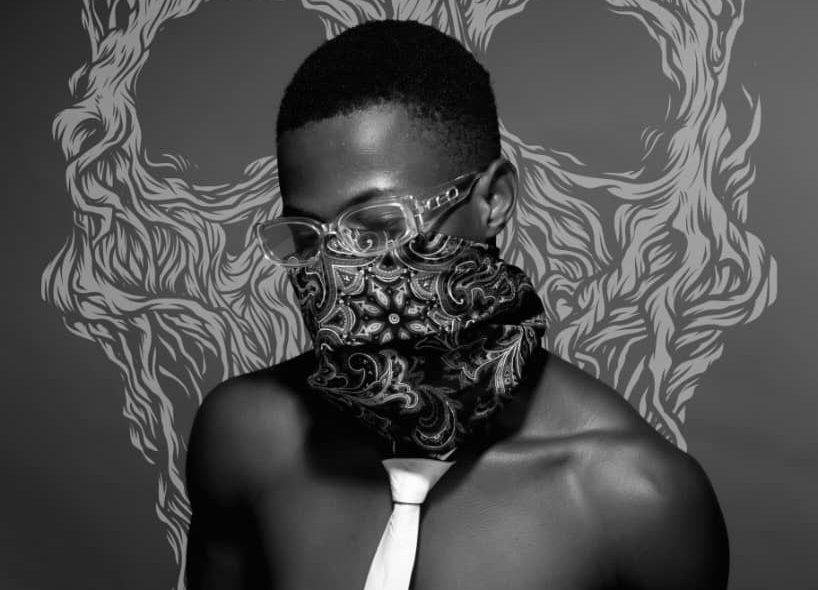
The piece, Breakdown, is centrally positioned to signal climax of the visual narrative sequence. The image conveys a sense of emotional or sensory overload with tendencies to depression, isolation and impulsive withdrawal from intrusive passerby in the public space. To heighten the emotional intensity and evoke concealment, the artist employs
dramatic lighting effects, silhouetted backdrop, and wrapping motifs, such as a scarf, into the visual storytelling.
Beyond its protective covering for the persona, the scarf functions as a deictic element that triggers emotional action in the portrait. It also evokes cultural, psychological, and social undertones.
Tension is generated as the persona is trapped in a dilemma, desiring to withdraw from the intrusive public eye, but unable to do so. Dramatic irony is realised from the understanding that the viewer can see through the persona’s pathetic plight.
In The Noise Beyond, the emotional tension thickens, becoming part of the persona’s reality. The tension is unintentionally externalised as restraint within the mind becomes impossible, marking its climax.
Although the Noise Beyond seems to escalate the tension, it introduces a roadmap to its resolution and reducing its intensity internally. The release comes as comic relief, embodying the old saying, “a problem shared is halved.”
The last image brings more visual clarity and balance. The creative deploys wearable materials as metaphor for emotional state as in “wearing the pressure like a uniform.” Resignation to fate, social conformity, and self-discovery among others are the overriding themes in Acceptance. Although the crisis remains unresolved, the image reveals that the persona has found a way to live with it.
Viewers can explore the uniform metaphor beyond its surface to realise embedded themes and connotations such as identity, discipline, familiarity, and sense of duty. The artist uses the image to transform an abstract concept, “pressure” to a tangible “overload”, reflecting emotional burden. For instance, as part of the persona’s dressing, the scarf symbolically represents a covering image used to limit visibility.
Significantly, this innovative artist systematically infuses other insightful images into the visual display without disrupting the narrative sequence anchored on the five-stage photographic work. “Headspace” and “ipélé” are such iconic photographs.
In Headspace, which focuses on adulthood and psychological transition, Iyanu extends the primary thematic concerns to include cultural identity and inevitability of change. He uses physical objects, posture, gesture, textile, reflection, clothes, and reimagined abstracted phenomena to relate personal experience with collective history.
As shown in “Breakdown” and, “Ipélé” a traditional clothing item such as a scarf could function as not only a physical wearable object, but an emotional and cultural instrument. The viewer could interrogate such symbolic images along with other social codes for
further insight into themes of cultural heritage, identity, and self-discovery.
Thematically, ipélé which is rooted in Yoruba tradition mirrors the close relationship between inherited culture and inner life among other themes.
Aside from his commitment to studio
work, Iyanu is passionate about using photography as a medium for showcasing individual identity, culture, communal existence, and personal or collective history.
Iyanu’s work has featured in local and international exhibitions held at famous spaces such as the Colchester Town Hall in the UK.
The artist stylistically navigates through the inward life of the subjects, prevalent socio-cultural realities, and societal expectations that shape individual identity.
Iyanu’s training in digital design and visual communication reflects in the quality of the photographs he stages, using installations, lighting, gestures, and postures to convey his intended message while maintaining the emotional appeal.
Iyanu develops a work in which photography transits to a visual language for interrogating life from diverse perspectives. He stages images that reflect how people accommodate pressure, internalise experiences, adjust to changes, and negotiate emotional, cultural, and psychological movements toward self-recognition and self-esteem.
In Acceptance, the artist depicts the theme of uncertainty, showing how emotion transits from a state of concealment to acknowledgement.
Across the frames as seen in ipélé and other photographic works, Iyanu uses portrait extensively to not only describe faces, but to preserve memory, externalise emotions, and establish spatial relationships. The artist also employs photography to document cultural histories, mirror the intersection between persona’s facial expressions and the inner self.
Iyanu’s visual language in exploring the embedded themes include non-verbal figurative expressions and imagery. For instance, he uses a scarf to represent different shades of emotional pressure – anxiety, stress, and acceptance.
All through his work, Iyanu engages photography as a veritable medium for showcasing identity, reimagining reality, and representing embodied emotions.
Although the titles guide the viewer toward interpretation, they do not provide enough explanation for the images. The artist leaves room for the viewers to interpret the images from their own perspectives.
Disclaimer
Comments expressed here do not reflect the opinions of Vanguard newspapers or any employee thereof.