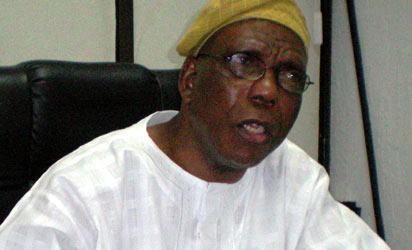
Prof Okojie, NUC Executive Secretary
*Says commission monitors private concerns more
*‘Our problems with ASUU strikes, admission quotas, illegal campuses’
Professor Julius Okojie, Executive Secretary of National Universities Commission, NUC, in this interview with Favour Nnabugwu, argues that decadence is no longer prevalent in our universities. Okojie, interestingly, insists that the education sector is fairly funded within the context of the competitive demands on government funds. He says some Nigerian universities are now ranked among top 100 in Africa.
With 117 universities- 45 private-owned, 36 Federal Government-owned and 36 owned by state governments, NUC, indeed, has a lot on its hands.
But the NUC boss says the commission is doing its best.
With a touch of humour, when asked about the possibility of an emergent Ivy League in Nigeria, Okojie charged back: “We must have our own League! How many universities in America have joined the Ivy League? There are 6,000 universities in America; 3,000 of them are accredited. How many of them are in Ivy League? Ivy League universities are 400 years old and above, formed by the Presbyterian Church like the Harvard, the Preston Brown, etc. We have our own League and we can’t be talking about Ivy League. Talk about first class universities that have good competition; that have world standard. They can’t work under the conditions we work here. What do we need an Ivy League setting for? We must have our own League”. Excerpts:
What is the state of Nigerian universities now?
We are making steady progress. It is not as cumbersome as it used to be. Government invested lot of funds and resources in the education sector because it is aware of the problems in the sector. The issue of quality assurance is taken seriously and there are more universities and more programmes. So, we have improved. Staff training is also on-going. We have 4,000 academic staff in training programmes across the country; 3,000 of them are trained within the country and 1,000 are being trained abroad. We have linkages with development partners. Government has provided N3 billion for research which we are also accessing. Government has made provision for training of staff at federal and state universities to the tune of N150 million a year.
Government has also made provision for direct teaching and laboratories courses to ensure that we have equipment for laboratories and disposables. Government has funded 12 universities to the tune of N3 billion each in the last three years to revamp the existing facilities and build new structures.
Government is also constructing six laboratories to ensure that we have adequate research centres.
I must say that good things are happening to education this time. If we continue to sustain the template of intervention in Nigerian universities, we would be there – we ought to be in the next five years. No Nigerian university was ranked among the top 100 in Africa five years back, but now we have 16 Nigerian universities ranked in the top 100 in Africa; so, we are making steady progress.
What is then responsible for the decadence in the universities?
It didn’t start yesterday. It has been progressive over the years and, now that intervention has come, we also have to be patient to ensure that we feel the impact of the efforts made. When you say decadence, l just laugh! Have you been to the federal and private universities lately? Have you been to University of Ibadan recently? Go and see what government is doing there with respect to intervention.

*Okojie
We no longer use that word decadence anymore because we are making steady progress in terms of providing teaching, research and learning environment. I won’t call it decadence because anywhere in the world, universities are difficult to fund. Government has realised what the problems are and we are addressing the issues such as staff shortages, quality of staff and retention of ICT deployment. Where we are today in terms of internet presence is not where we were five years ago.
Why should we still talk about decadence? Our graduates are competitive. Government has introduced entrepreneurship which means that our graduates are better prepared for the job market. Decadence! No. I won’t call it decadence. There are challenges; even the universities that are ranked first in the world still have their own challenges. Universities are continuous investment profile setting. You don’t just invest one day and hands off. What we need to do is to sustain the level of awareness that we need to invest in education at the tertiary level particularly at the university level.
Some people are of the view that NUC’s supervisory responsibilities are suffering massive discounts. How often does your staff inspect the universities?
How often? That is a day-to-day activity. In fact, we monitor the private universities more than the others. From the beginning, we implement the 14-point procedures before they obtain their licences. They have to write a letter of intent; they have to prove that they have values and access; they have to have the physical structures on ground and also show us the profile of the expenditure and sustainability of their programmes. We supervise the private universities more than any other institution because education is on the concurrent list.
Besides that, we assist the private universities in their appointment of officers; we inspect and monitor them regularly. We use the yearly intervention to invite the universities and access them to know what they have put in place and what they have improved upon in terms of facilities. Recently, we had problems in some universities about water and student riot, we also visited them. Where there are flashpoints in the system, we invite the principal officers and address the issues.
We also try to ensure that the issue of religion and other things do not cause problems in the system as some of them are faith-based. There was a case of compulsory HIV test for students, we took the issue up with NACA and discovered that it was something they could resolve in the institution because it was even in the best interest of the students to know their HIV status but not by forcing them to do the test. We are on top of the situation in all the universities. We have 117 universities- 45 are private, 36 federal and 36 states.
When will the new universities promised by the Federal Government take off?
When you talk about taking-off, they have taken off; it is just that students’ activities have not come on board. We assessed the situation on July 13, 2011. All of them may not take off at the same time but some of them will definitely take off before the end of the year. We had promises from state governments on assistance for take-off sites and what have you, but things have been slow as a result of new governments that came on board in some states otherwise government is making provision for them. If they are not ready, we are also making provision to ensure that we do not leave the students unattended to and they do not take off when they are not ready.
For any university to take on a post-graduate programme, it must have graduated a set.
Not just one set but a minimum of two sets. And the programme must have full accreditation.
So, what is NUC doing to curtail the excesses of universities in terms of unapproved programmes and satellite campuses?
I won’t call them satellite campuses because, in 2002, government stopped all satellite campuses. We have had problems with some state varsities coming up with campuses outside their main campuses. We had a problem with one particular state in the South-West and we had to close it.
They went to court but recently they came to us to ask how the issue could be addressed. We don’t want a situation where students earn degrees that are not worth it. So, l won’t call them satellite campuses though there are provisions for universities to have campuses outside their main campuses, but we must, as of necessity, go and inspect and ensure that they have resources to run those campuses. They must apply to us just as they do for programmes. When there are campuses that NUC has not given approval to, we say they are illegal campuses.
What is the admission quota for the 1.4 million JAMB candidates?
You can’t be too sure of that because even when you have given them, students may still meet conditions for clearance in the new requirements in respect to National Examinations Council, NECO, and West African Examinations Council, WAEC. Having said that, l think, this year, we should have about 400,000 in all the universities. All of them may still not qualify when it comes to the nitty-gritty due to shortcomings here and there. They may not meet the requirements for admission and all that.
What are the constraints of NUC in terms of funding and human resources?
Within us in NUC, we have built capacity over the years but no regulatory agency has all the resources and resource persons to do their jobs. So, we do what we call peer-review. We draw staff from the universities to do some of our work. When it comes to funding, we are fairly well-funded. There is what we call the stabilisation fund which was established in 1992. We use the interest from it to address the issues of regulating the universities.
Government also gives us money every year for accreditation. So, to a large extent, we are fairly well- funded. Though we would like to do with more money, when you look at the competitive demand for government funds, we would say we are not doing too badly at the level of funding the commission.
Federal universities are doing well in terms of funding but state and private universities are not doing well because government intends for all the universities to start the intervention. We also have the Step B of $180 million and recently we got $1million from Education Trust Fund, ETF, to invite professors of Nigerian extraction from abroad to come and stay for a short period.
I was reading in the papers where the Academic Staff Union of Nigerian Universities, ASUU, chairman was quoted as saying that we have a shortfall of 30,000 academic staff. He never interviewed me; even if l had discussed that with him, he hasn’t told us how many are in the system now. There is no part of the world that will you not have shortages – even in the Ivy League schools.
The level of staff shortages vary from one proprietor to another. There are more staff in the federal universities than you find in the states and private institutions. So, when the chairman of ASUU asks, why should we create more universities when we don’t have staff?
We look at the staff of the federal universities because people prefer to teach there than in states and private universities. So, we don’t have the same ratio of shortfall for federal and the purpose of federal universities is equity because government says that as a policy we must have a federal university in each state.
That is the reason for creating those nine universities, we didn’t just create them and there are three more that are going to come on board. It shouldn’t be an issue that should be flogged around. It’s like the creation of states, people are still pressing for the creation of more states; creation of states has brought development to the grassroots just like education at the tertiary level.
When you don’t have a university, you have to go from one place to the other. University brought development; so, why would anyone say a state cannot have a university because we already have too many universities in the system? Ideally, a university per state is not too much for the Federal Government to run because universities are on the concurrent list of government. The system allows states and private citizens to have universities. So, if you look at the distribution of demand, you will find out that there is a concentration.
Lagos has a population of over 10 million people. Would you say that because they have one university, they should not have another one? We must address the issue as they arise, there is need for access. We are hoping that the National Open University, when we properly articulate the problems there, will provide what it takes. The Indira Gandhi Open University has more than 1.8 million students, more than all the students in this country. So, we must encourage open distant learning.
Rather than creating more universities, is it not better to fund the existing ones properly?
Government tried some years ago to expand the University of Ibadan, we expanded it to 30,000 and still discovered that there is a problem in the system. The water works there could not supply even the Ibadan setting. It means that you rather have one university in Ibadan and tell people from Sokoto to come to Ibadan? Is the town ready to provide the needed accommodation? What is wrong with a university in a setting where they can also address the issue of local environment?
Government is funding the existing ones and also creating universities where there is none. I don’t see what the problem is. In about 20 to 30 years from now, alumni will be funding institutions and industries too will be funding institutions. Though we still have a very weak link between industries and the institutions. Our universities are still too young in this country to self-fund; the oldest is about 60 years.
What is NUC doing to relate with ASUU and curb cultism in the universities?
About five to six years ago, government provided funds for us to buy security equipment. Number two; we need a good governance structure, good chairmen of councils; good vice-chancellors to respond to the needs of the people because it is the way you treat people that they will react to you.
As for ASUU, when you have a regulation that needs to be reviewed every three years, there is need to exercise caution because each time they go on strike, they learn the habit of not working. In spite of that, we are encouraging government to meet their needs in terms of improved funding and implementing the agreement. Government is providing a lot of research grant in the system.
There is a lot of funding in the system, so, we cannot complain. We are going to subscribe to e-journals and e-books in order to engage the people in research and all that. Government is training the staff and providing more universities. What is happening in the union is that if there is a problem in one state university, it creates problems for the whole system because unionism has brought about that.
It is better to dialogue and continue to work than learning the habit of not working. They are very reasonable people and my colleagues as well, hence it is when there is a slow reaction to their demands that they tend to go on strike but they should realise that there is a competing demand on government funds.
During the minister’s take-over ceremony, you applauded the government for continuity in re-appointing the minister of education. Why?
We are looking at the issue of the bill that has not come through because she is aware of it. It is just like starting from where you stopped, else we would have been talking about going to brief the new minister but it looks as if the re-appointed minister just went on leave. We have an education road map which she said we must complete and she did that in the first one year.
We already have a template to operate on. We call them turn-around strategies. What we are going to achieve this year is all set out. Once she dictates the direction for the sector, we will follow up by providing what is takes. And these are matters that the minister already has knowledge of. She knows the system very well otherwise it would have been a question of familiarity talk which could take a whole year.
When will the universities attain the Ivy League status?
How many universities in America have joined the Ivy League? There are 6,000 universities in America; 3,000 of them are accredited. How many of them are in Ivy League? Ivy League universities are 400 years old and above, formed by the Presbyterian Church like the Harvard, the Preston Brown, etc. We have our own league and we can’t be talking about Ivy League. Talk about first class universities that have good competition; that have world standard.
They can’t work under the conditions we work here. What do we need an Ivy League setting for? We must have our own League. Oxford and Cambridge are of the same standard with Ivy League but they are not called Ivy League. It is a generic name for a set of universities that made it over the years in terms of quality and tradition. They have tradition and they are expensive. Go to Landmark, Elizade, Bowen, Ajayi Crowther, etc. They respond and enjoy the benefit of the private sector discipline.
Disclaimer
Comments expressed here do not reflect the opinions of Vanguard newspapers or any employee thereof.