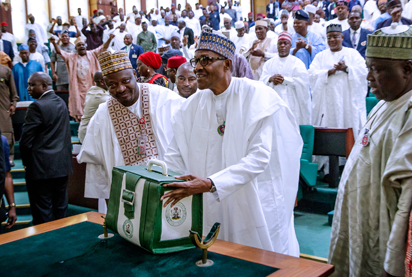
President Muhammadu Buhari (M), presenting the 2019 Budget at the National Assembly in Abuja on Wednesday
By Owei Lakemfa
THE year 2019 presents a lot of challenges to Nigerians ranging from the economy and growing insecurity to hunger, but it is politics, or the politics of the these challenges that will reign supreme. The first two months will be dominated by the February general elections while no matter who emerges winner, the next ten months will be expended on post-election politics including settling scores.

President Muhammadu Buhari (M), presenting the 2019 Budget at the National Assembly in Abuja on Wednesday
The presidential election itself, poses a dilemma because our choices are primarily narrowed to two candidates who are not fundamentally different and one of who can return the country to the part of development we started out on at independence. They have similar ideological positions on issues like privatization, the reign of market forces, and have indeed, been together in the same political party. As far as choice of party goes, both men have, like most leading politicians, sailed the political waters to different party ports; anchoring for a while before setting sail again.
President Muhammadu Buhari for instance was the Presidential candidate of the All Nigeria Peoples Party, ANPP, in the 2003 and 2007 elections, before moving out to be the 2011 candidate of the Congress for Progressive Change, CPC, and then, that of the All Peoples Congress, APC, in 2015. Today, he is flying that party’s flag for the 2019 elections. His main opponent, Alhaji Abubakar Atiku was for two terms, the country’s Vice President on the platform of the Peoples’ Democratic Party, PDP, before decamping to the Action Congress, AC, on whose platform he contested the 2007 elections. He returned to the PDP in 2009 but was not picked as its candidate. The 2015 elections saw him as a chieftain of the APC where he had unsuccessfully contested against President Buhari to be its Presidential candidate. Atiku returned to the PDP for a third time where today, he is its presidential candidate.
So while the APC and PDP are obviously two political parties with different slogans, mouthing seemingly different phraseologies, in reality, they are Siamese twins sharing vital organs. In this, lies the complex choice Nigerians have to make. Also, the fact that politics is the most lucrative business in the country with very high returns and unquantifiable profits, the stakes for the political elites are so high that the electoral contests resemble mini-Civil Wars which threaten public good, wellbeing and public morality. In some cases, elections threaten the very existence of the country itself.
Open and distance learning
So how can an informed choice be made? President Olusegun Obasanjo and his Vice President Atiku had the mandate to govern the country from 1999 to 2007. They replaced military regimes that had held sway for fifteen years and set the country back. But rather than set us on the road to national recovery and development, they, with the aid of Malam Nasir El-Rufai current APC governor of Kaduna State, sold all national assets they could lay their hands. Until today, the country does not know precisely what the proceeds of those prodigal sales were used for. They did not develop the university system as expected, rather, as the highest political office holders in the country, both engaged in private business while in public office. They established their personal universities in 2004. While Obasanjo est lished the Bells University of Technology, Atiku gave birth to the tmerican University of Nigeria.

In contrast to Obasanjo and Atiku, Buhari has not been known to engage in private business while in office, certainly, he has not established his private university. However, while he is not known to have developed the tertiary system in Nigeria, Buhari has the record of shutting down schools and universities other administrations had established. On July 22, 1983, President Shehu Shagari – who passed away on December 28 – established the National Open University as the spring board for open and distance learning in the country. Buhari as military Head of State, shut it down on April 25, 1984. It was not until April 12, 2001 the university was re-opened by President Obasanjo. That is 17 years later!
Perhaps the administration that has laid the greatest emphasis on the education of nomadic children and establishment of universities in the country was President Goodluck Jonathan. In 2012, his administration set out to build 400 schools in the North to vastly improve education in that part of the country. At least, 165 of these integrated Amajiri schools were opened, some fitted with language laboratories and health clinics. But since the Buhari administration came to power, some of these schools have been shut down, some seized by state governments and many underutilized with the students roaming the streets.
https://newlive.vanguardngr.com/2018/12/alleged-corruption-in-military-report-vindicates-our-position-pdp/
The Jonathan administration also decided to launch a dozen new universities, out of which nine were established. But the Buhari administration decided to close some of them. A closure that became quite controversial was the Nigeria Maritime University which was to commence academic work in the 2015/16 Session when it was shut. This seemed the unkindest cut because the country had no single maritime university and only one maritime academy while a third world country like the Philippines has 44 maritime universities and academies and Bangladesh, one of the poorest countries on the earth’s surface, has 14 maritime universities and academies. Also, while Nigeria needs 150,000 personnel in the maritime industry, we had less than 1,000.
The excuses by the Buhari government for the closure including claims that the university has no structures (when it has some of the best structures in our tertiary institutions) were systematically debunked. With this and fears that the Niger Delta might erupt in violence over the closure, the university was reopened in 2018.
Now, who should Nigerians vote for; an Atiku who as Vice President of the country engaged in private business including establishing his own private university to rival the public universities he was supposed to be developing, or a President Buhari who shutdown public schools and universities without replacement? The thinker and writer, Odia Ofeimun likens our electoral dilemmas to having to choose between a villain and a slave trader. He argues that while the former is primarily interested in divesting you of your belongings, the later wants to own your belongings, your ancestral lands and your life. While this analogy might seem farfetched, our position is not helped by a polity that does not allow unfettered debates.
The fact is that in the sixteen years the PDP ruled – with Alhaji Atiku as Vice President for eight of those years – Nigeria experienced what locust years means. Even the party acknowledged its bad governance and apologized for its misrule. But if you ask what has changed; what new programmes or better leadership the PDP wants to introduce that informs its desperation to return to power, an army of apologists will be unleashed on you and you will be termed an ‘hailer’ a blind follower of Buhari who is incapable of reasoning.
On the other hand, when the APC came to power in May, 2015, it was confronted by an on-going terrorist challenge in the Boko Haram. The Buhari administration vowed in September 2015 that it would defeat the Boko Harm within three months. When the period expired, rather than admit difficulties and mobilize the populace in the fight, the administration claimed it had “technically defeated” the Boko Haram. Today, three years later, Boko Haram remains a force strong enough to mount sustained attacks both on civilians and military installations and take territory.
There was serious insecurity, especially kidnapping before the Buhari administration assumed power, now, it is far worse with parts of the country like Kaduna being virtually no-go-areas. There were ‘herdsmen-farmers clashes’ but now it has become a war of survival in the Benue Basin with armed terror gangs, whom President Buhari, the Commander-in- Chief of the Nigerian Armed Forces, said, are from Libya, carrying out horrendous massacres. These bandits overrun villages, occupy some, and even rename them. In Plateau State alone, 54 occupied communities have been renamed by the invaders. Yet the army is not wiping out the bandits, retaking the lands and resettling the victims who are now internally displaced persons, back on their ancestral lands.
In fact, in one of the most shocking statements I have ever heard, the Buhari administration advised the victims to abandon their ancestral lands to the terrorists as it is better to be alive than be killed in their homes! Bandits have also taken control of Zamfara State. To worsen our security situation, the administration is adding another sectarian religious crisis by its continuous massacre of Shittes protesting the incarceration of their leaders despite court orders.
https://newlive.vanguardngr.com/2018/12/atiku-buhari-bicker-over-corruption-allegations/
I don’t know about you, but I am quite unsettled that the President in his wisdom, but contrary to the constitutional provisions on Federal Character, has picked almost all our security chiefs from one part of our multi-ethno-religious country. By this, he alienates most parts of the country. This is not a matter of compensating the 97 percent of those who he claimed voted for him and being less responsible to the five percent he claimed did not vote for him. Rather, it is about the wellbeing of the country and the need for all Nigerians irrespective of their political affiliation to have a sense of belonging to one large Nigerian family.
Let me clarify that despite empirical evidence that the Buhari war against corruption is primarily verbal and selective, it is welcome because at least it puts some political elites on their toes and has seen a sprinkle go to jail. Also, it provides a template for future governments to probe the Buhari crowd. But if I were to question why a government as inept as the APC’s which has elevated mass deceit and falsehood, to statecraft, wants a second term, I will be accused of being a ‘Wailer’ mourning the 2015 PDP loss of the Presidency, and making a ‘Hate Speech’
So here we are, with two dominant parties lacking strong principles, no difference in ideology, no party discipline and no clear manifestoes. Here we are with political leaders who regard even party primaries as fierce contests in which it is every politician to himself and God for them all. We seem stuck when most of the leading politicians see politics basically as access to the national wealth and the determinant sharing formula.
We are, as the saying goes, caught between the devil and the deep blue sea. We cannot say it is better to stick with the devil we know than sail with the angel we don’t know because we know both the APC and PDP. The general elections will role by, no matter the consequences. Secondly, given the fact that the APC and PDP are desperate for power, it will in my view, be a waste of time advising the septuagenarian candidates of both parties to be law abiding, play by the rules, embrace themselves and agree to abide by the outcome of the elections. Rather, the challenge for all of us is, how do we mediate the process in such a way that Nigerians would be tolerant of differing political views and not engage in electoral violence. How do we stop Nigerians from killing themselves over the elections?
We also need to leverage with the Independent National Electoral Commission, INEC, to strive for a free and fair process so that aggrieved persons would not resort to violence. It is not logical to allow the electoral system to be compromised and ask the aggrieved to go to court; crass legalism does not translate to justice. How do we ensure that those responsible for electoral violence are brought to justice, even if it means holding them accountable outside the shores of our country.
All the foregoing are in the immediate and short term. In the long term we need to make fundamental changes including returning our country to federalism such that as it was in the First Republic, it would make more sense for the leader of the ruling party to remain at the regional or state level rather than become the President or Prime Minister at the centre. We should devolve powers to the building blocs of the federation to drastically reduce the powers of the President which today, are essentially, dictatorial. Establishing community and state police in addition to the federal, with clear lines of authority has become a necessity.
There is the need to stop the deployment of the armed forces and secret services for civil duties such as conducting elections or monitoring civil protests. At all times, the deployment of these forces for internal or external operations, must be with the approval of the National Assembly. To cut the cost of governance and reduce desperation for political power, the country should pay local government, state and federal legislators only their approved salaries with no extra allowances or constituency projects which are nothing but fraudulent schemes. For instance, paying a senator over N14 million ($40,000) monthly as allowances is a crime. Additionally, we have to check the open banditry called ‘Budget Defence’ .
Abolishing so called security votes at all levels is a basic prerequisite to fighting corruption. All monies from the local government, state or federation accounts must be appropriated under the budget, accounted for and properly audited. I hold that the primary duty of government is to solve the problems of society and meet the challenges of development. However, Nigerian governments have for decades demonstrated manifest incompetence in this direction.
A primary solution to the problems of the country, is to call the elites to order and impose the basic rule of law and order in which ALL, irrespective of age, class, rank and position will be subject to the basic rules of social justice. In ensuring this, we would need the active participation of the pro-people section of the elites, patriotic and progressive students, workers and intellectuals, and above all, of the people who must assert their sovereignty over all levels of power in accordance with Section 15(2) of the constitution which states that “sovereignty belongs to the people of Nigeria from whom government through this Constitution derives all its powers and authority.”
Additionally, we must make justiciable and implement the provisions of Chapter Two of our constitution which all governments since 1999 have pointedly refused to implement. Patriotic Nigerians have a lot of work in their hands so, no matter the outcome of the general elections we should utilize 2019 to build new political foundations in order to save our country, and guarantee a better future.
https://newlive.vanguardngr.com/2018/12/2019-apc-must-have-100-votes-in-katsina-oshiomhole/
Disclaimer
Comments expressed here do not reflect the opinions of Vanguard newspapers or any employee thereof.