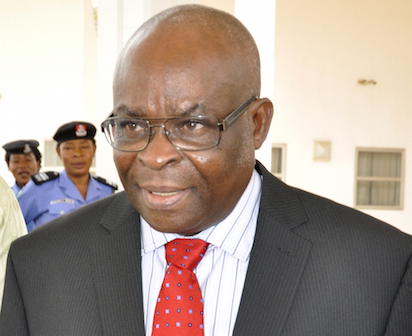
Former Chief Justice of Nigeria, Walter Onnoghen
By Ikechukwu Nnochiri
Undisputedly, the next few months will be a busy period for the judiciary, as many courts will be flooded with applications bordering on pre and post-election matters requiring adjudication.

Chief Justice of Nigeria, Justice Walter Onnoghen,
There is no doubt that election litigation has become an inevitable part of the electoral process in Nigeria.
Whereas the Independent National Electoral Commission, INEC, has the responsibility to conduct and manage elections, the Judiciary on its part, is charged with the responsibility of resolving disputes arising from the process.
Consequently, aware of the burden of responsibility before it, the Judiciary, in a bold step, recently circumscribed itself from arming the political gladiators with ex-parte injunctions. Though such court orders, by its nature, is geared towards the preservation of the ‘Res’ (subject matter) of a case between parties, however, it became subject of abuse in recent years.
The situation got so bad that during the 2011 general elections, the former Chairman of the INEC, Prof. Attahiru Jega, wrote the then Chief Justice of Nigeria, CJN, Justice Aloysius Katsina-Alu, begging him to prevail on Judges to stop granting spurious ex-parte orders to aggrieved aspirants.
Determined to forestall such scenario in the 2019 general polls, the Chief Judge of the Federal High Court, Justice Adamu Abdul-Kafarati, in a new legal directive, recently barred Judges of the court from granting ex-parte orders in political cases.
The CJ who made the directive public on September 17, after flagging-off the 2018/19 Legal Year of the Court, further directed that all pending political cases that could affect the opportunity of candidates to pursue their political ambitions, should be concluded before the end of October.
He said the decision was reached so as “to forestall any hiccups and the blame of the court by the political gladiators”, adding that a circular was earlier issued to Judges to the effect that “interim orders ex parte shall not be granted in any political cases brought before the court.”
The CJ said: “I believe that controversies especially in political cases can be reduced when the court takes a decision after hearing all the parties in the case. It is also extremely important that all political cases that may affect any of the parties which are still pending in any of our courts be concluded without further waste of time to afford all candidates the opportunity to pursue their political ambitions.
“I urge your Lordships to be wary in handling all cases and especially cases concerning political parties and the upcoming general elections. We should again use this court and the constitution to regulate our society for the good of our children and mankind. I still believe that the judiciary remains the hope of all people whether common or uncommon.
“It is therefore your duty to ensure that the society is moulded in accordance with the rule of law and the constitution. You must therefore administer justice without fear or favour.”
To further amplify the seriousness of the matter, the CJ, at the opening session of 2018 Judges’ Conference, further reiterated his warning, stressing that Judges of the court must avoid ex-parte orders, except on exceptional cases.
Commending the initiative, the Chief Justice of Nigeria, CJN, Justice Walter Onnoghen, said that election periods usually place the judiciary in the eye of the storm. “We must ensure that matters brought before our courts are determined on their merits, devoid of any external interference, to ensure the sustenance of the independence of the Judiciary,” he said.
Similarly, the Attorney- General of the Federation and Minister of Justice, Mr. Abubakar Malami, SAN, in his speech at the FHC new legal year, urged the judiciary to remain neutral and impartial in the face of litigations that will trail the forthcoming general elections.
He said the judiciary must always strike the appropriate balance between the personal rights of litigants and the overall good of society.”
Disclaimer
Comments expressed here do not reflect the opinions of Vanguard newspapers or any employee thereof.