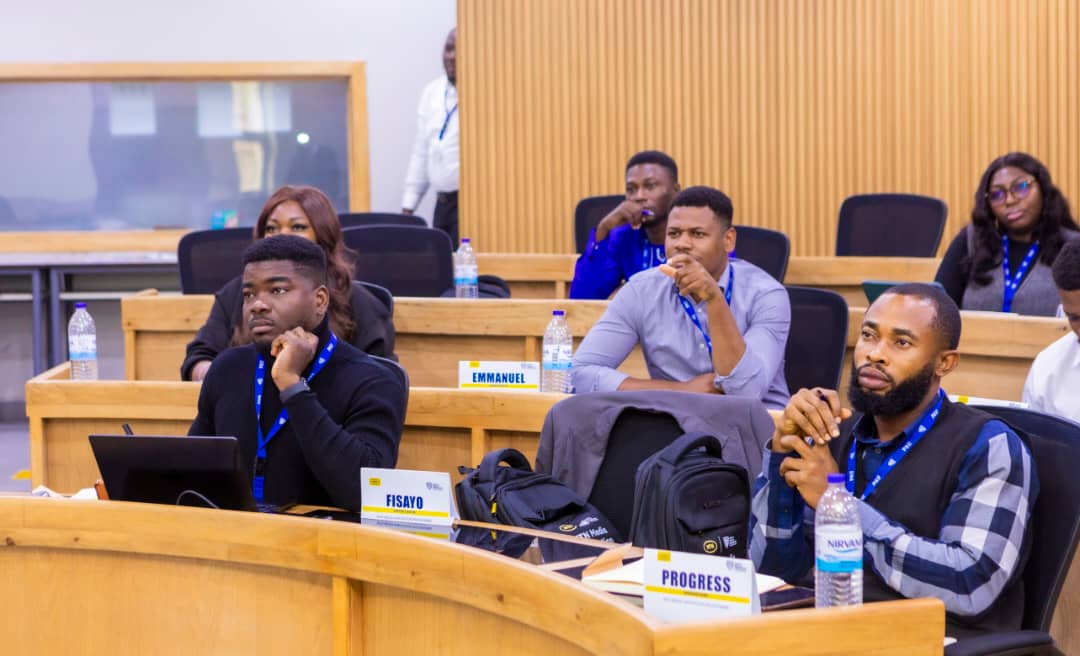
By Progress Godfrey
When I first received an email from the School of Media and Communication (SMC) at Pan-Atlantic University (PAU), informing me that I had been admitted as a fellow of MTN Nigeria’s Media Innovation Programme (MIP-5), Cohort 5, I knew a new journey had begun.
But I had no idea what to expect or where it would lead. I was simply excited. That excitement grew as congratulatory messages poured in from family, friends and colleagues. It slowly dawned on me that I had become part of something many had hoped for.
Soon, I was on a flight from Abuja to Lagos. Before long, I found myself among 25 finely selected media professionals drawn from print, broadcast, digital platforms and content creation, out of more than 6,000 applicants. We came from different newsrooms, backgrounds and experiences, but shared one thing in common: a desire to become better.
The MTN Media Innovation Programme (MIP) is a six-week executive fellowship delivered over six months for media professionals in Nigeria. The School of Media and Communication at Pan-Atlantic University serves as the academic partner delivering the executive fellowship. Through the programme, MTN Nigeria seeks to deepen participants’ knowledge, sharpen their skills and prepare them for a media industry that is constantly evolving through technology and innovation. For 2026, the programme started in May and would end in October.
SMC-PAU, where journalism is reimagined
At exactly 7:00 a.m. on Monday, 18 May 2026, a white Nissan Coaster rolled quietly through the streets of an exclusive estate in Lagos, picking up the 25 fellows for what would become a morning routine during each week of the programme. Each day began with conversations on the bus, some about politics, others about breaking news, while others simply admired the new reality of returning to school after many years.
I was fascinated.
Then came Pan-Atlantic University.
The first thing that struck me was not the impressive buildings or the neatly kept environment. It was the atmosphere – a young Gen Z population of students with something unique: everyone seemed driven by a quest for knowledge and skills to solve real-world problems.
There was an unusual sense of calm that made learning feel less like an obligation and more like a privilege.
As we resumed for the first week, the sessions unfolded in such a way that participants did not simply listen in silence. The classroom was designed for conversations. Every session invited questions, healthy disagreements and fresh perspectives. It did not matter whether you had spent two years or 20 years in journalism. Everyone had something to contribute, and everyone had something new to learn.
That, perhaps, was my first lesson at the School of Media and Communication.
Here, journalism is not presented as a finished profession. It is treated as one that must continually evolve. Every lecture challenged me to rethink what I already knew, question long-held assumptions and prepare for realities that many newsrooms are yet to identify.
One day, we are discussing creative and innovative thinking as media practitioners. Next day, it is the convergence of ICT and the media, artificial intelligence, entrepreneurship, how to develop a business plan, build a digital product, or understand 5G, IoT and the future of technology.
Every topic somehow returned to one central idea: journalism is changing, and journalists must change with it. Innovation, therefore, must be non-negotiable as media practitioners evolve.
What impressed me most is that the lecturers were not interested in teaching theory for theory’s sake. Almost every class connected academic ideas with real newsroom experiences, with technology often at the centre of the discussion. The conversations felt practical because those who lead them, whether facilitators from PAU, MTN or other professionals, brought real-world experience to the classroom.
Beyond the lectures, there is something else the school quietly taught me.
Respect.
Respect for time. Respect for ideas. Respect for people, regardless of title or experience.
Classes started as scheduled. Discussions were orderly. Different opinions were welcomed. You could challenge an argument without attacking the person making it.
Outside the classroom, learning continued. Sometimes it happened over lunch among colleagues. Sometimes on the bus ride back to the accommodation. Other times during dinner, where conversations from class continued long after the lectures had ended. Those informal moments became classrooms of their own, for me.
As the programme progressed, I realised that MTN Nigeria was using the fellowship for something deeper than teaching journalists new skills. It was helping me rediscover why I chose journalism in the first place and how to thrive through learning, unlearning and relearning, while leveraging technological innovation.
For me, that may well be the greatest lesson from the School of Media and Communication, Pan-Atlantic University.
It reminds me that journalism is not merely about breaking stories first. It is about understanding people, asking better questions, embracing technological and innovative change without losing my values, and recognising that learning never truly ends.
Perhaps that is what makes the experience memorable even while it is still unfolding. But long after individual lectures are over and notebooks are filled, what stays with me is a renewed way of thinking: the realisation that I can do more as a media practitioner.
Disclaimer
Comments expressed here do not reflect the opinions of Vanguard newspapers or any employee thereof.