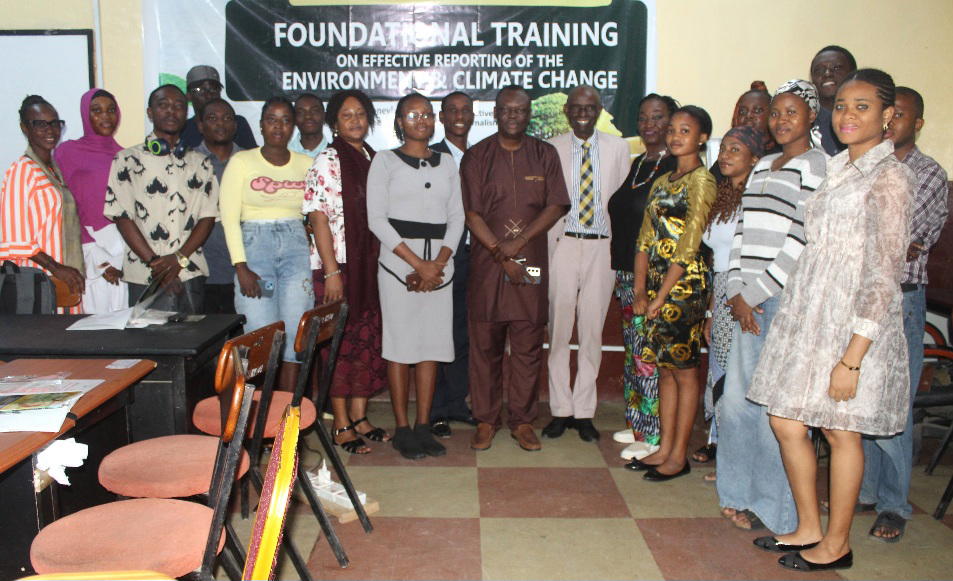
Environmental activists have emphasized the importance of giving trainee journalists hands-on experience through visits to environmental hotpots across Nigeria to complement classroom learning. They made the submission at the Foundational Training on Reporting the Environment and Climate Change organized by the Renevlyn Development Initiative in collaboration with the Nigeria Institute of Journalism (NIJ), Lagos.
The three-day event which ran from 18-20 August 2026 exposed 20 students of the NIJ to different topics on the environment and built a connection between them, the environment/climate justice community and impacted communities.
Philip Jakpor, Executive Director of RDI, in his brief on the partnership, said the initiative aims to advance a model of environment and climate reporting that can be inculcated into the tertiary curriculum of Nigerian institutions of learning.
Under the arrangement, the NIJ students will benefit from the RDI network of environment and climate activists who will be invited to speak with them and field visits to environment/climate hotspots across the country.
The inaugural training included classroom sessions and a field trip to Okun Alfa, a climate impacted waterfront community in Ibeju Lekki area of Lagos.
While delivering his welcome address, Provost of the NIJ, Mr. Gbenga Adefaye said that the training fills the gap in Nigeria’s education curriculum which emphasizes theory but does not include physical interaction or engagement of real-life situations in climate impacted or degraded communities.
Mr. Adefaye explained that Nigeria is beset with a host of environmental challenges including the drying up of Lake Chad which has displaced millions of farmers and local communities that depended on it in the 1960s. It has also led to clashes in other communities in central Nigeria where pastoralists and farmers moved to in order to survive the harsh realities.
He frowned at the excesses focus of tabloids on politics in the face of the enormous environmental challenges besetting the nation, even as he hoped that students benefitting from the training would turn the tide.
He also said the trainees are lucky to be trained by experts on ground, a development he said was not available for older generation of journalists..
The first presentation titled The Environment, Our Life was delivered by Philip Jakpor, executive director of RDI who defined the environment in simple terms, summarizing it as everything around mankind that cumulatively provides shelter, gives food and water and good health which in turn sustains life.
Jakpor said that mankind has not been a good steward of the environment but has instead polluted it through the current industrialization model that relies on fossil fuels, leading to sludge discharged into rivers and streams and vehicular emissions among others.
He argued that man continues to harm the environment by cutting of trees without replacement, production of single use plastics, and indiscriminate dumping of waste.
At the global level, he said that impacts are felt through rising temperature, melting glaciers and sea level rise, typhoons, forest fires and desertification among others.
For journalists interested in reporting or upscaling their knowledge of climate and the environment, he said they must avail themselves of educational opportunities such as the training so that they can contribute to addressing the challenges and sensitizing others.
Through in-depth reports journalists can also promote the practice of tree planting, adoption of environmentally-conscious lives e.g. reducing waste and cleaning our environment and limiting the use of plastics, reducing energy use and amplifying calls for sanctions for violators of the environment.
Development expert, Sam Orovwuje in his presentation on Climate Change and the Environment: The Role of Journalists in Reporting the Defining Story of Our Generation, defined the concepts on climate change and environmental degradation, identified the causes of climate change and also pointed at career paths open for the trainees within the environment/climate space.
Orovwuje drew the attention of the trainees to flooding in Kogi, Bayelsa and Lagos, desertification in northern Nigeria, coastal erosion in the Southwest and the heat stress in urban areas, that are largely unreported or not properly situated.
He emphasised the importance of ethical reporting and accuracy which, according to him, makes the writer stand out, concluding with an exercise centered on a pledge by the trainees to embrace hard work and ethical standards.
Barrister Chima Williams of the Environmental Defenders Network (EDEN) delivered a lecture on Extractive Governance, explaining to the trainees that oil and gas are addictive and have devastating footprints. He pointed out however that the often overlooked sand mining in different communities across the country are also issues that escape the lens of journalists and deserve reporting.
In her intervention on Desertification, Faith Nwadishi, Executive Director of Center for Transparency Advocacy explained that most practising journalists enter the field with limited grounding in the science, politics and human stakes of the issues, sometimes producing reporting that are thin, occasionally inaccurate, and unable to move public debate toward solutions.
Nwadishi argued that desertification sits at the intersection of food security, migration, farmer–herder conflict, gender inequality and public finance; fertile, and therefore stands as an under-reported ground for rigorous journalism.
In defining desertification, she said it is essentially land degradation in arid, semi-arid and dry sub-humid areas resulting from climatic variation and human activity — the United Nations Convention to Combat Desertification (UNCCD) definition.
She also used the opportunity to differentiate four terms that are usually confused by journalists. They include drought, land degradation, desertification and coastal erosion, pointing out that drought is a temporary, natural shortage of rainfall which can trigger desertification, but the two are not synonyms.
She also revealed that 11 states of the north are experiencing desertification, adding that 43 percent of Nigeria’s landmass is affected by desertification, 350,000 hectares lost yearly and 40 million livelihoods at stake.
Anthony Oligbo , Lecturer at the NIJ who delivered a presentation on Deforestation, explained that it is caused by the conversion of forest to other land use independently of whether it is human-induced or not.
He said that it is the large-scale removal or destruction of trees and forests, usually caused by human activities such as farming, logging, construction, mining and urban development, leading to the loss of forest resources, wildlife, habitat biodiversity, and environmental balance.
Anthony Akpan, President of the Pan Africa Vision for the Environment (PAVE) took the participants on The Waste Challenge, explaining the concepts of organic waste and their types, sources of organic waste, data on organic waste generated by households, Organic waste and methane emission, and Methane Emissions from Landfills in Nigeria and Lagos.
Akpan told the participants that while governments expend huge sums on recycling, environmentalists would rather advocate for waste reduction and reuse in view of the huge energy cost and toxic chemicals emitted into the atmosphere in the recycling process.
On methane emission from Lagos dump sites, he recommended proper management to turn it into compost to enrich soil and grow food.
He also queried the Lagos State Government waste management system that lumps all wastes together thereby making waste management a burden. Instead, he proposed sorting and segregation at the home front through different waste bins to make waste management more effective.
Mfreke Asigbe, Executive Director of Cypress Global Health made a presentation on Environmental Impacts on Women, focusing on how climate change, extreme weather, and environmental degradation reshape health, safety, and dignity for women and girls — and what journalists can do about it.
She particularly highlighted the fact that women manage children, the sick, and the elderly – work that intensifies, not pauses, during disasters, adding also that pregnancy, childbirth, and menstruation create time-sensitive health needs that heat, floods, and displacement can directly disrupt.
Rachel Greenwood, a Human Rights & International Development Professional made a presentation on International Treaties and Agreements on Climate Change.
Greenwood’s intervention kicked off with an assessment of the trainees understanding of climate and environment happenings at the global stage.
She explained that the discourse on the global stage is important because it determines to a large extent the actions that different countries adopt in addressing climate change.
She took the trainees on memory lane to the foundations of global cooperation and actions on the environment and climate change, which started with the Stockholm Conference in 1972 and the birth of the United Nations Environment Programme (UNEP). 20 years after there was the Rio Declaration in 1992, and then the Kyoto Protocol in 1997 and then the Paris Agreement of 1995 which has continued to be the roadmap for climate change discourse.
She encouraged the trainees to interrogate Nigeria’s progress in implementing its Nationally Determined Contributions (NDCs) as the yardstick for measuring the country’s commitment to addressing the climate crisis.
Deputy Clerk and Permanent Secretary, Lagos State House of Assembly, Dr. Olaosebikan Olajuwon delivered a lecture on Environmental Laws in Lagos, and Paul Ashibel, an Abuja-based Communications Consultant dwelt on Digital Platforms for Reporting Climate Change/The Environment.
Ashibel was particular about adhering to facts in reporting environmental issues. He also encouraged the trainees to be intentional in their pick of platforms for amplifying stories and pictures. Some of the platforms he recommended are Instagram, Facebook, X , Instagram and Tok Tok.
Disclaimer
Comments expressed here do not reflect the opinions of Vanguard newspapers or any employee thereof.