By Osa Mbonu-Amadi
When you stand before a king, be slow to speak, but quick to listen and hear. In Temitope Ogunseitan’s OBA, the King speaks words that reveal things of the distant past, the present, and the future, making your own story unfold as you watch.
Ogunseitan’s OBA is not a distant, mystic figure existing in classic texts, but something more present and captivating. The artist repositions the accumulated wealth of wisdom and traditions that have survived generations, highlighting how African migrants turn displacement into belonging, diverse experiences into identity, and heritage into a living art form.
That is the territory the multidisciplinary artist and designer operates in. Ogunseitan, who studied General Art at Yaba College of Education, also trained as an intern with the animation company Sporedust, where he honed his skills in digital painting, illustration, and 3D animation. His early artistic journey began in Lagos, Nigeria, where he first explored creativity through depictions of historical events and real-life experiences. As an innovative art creator, he redesigns and recreates art into fascinating new forms that collectors gladly seek and acquire.
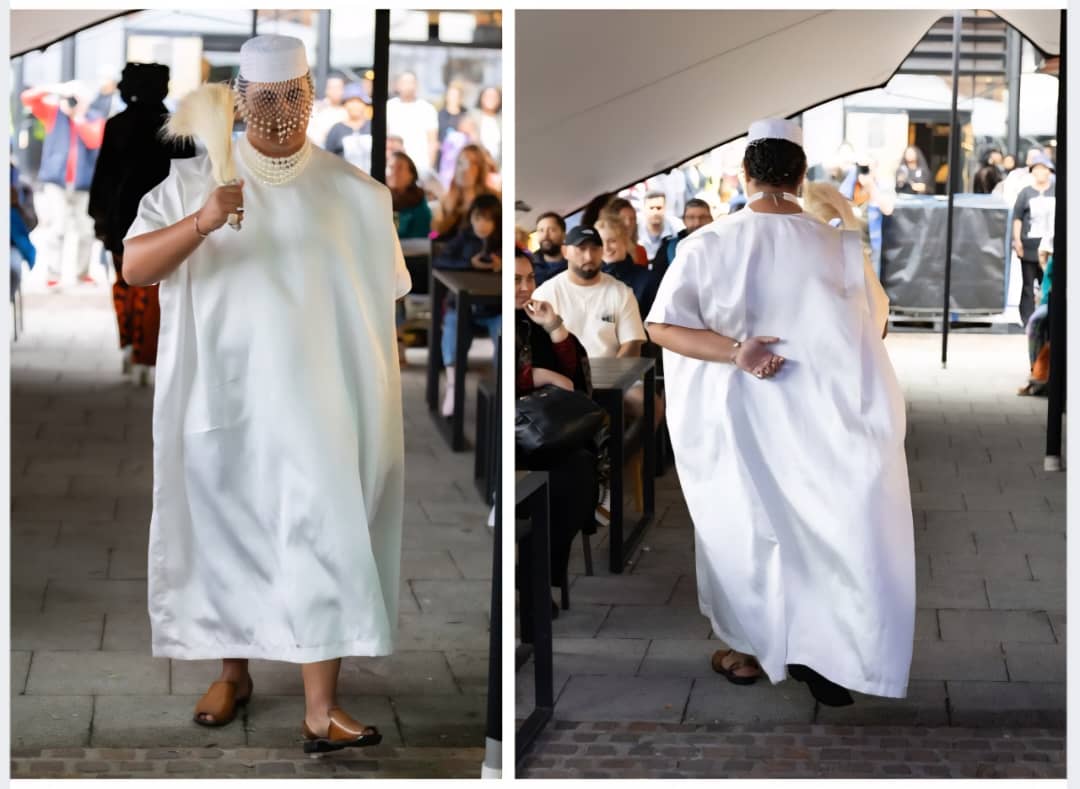
Ogunseitan’s expansive skillset and distinct vision converge in OBA, “The Walking Canvas”, a reimagining of Obatala, the first king who descended from a divine realm to govern the human race. In addition to being a ceremonial, cultural, and traditional display, the art piece is a resplendent figure whose costume and carriage wow audiences. OBA is an artistic narrative presented in fabric and pearls. It mirrors a spiritual journey that transcends generations.
Every fold of OBA’s white cloth conveys the essence of purity and order. The adornments radiate the quiet authority of a powerful angelic figure heralded as a harbinger of peace, order, and beauty.
Ogunseitan’s OBA, exhibited at the Butetown Carnival (2024) under the theme “Afro-Futurism” graphically transforms ancient cosmology into a striking statement of identity and present social reality in contemporary arts. Rooted in Yoruba tradition, the work speaks to a heritage that has travelled distances, evolving along the way. Ogunseitan’s present artistic expedition draws from a belief system where deities play active roles in shaping the lives of their adherents. The creative process aestheticises through the representation of ancient symbols and figures in the cultural landscape of modern Welsh society.
Every element of this work, from the colour palette to its accessories, was deeply researched and presented by the artist. Obatala’s regal presence is captured via the innovative artist’s vision, indicating that his creative practice is a product of years of formal training, exposure to technical depth, and grounded knowledge of the subject matter he masterfully explores.
Layers of meaning in this masterpiece are unveiled via colours, as in the use of white to signify clarity and purity. Traditionally recognised as Obatala’s colour, “white” signifies clarity, wisdom, and sacredness, while the fan, “irukere” is an emblem of authority and protection. With its intricate pearl work and striking veil, the “irukere” is a blend of traditional beading and futuristic aesthetics that goes beyond decorative curation as it defines details and adds extra layers to the story. The connection between the historic past and the diasporic present shows that culture travels. It also turns ancestral memory into new art, music, and stories, sustaining identity across borders and conveying the message: Home is a culture one carries about.
In Yoruba mythology, Obatala is the perfect embodiment of the creator, who fashioned humanity from clay. With the title “The Walking Canvas”, the artist relates this message. In Ogunseitan’s art, Obatala’s figure is portrayed as a caring majestic entity in charge of creation. Besides the integration of African culture with that of the host community in the United Kingdom, the artwork depicts the wisdom of the ancestral king in shaping humanity and ordering communal existence.
The story of Obatala is one of purpose, responsibility, and history. Ogunseitan depicts the deity as a forerunner whose purpose as a creator of human potential includes establishing social order. The art piece also captures diasporan traditions, illustrating how African migrants adapt in their settlements by redefining the socio-cultural setting while retaining their core essence.
The Obatala figure as portrayed in Ogunseitan’s OBA is the metaphor for the experience of African migrants in Wales. The diasporan community embodies ancient truths which add to the cultural fabric of host communities, a fabric constantly reshaped by the infusion of visiting cultures.
The narrative power of this piece lies in the dignified, serene, and mystic presence of the subject Ogunseitan artistically visualises, stressing the place of honouring, belonging, and identifying with one’s cultural heritage irrespective of where one resides. The artist masterfully uses art to transform history into an epic movie, showcasing identity, culture, and ancestral wisdom.
Disclaimer
Comments expressed here do not reflect the opinions of Vanguard newspapers or any employee thereof.