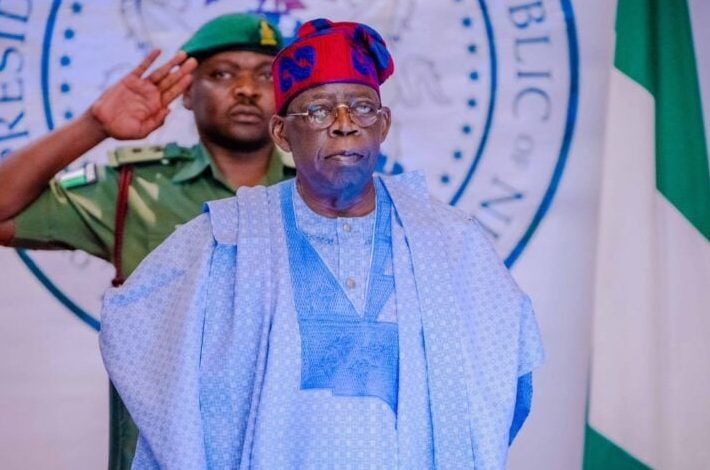
File: President Bola Tinubu
lTo spend N49.39trn on capital projects, recurrent gets N43.45trn lLagos, Delta, Ogun, Enugu, Imo, A/Ibom emerge as top spenders ***Ekiti, Yobe, Ondo, Nasarawa, Adamawa’re least spenders
***Lagos budget higher than entire N/East zone; 5 S/West
***How zones fared lS/East, N/West lead in allocations to capital projects
****Rivers, Borno, FCT yet to announce budgets
By Clifford Ndujihe, Politics Editor
LAGOS — TO fight hardship and improve the fortunes of Nigerians in 2026, the Federal Government and 34 of the 36 states of the country have proposed N92.979 trillion as budgets, next year.
Rivers State, Borno and the Federal Capital Territory, FCT, Abuja, are yet to announce their budgets.
The N92.979 trillion is higher than the N78.411trillion that the Federal Government, 36 states and the FCT spent in 2025. And the appropriations could be more, by the end of 2026, as the Federal Government and most of the states’ proposals are yet to be passed by the various legislatures. There is also the likelihood of supplementary budgets.
In 2025, while the Federal Government revised its budget to N48.316 trillion, the 36 states budgeted N28.285 trillion, and the FCT had N1.81 trillion.
Plans for 2026
According to Vanguard’s tally of the various budgets, the sum of N49.39 trillion or 54.10 per cent would be spent on capital projects while recurrent expenditures were allocated N43.454 trillion(45.90 per cent).
Indeed, all the 34 states whose cumulative budget is N34.509 trillion, allocated more funds to capital expenditure except Ekiti, and the Federal Government.
Of its N415.572 billion budget, Ekiti allocated N193.699 billion to capital projects, and N221.871 billion to recurrent expenditures.
At the centre, the Federal Government unveiled a N58.47 trillion proposal made up of N32.37 recurrent expenditure and N26.08 trillion capital expenditure.
The recurrent budget among others consists of N15.52 trillion(debt servicing) and N15.25 trillion(non-debt). And the capital expenditure include N5.41 trillion (Defence and Security), N3.56 trillion (Infrastructure), N3.52 trillion(Education) and N2.48 trillion(Health).
Heavy spenders
Among the states, Lagos, the economic nerve centre of the nation is the only multi-trillionaire with her N4.237 trillion budget. This is higher than the combined budgets of the six states of the North-East geo-political zone(N3.248 trillion). Lagos budget is also more than the combined budgets of the other five South-West states(N4.228 trillion). It is lower than North-Central’s N4.620 trillion by N382 billion.
Other states that proposed trillion naira budgets are Delta(N1.729 trillion), Ogun(N1.669 trillion), Enugu(N1.62 trillion), Imo(N1.439 trillion ) Akwa Ibom(N1.39 trillion), Kano(N1.368 trillion), Niger (N1.072 trillion), Abia(N1.016 trillion), and Bayelsa(N1.01 trillion).
Low spenders
The low budget states are Ekiti(N415.572 billion), Yobe(N515.1 billion), Ondo(N524.41 billion), Nasarawa(N545.182 billion), Adamawa(N583.32 billion), Benue(N605.51 billion), Gombe(N617.953 billion), Kebbi(N642.9 billion), Kwara(N644.004 billion), and Taraba(N653 billion).
Moderate spenders
In the league of moderate spenders are Kaduna(N985.9 billion), Cross River(N961.624 billion), Edo(N939.85 billion, Plateau(914.863 billion), and Jigawa(N901.84 billion).
Others are Katsina (N897.865 billion), Oyo (N891.99 billion), Ebonyi (N884.868 billion ), Bauchi (N878.15 billion ), Zamfara (N861.2 billion), Sokoto (N758.701 billion ), Anambra (N757.9 billion) and Osun (N723.454 billion).
Of the 34 states, only four – Ekiti, Ondo, Akwa Ibom and Niger have proposed lower budgets than what they spent in 2025.
How the zones fared
Among the zones, the South-West came tops with N8.465 trillion and the least is North-East(excluding Borno) with N3.248 trillion.
The others are North-West (N6.417 trillion), South-South without Rivers (N6.031 trillion), South-East(N5.720 trillion), and North-Central (N4.620 trillion).
Capital projects allocation
In terms of allocation to capital projects, South-East is leading other zones by proposing to spend N4.658 trillion(81.43 percent) of its N5.720 trillion on capital expenditure.
The North-West allocated more funds to capital projects. However, its N4.802 trillion is 74.83 per cent of the N6.417 trillion budget.
The other zones’ allocations to capital projects are South-West-N4.642 trillion(54.84 per cent), South-South-N4.164 trillion(68.97 per cent), North-Central-N2.90 trillion (62.77 per cent), and North-East-N2.14 trillion(66.13 per cent).
Will 2026 budgets make impact?
While presenting the budget bills before the lawmakers, each of the governors promised to implement the budgets in a way that would address the socio-economic pains of the citizenry. This is one of the reasons they gave the budgets lofty titles and themes such as Lagos – Budget of Shared Prosperity, Taraba – Budget of Demonstration, Ondo – Budget of Economic Consolidation, Delta – Budget of Accelerating MORE Agenda, Abia – Budget of Acceleration and New Possibilities, and Akwa Ibom – People’s Budget of Expansion and Growth.
Others include Anambra’s Changing Gears 3.0: Solution continues, Oyo – Budget of Economic Expansion, Cross River – Budget of Inclusive Growth, Imo – People’s Oriented Budget, Ekiti – Budget of Sustainable Governance, Ogun – Budget of Sustainable Legacy, Osun – Budget of Economic Transformation, Nasarawa – Budget of Strategic Consolidation, Bayelsa – Budget of Assured Prosperity and Zamfara – Budget of Stability and Growth. At the federal level, President Bola Tinubu told a joint session of the National Assembly that his N58.18 trillion budget, which the lawmakers made N58.47 trillion seeks to lock in recent macro-economic gains, restore investor confidence and translate recovery into jobs, and improved living standards for Nigerians.
Describing the 2026 appropriation bill as ‘Budget of Consolidation, Renewed Resilience and Shared Prosperity,” President Tinubu said the task ahead is to ensure that “stability becomes prosperity, and prosperity becomes shared prosperity.”
With 139 million Nigerians living below the poverty line or on N376.50 per person a day according to the baseline of the Nigeria Bureau of Statistics, NBS, and given past trends of poor budget implementation, it is to be seen if the pledges and assurances of the president and governors will translate to better fortunes for Nigerians in 2026.
Disclaimer
Comments expressed here do not reflect the opinions of Vanguard newspapers or any employee thereof.