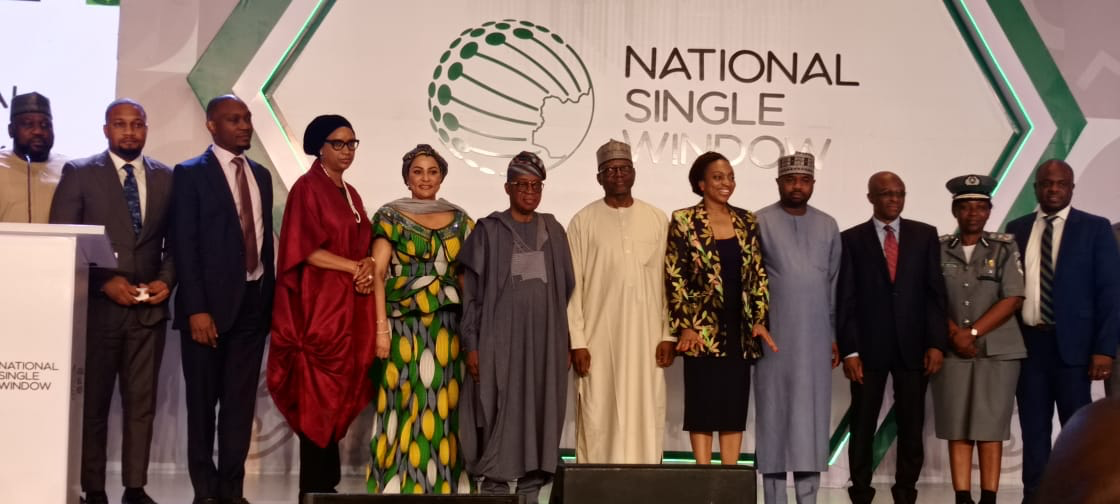
…says Nigeria to get N3 billion dollars annual returns if implemented
By Evelyn Usman
In its determination to achieve its ambitious goal of a $1 trillion economy by 2031, the Federal Government yesterday, disclosed that it was set to implement the National Single Window project, expected to generate $3 billion in annual revenue, this year.
The project, according to stakeholders and industry experts who converged at the Marriott hotel, Ikeja Lagos, for a three-day forum themed ‘Shaping the Future of Nigeria through seamless trade facilitation to explore the transformative potential of collective action;, asserted that if implemented, the project, which was launched by President Bola Tinubu in April 2024, would eliminate bureaucratic delays in export and import processes, as well as enhance trade efficiency and economic growth.
Highlighting the potential of the project if successful, the Minister of State for Finance, Doris Uzoka-Anite, said “I know that this is going to give us a minimum of $3 billion annual returns, that is annual revenue generation. And as our trade grows, we intend to become a transshipment nation which means we will become like the Singapore and the Dubai of this world, in Africa. So we can actually process and facilitate trade in Africa.”
She described the project as a cornerstone of modern trade facilitation that represents a significant leap forward in the nation’s journey towards becoming a global trade hub.
In his remarks, Executive Chairman, Federal Inland Revenue Service, FIRS, Dr. Zacch Adedeji, lamented that for too long, Nigeria’s trade facilitation processes had been hampered by a complex web of bureaucratic hurdles, characterized by cumbersome and inefficient procedures, which has led to delays at the ports, increased costs of doing business, and a substantial erosion of Nigeria’s competitiveness in the global marketplace.
This, he noted, “has resulted in substantial revenue losses to the country, reduction in foreign direct investments, and hindered the full realization of our nation’s economic potential.” “I believe that by establishing an integrated platform that seamlessly connects all critical actors – seaports, airports, free trade zones, government agencies, financial institutions, and the private sector – we are set to revolutionize the way we conduct international trade.”
Corroborating Adedeji’s position, the Minister of Industry, Trade, and Investment, Dr. Jumoke Oduwole, asserted that the establishment of a National Single Window system for trade processes in Nigeria was not merely a policy objective but a transformative reform that would redefine the way trade would be conducted across the nation’s borders.
Disclosing that its implementation would begin this year, she explained that the project would also provide a centralized digital platform for traders to submit, process, and access trade-related documentation, thereby eliminating corruption through improved transparency, as well as reducing administrative burdens, and enhancing the ease of doing business in Nigeria.
Declaring that the time to act is now, Oduwole highlighted the important elements required to get the project right to include “Strong political will, buy-in, and leadership, disciplined execution – phased implementation with clear performance targets and monitoring mechanisms; strategic communication on the project milestones, achievements, challenges, and delays; adoption of global best practices and aligned standards (WTO, WCO, UNCTAD), reprioritization of service delivery, and robust change management by MDAs”.
In his keynote address, the Minister of Marine and Blue Economy, Adegboyega Oyetola, noted that the cost of doing business at Nigerian ports was up to 40% higher than in other West African countries due to delays and administrative bottlenecks.
This he said leads to an estimated annual revenue loss of ₦2.5 trillion within the business community, as highlighted by the World Bank.
However, he expressed optimism that implementing the Single Window System could enhance efficiency, potentially reducing these costs by at least 25%.
According to him “By streamlining operations, improving transparency, and minimizing delays, the system drives cost savings and strengthens overall trade facilitation. The cumulative impact across all areas, including reduced costs, enhanced efficiency, and greater transparency, ultimately contributes to the overall ease of doing business.
“The executive decision to implement the National Single Window system alongside the Port Community System, led by the Ministry of Marine and Blue Economy through the Nigerian Port Authority, marks a pivotal step in this direction. This demonstrates the government’s commitment to modernizing trade processes and maximizing the utilization of our marine resources.
“Nigeria’s marine and blue economy represents an untapped gold mine of opportunities. It encompasses a vast spectrum of activities – from maritime shipping and fisheries to renewable energy and coastal tourism. With an expansive coastline of 853 kilometers and a maritime area of over 46,000 square kilometers, our nation is strategically positioned to leverage these resources for sustainable economic growth. The marine and blue economy holds immense potential to contribute significantly to our GDP, create thousands of jobs, and drive regional and global trade.
“Despite its immense potential, the marine and blue economy faces challenges, including inefficiencies in port operations, bureaucratic obstacles, and insufficient coordination among stakeholders, which have impeded its growth. Addressing these challenges requires an efficient, integrated, and secure logistics ecosystem – a goal that the National Single Window system is poised to enable,” the Minister of Marine and Blue Economy stated.
On her part, Special Adviser to the President on Policy Coordination, Central Coordination Unit, Hadiza Bala, called for a buy-in of the project by all government agencies.
She said, “There is need to ensure full compliance from all government agencies. We must prevent agencies from finding loopholes to avoid complying with digital requirements, including political aspects. Our staff must receive proper training and ongoing education on the necessary details.
“Let’s also study how other countries have implemented single windows ,to learn from their experiences. Achieving these goals is crucial for Nigeria to become a business-friendly country, leveraging technology for seamless and efficient trade facilitation in our ports system.”
Earlier in his welcome remark, the Director of the National Single Window, Mr. Tola Fakolade, highlighted the objectives of the three-day forum to include learning more about the project, its features, and benefits
He said, “It is important for all of us to have the right understanding of the benefits of a single window and why we are doing this. It is also very important to make sure that we all understand what we want to deliver and our end result. We will also use this forum to update the team and everybody here about the progress that has been made so far since the time Mr. President inaugurated this project. We also want to share the outlook: what is our plan, what do we plan to deliver over the next 12 months?
“And lastly, which I think is the most important, is that all our key stakeholders are here, both from the public and private sectors. It is important to listen to them and get feedback for the project team, so that as we go through the stages of implementation of this project, we can make sure that everybody, all the key stakeholders, are carried along.”
Disclaimer
Comments expressed here do not reflect the opinions of Vanguard newspapers or any employee thereof.