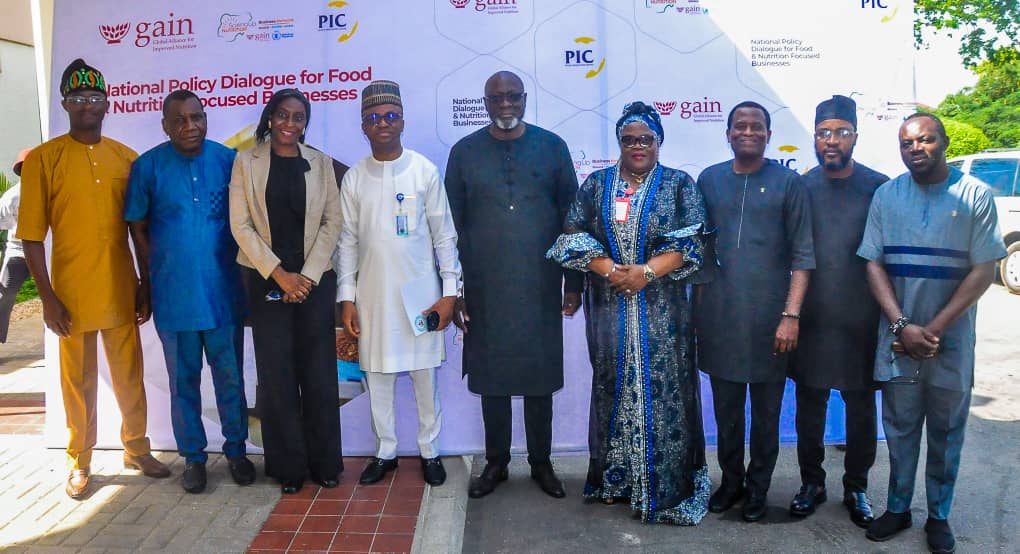
Dr. Kingsley Uzoma Senior Special Assistant to the President of Nigeria on Agribusiness and Productivity Enhancement · Office of the President of the Federal Republic of Nigeria (middle) with country Director of GAIN Nigeria, Dr. Michael Ojo flanked by other participants at the workshop in Abuja.
By Emmanuel Elebeke – Abuja
Enabling food and nutrition-focused businesses is fundamental to improving the availability of safe, nutritious, and affordable food for all Nigerians. To achieve this, stakeholders from across Nigeria’s food and nutrition ecosystem gathered at the Abuja Continental Hotel for the National Policy Dialogue on Food and Nutrition-Focused Businesses.
Organized by the Scaling Up Nutrition Business Network (SBN) Nigeria, in collaboration with the Global Alliance for Improved Nutrition (GAIN), the event aimed to catalyze policy reforms for regulatory compliance and financial access, enhancing the private sector’s impact on nutrition.
Themed Address: “Catalyzing Policy Reforms for Regulatory Compliance and Financial Access: Enhancing Private Sector Impact on Nutrition”, the event Identify critical pathways to empower nutrition-focused Micro, Small, and Medium Enterprises (MSMEs).
In his opening address, Dr. Michael Ojo, Country Director of GAIN Nigeria, emphasized the need for policy-driven support to enhance the private sector’s impact on nutrition. This, he said aligns with Nigeria’s commitment to transformative food systems action, as evident in its delivery of a pathway for food systems transformation.
The event spotlighted the importance of policy reforms in promoting regulatory compliance and financial access for nutrition-focused MSMEs.
By fostering a supportive policy environment, Nigeria can unlock the potential of its food and nutrition ecosystem, ultimately improving the availability of safe and nutritious food for all citizens.
The keynote speaker, Dr. Kingsley Uzoma from the Office of the Vice President of Nigeria, underscored the importance of nutrition in nation building.
He noted that “as of 2023, Nigeria has one of the highest rates of malnutrition globally, with over 6 million children suffering from acute malnutrition.
According to him, “For many families, especially the most vulnerable, access to safe, nutritious, and affordable food remains elusive.”
Uzoma listed economic pressures, inflationary shocks, and rising production costs as some of the barriers inhibiting the efforts of nearly 39 million Micro, Small, and Medium Enterprises (MSMEs), which he said form the backbone of Nigeria’s food supply chain and called for their support.
On what the government is doing, he outlined several government policies aimed at reversing these trends, including the National Food and Nutrition Policy, the Micronutrient Deficiency Control Program, and the upcoming Food Safety and Quality Bill.
in his submission, Prof. Kola Anigo, who decried high level of deprivation and poor food and nutrition intake in Nigeria said there is need for government and the people to sign a social contract on provision of basic amenities such as food and subsidies as obtains in other climes. “We need to lobby for government not to change policies for up to 2-3 years, government need to be committed to the people”
Another speaker, John Paul Iwuoha said, financial accessibility is a major challenge for MSMEs in the sector and called for cluster financial as a remedy to food producers.
“We need to derisk the food and nutrition sector to attract financing and help private sector connect the dots and cross the ts. Farmers on the other hand need cluster funding to access funds.
This we can do by adopting a grassroot approach to funding challenge.”
Discussions throughout the day focused on how these policies could further support private sector contributions to nutrition by addressing the regulatory and financial barriers faced by businesses in the sector.
He also hinted on an upcoming Food Safety and Quality Bill which he said will provide a unified framework to ensure food safety and quality, protecting public health by ensuring all foods meet safety standards.
“These policies reflect Nigeria’s commitment to improving nutrition through agricultural support, food fortification, and food safety. They also highlight the importance of collaboration with the private sector to encourage locally sourced, nutritious foods that are affordable and accessible.”
To turn Policy Into Action for a Healthier Nigeria, he said Policies advancing nutrition need champions, government leaders, business executives, and community advocates, who are united in building a food system that promotes both health and prosperity.
He however, encouraged all stakeholders, government, private sector, and civil society to work together to ensure that all public policies build a foundation of health and nutrition for all Nigerians.
The dialogue also explored the potential of the Enabling Business to Advance Nutrition Index (EBANI) tool, developed by GAIN and SBN, which provides insights into the policy landscape affecting food and nutrition-focused enterprises in Nigeria.
“By leveraging insights from EBANI, we aim to identify key policy reforms that can catalyze financial access and regulatory support for nutrition-focused businesses across the country,” said the GAIN Country Director.
The event concluded with calls for strengthened public-private partnerships and actionable policy changes that will enable MSMEs to provide safer, healthier food choices for Nigerians. Stakeholders reaffirmed their commitment to work together to build a supportive environment that prioritizes public health through resilient, nutrition-focused business practices.
The National Policy Dialogue on Food and Nutrition-Focused Businesses marked a significant step towards empowering nutrition-focused MSMEs in Nigeria.
By catalyzing policy reforms and fostering collaboration among stakeholders, Nigeria can create a supportive environment for its food and nutrition ecosystem, ultimately improving the health and well-being of its citizens.
Disclaimer
Comments expressed here do not reflect the opinions of Vanguard newspapers or any employee thereof.