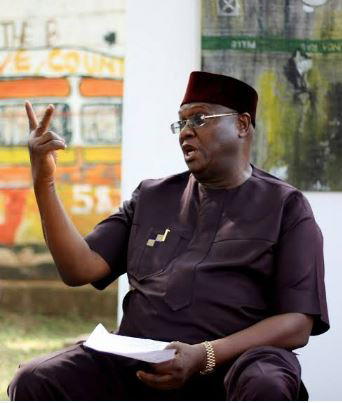
Bothered by Nigeria’s unappreciative stance to art, artistic expression and artists, celebrated art patron and Nigeria’s largest art collector, Prince Yemisi Shyllon has given insights into how he would preserve his legacy as an art collector.
The eminent art collector made this known while responding to questions from the panel and audience of the Toyin Falola interview series held on Sunday, January 15, 2023, led by African historian and celebrated academic and university administrator, Professor Toyin Falola. The panel included Professor Peju Layiwola, Professor Dele Jegede, and Victor Ekpuk.
Prince Shyllon is currently Nigeria’s largest private art collector, with over 7,000 artworks of sculptures, paintings and other media, as well as over 55,000 photographic shots of Nigeria’s cultural festivals. The art works in his collection are dated from as early as the 9th century and as late as the 21st century. They include the works of both early and later Nigerian artists, such as Aina Onabolu, Akinola Lasekan, Ben Enwonwu, Okaybulu Eke, Nike Davis-Okundaye, Charles Shainumi, Okpu Eze, Clary Nelson Cole, Kolade Osinowo, David Dale, Simon Okeke, Isiaka Osunde, Abayomi Barber, Olu Amoda, El Anatsui, Ben Osawe, Bruce Onobrakpeya, Lara Ige-Jacks, Susanne Wenger, Theresa Akinwale, Uzo Egonu, Jimoh Akolo, Lamidi Fakeye, Uche Okeke, Erhabor Emopkae, Kunle Filani, Tola Wewe, Yusuf Grillo, Adeola Balogun, Olawunmi Banjo and Oresegun Olumide. His collection also includes art from other African Countries like Senegal, Cameroon, Togo, Ghana and South Africa. Paintings of artists from other continents such as Salvador Dalí and Simon Bull are also housed in his collection.
According to Shyllon, “Collectors need to be wise. When you want to collect for members of your family or yourself, you must realize that art works have very limitless life but human beings have limited life. My first attitude which made me get interested in establishing a private museum is the fact that I have a finite period on earth and my children also have a finite period on earth. I wanted to take a lesson from others who have done great things in life. That is why I set up the museum with a view to ensuring that even when I am gone and my children are gone, and my grandchildren are gone, the works of great artists who lived in my time and before my time would continue to be preserved for the good of humanity.
“I have three children. The first one who is a medical doctor is very much in love with arts. She collects her own work of arts. That is why in the draft agreement that I had with the Pan Atlantic University, I made her an alternate member of the museum supervising council. This is so that she can begin to learn the goals that her father intended. But majority of the works are outside the museum. I am already thinking and talking to the right people to ensure that my home in Lagos and the collections do not go the way they had gone with the other collectors before me. These were people who have died and had their collections lost. I am already discussing with corporate entities to ensure that there is a lot of preservation of my space and art works when I am gone. This is such that people will come and enjoy the space and art works without necessarily calling it a museum.
“I brought up my children in such a way that they are not dependent on me, nor I dependent on them when I am old. I gave them the best education in the world. They grew up knowing full well that they have to provide for themselves. They are very okay. If the others have an interest like my first child does, they will continue and ensure that whichever corporate entity is given the privilege of possession will be controlled by my children. They will be controlled to ensure that my legacy lives on.”
In response to one of the questions of Professor Toyin Falola, the chief panelist, on the perception of art being a profession that is less appreciated, Shyllon argued that: “Every human endeavor is a pyramid. At the beginning, we start at the base. It involves a lot of reading, exposure, critical analysis, mentoring will make the big difference. It is normal that when you have ten people graduating from the university in any course, they cannot all be successful. But the ones that are going to be successful are those who take their career and profession very seriously. They know that they have to make sacrifices and are not only pursuing money. Money is just a means of exchange. What you gun for is self esteem. We should aim at recognition which is the upper level of Maslow’s theory. We should aim at self-actualisation and not the physiological and security needs of man.”
Reacting to the relevance of Nigeria’s Ministry of Information and Culture in the preservation of art, Shyllon insisted that something urgent must be done to up the nation’s commitment to art. For him, “Our Ministry of Information and Culture is not doing enough in orientating Nigerians about their culture. Rather they are allowing religious houses to usurp and manipulate the minds of the people. It is for us as both leaders and followers to re-orientate ourselves. One of the ways I have intervened is that a friend of mine who owns the Yoruba cultural centre in Dallas in the United States invited me to be a patron. I funded their last cultural festival. In that centre, they teach the children of those in the diaspora the elements of Yoruba culture: our drums, our language which is fast being de-emphasized. The owner of this cultural centre in Dallas is not only an artist but also a surgeon and author. He is Dr. Oladele Olusanya. A governor visited me and I told him to reintroduce teaching of Yoruba language and culture. He did partially. He introduced it in primary school but not at the university nor teacher training institutes. Who then will teach this?”
The interaction featured eminent art collectors, patrons, enthusiasts and academics from across Africa and beyond.
Disclaimer
Comments expressed here do not reflect the opinions of Vanguard newspapers or any employee thereof.