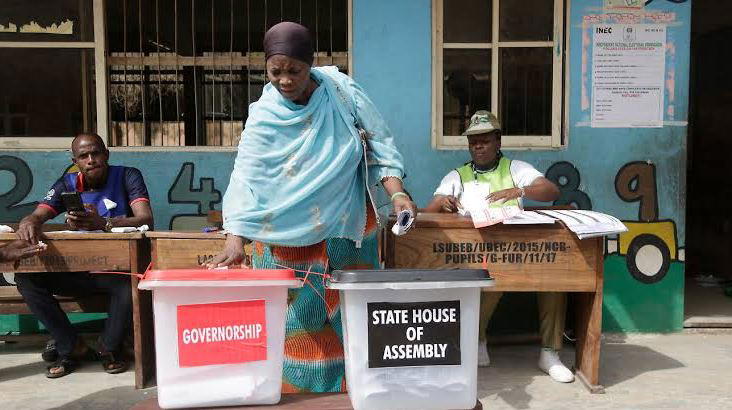
Nigeria’s Federal Government has been called upon to create the needed electoral environment to ensure better participation of women and youths in the forthcoming general election in 2023, just as this would aid better representation of various sections of the country in governance.
This charge was given by a team of panelists at the last edition of the Toyin Falola Interview Series held on Sunday, May 22, 2022, and aired on various social media platforms. The panel was chaired by Professor Toyin Falola. An African intellectual legend on both the continent and in the world, Falola is the Jacob and Frances Sanger Mossiker Chair in the Humanities and University Distinguished Teaching Professor at the University of Texas at Austin.
While the panel—consisting of Dr. Hussaini Jibrin, a senior lecturer at the Nigerian Defence Academy (NDA), Kaduna, Nigeria; Dr. Abiola Akiyode-Afolabi, chairperson, Transition Monitoring Group and the founding Director of Women Advocates Research and Documentation Center (WARDC); Dr. Chido Onumah, currently the coordinator of the African Centre for Media & Information Literacy (AFRICMIL), Abuja, Nigeria; and Miriam Oke, an Associate Editor at the Pan-African University Press—touched on various issues such as electoral violence, money politics, absence of ideologies in the nation’s political space, insecurity, Dr. Akiyode-Afolabi, Dr. Onumah and Oke harped on the need to improve better women and youth participations in the coming general election.
According to Dr. Akiyode-Afolabi, “The issue of underrepresentation of women in the political space in Nigerian has been on for a long time. We have countries like Rwanda where women have been able to reach about 62 per cent in parliament. There are developments in places like Kenya, South Africa where we have seen increase in the number of women representation. There are several ways to this come-by. In some parts of the world it is the political parties that would take the step to ensure that they enlarge the space for women to be able to participate and then increase their number. In some places, it is through the law. In Nigeria, there was an attempt in the last electoral review to allow for that expansion in the political space but it never happened. Looking at the patriarchal nature and the cultural, religious beliefs in the country, it would be very difficult to increase representation of women without the rule of law. The law becomes very important to do that.
“About a month ago, we won a good success in Nigeria when we went to court. The Nigerian Women Trust Fund was part of the party that took the Nigerian government to court on the 35 per cent affirmative action. As at 2006, the Nigerian government had a national agenda policy where it committed to 35 per cent affirmative action. We went to court in that regard and the court affirmed that it would run against the principle of governance if you come up with a policy to increase representation of women and you don’t do that almost 20 years after. The court is asking the government of Nigeria to ensure that in subsequent appointments, there must be increase in the number of women.
“Having said that, in the political space is still a major issue. With the last constitutional process we have realised that, it is not on the agenda of the current administration to increase the participation of women. There are several things that would also not allow women win political offices: money, violence, culture, religion. In this country, we have places where women cannot even be chairman of local governments. It is a very complex situation. The recent INEC data is showing that after youths who were able to collect their PVCs, we have women next in terms of collection. This means that there is that power that we need to explore as women to be able to expand the space and I think that that is where we are. We need to exact that power to increase women’s representation.”
On her part, Oke, who represented the youth demography, strongly held that: “At best, youth participation is very minimal. When you look at the different political parties, how many informed, educated youths are in these parties? Despite the passage of the not-too-young-to-contest bill into law, how many youths can afford to run in this presidential race? The idea of youth participation is unrealistic. Aside from the streets of twitter, Facebook, youth participation is still at the minimum. We need more awareness. Many youths are not informed; many do not have their PVCs. Many do not know what it takes to be an active participant. It goes beyond deliberating on twitter.”
Speaking in the same vein, Dr. Onumah stated that while there is so much disillusionment about Nigeria, efforts are ongoing to ensure better participation. “We can do better. There are efforts to get young people to participate. There is so much disillusionment about Nigeria, about its politics, about what is possible and all of that.
That has made it not fanciful for people to get interested. I know a lot of young people who want to run but there is the challenge of fund. But in terms of interest, the interest is increasing. We still see more of it on social media spaces and the ground. I think part of the challenge is the general climate of fear and insecurity in the country. People don’t want to go out to register and vote because they are unsure of what is going to happen. A lot of the students who registered while they were in school are at home. All of these dislocations are quite worrying.
The other thing that might get more people engaged is if people find that you are actually dealing with a democratic process whether it is in the main political parties and in the minor parties. If the party primaries are seen to be democratic, that will spur additional interest. But when people get the feeling that it is the same old thing, it would get people disinterested. We are looking forward to see what happens with the party primaries at the end of this month; that may be a pointer to what we should expect during the general election next year,” he said.
Disclaimer
Comments expressed here do not reflect the opinions of Vanguard newspapers or any employee thereof.