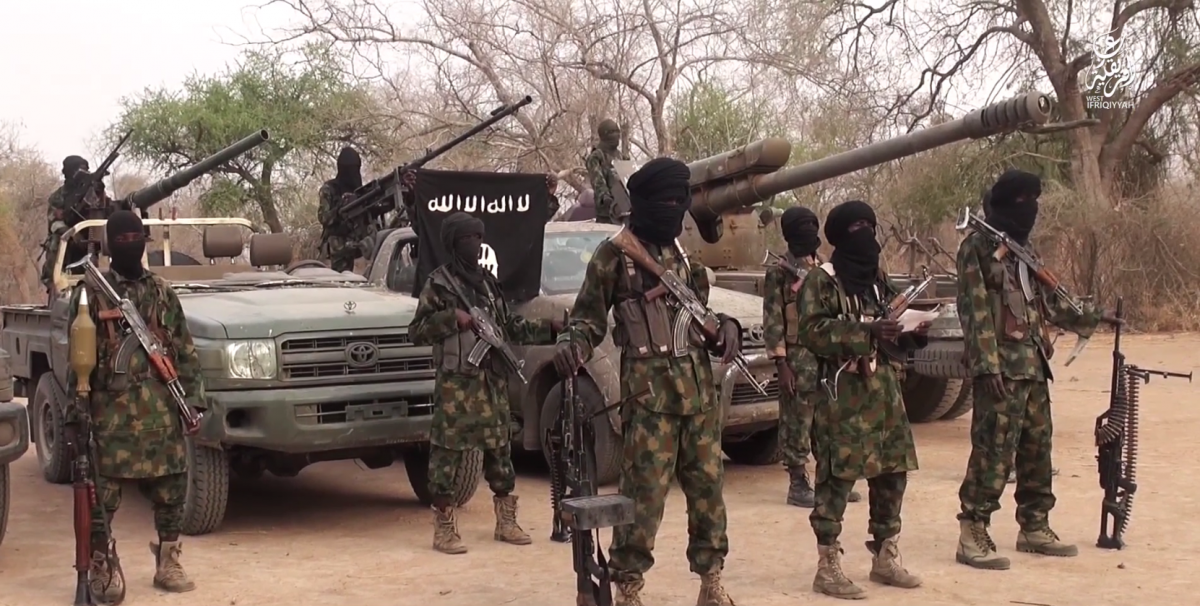
File Photo
*Begs Buhari to hire mercenaries
*Demands accountability in military spending
*FG names 553 as terrorism sponsors, flaunts anti-graft war blessings
*Says 45 terrorism sponsors set for trial
*Blames rising insecurity in rural Nigeria on financial suffocation of LGs
By Soni Daniel, Northern Region Editor & Johnbosco Agbakwuru
Governor Babagana Zulum of Borno State yesterday raised the alarm that the Islamic States of West African Province, ISWAP, is poised to take over the country.
Consequently, the governor appealed to President Muhammadu Buhari to hire international mercenaries to help the country tackle the menace.
Zulum’s alarm came on a day the Federal Government said it uncovered 96 financiers of Boko Haram and ISWAP, adding that at least 123 companies and 33 bureaux de change were also linked to the terrorists.
Governor Zulum said the growing number of ISWAP fighters in some parts of the state is of great concern to many Nigerians, warning that allowing the terrorist group to grow would spell doom for the country.
ISWAP deadlier than Boko Haram — Zulum
The governor, who spoke at the weekly ministerial briefing organised by the Presidential Communications Team at the Presidential Villa, Abuja, said if nothing was done to tackle ISWAP headlong, what Boko Haram had done to the country would be child’s play.
He said ISWAP members are more educated and massing up in his state, exploiting its closeness to the Sahel.
He, therefore, called for a retooling of the military strategy to stop them from growing into a greater monster that would further imperil the security of the country, and urged President Muhammadu Buhari to re-engage external mercenaries for additional support.
Noting successes achieved so far in the war against insurgency in the North-East, Zulum said: “All I have said now, would never have been feasible without the support of the government. But notwithstanding all the contributions of the Federal Government, we still have some challenges.
“One, I said it before, a growing number of ISWAP in some parts of the state is a matter of great concern to everybody. Why? In the shores of the Lake Chad, again in southern Borno State. Luckily enough, I was told there was military deployment yesterday (Wednesday) to southern Borno State to fight the insurgents in Tudun Katarangwa.
“But I think this is the early warning signal. We shouldn’t allow ISWAP to grow. ISWAP are more sophisticated, more funded and they are more educated. And we shall do everything possible to defeat ISWAP, otherwise what Boko Haram did will be child’s play.
‘Army has to re-strategise’
“This is an early warning signal. Nigerian Army has to restrategise and defeat ISWAP. ISWAP will be a threat to the entire nation. Because of the proximity of Sub-Saharan Africa, they are coming from Libya and resettling here.”
He debunked reports that two local government areas of the state are under control of terrorists, stressing that though there was no human population in the areas, the military had taken over the council areas.
“Whether we like it or not, a few days ago, I said something that about two local governments are still not occupied by human population. I think there are some misunderstandings. Some say two local governments are under the control of Boko Haram, no.
READ ALSO: Over 90% of repentant Boko Haram members ‘re genuine- Zulum
‘’Two local governments are not occupied by human population. But whether we like it or not, it’s right because if two local governments are not occupied, what does it mean? It means the capacity is not there to protect this human population to go to these local government areas.
“But we’re working with the Nigerian Army to ensure immediate resettlement of people to Malam Fatori, which is the headquarters of Abadam Local Government, Gudun-Bali, headquarters of Mainari Local Government. We are not saying these two local government are under their control, but they are not under human occupation.
“We need support from Federal Government for relocation of people to these local government areas. This committee that has been constituted by the Federal Government will look into these matters, among others.
‘Let’s use mercenaries’
“We want clearance of the shores of the Lake Chad. Again, in conclusion, while the challenge of insecurity is being solved gradually, it is not yet over. I have said times without number that in addition to what we are doing, there is need for government to rethink and look into the possibility of hiring mercenaries.
“I have said it that there’s nothing wrong. America, Britain, many more countries that are stronger than Nigeria used to seek support outside. There is nothing wrong in it because this problem has been compounded.
“It’s not easy for us to solve the security challenges we are having now. While Nigeria is providing a lot of things, Federal Government is buying equipment, there is the need for us to seek support from external agencies to defeat these insurgents once and for all, before the matter will reach other parts of the nation.
“This is very important. Whether we like it or not, we have an existing gap and we need to fill it. This gap cannot now be filled without external support, while we continue to build our own institutions, training and re-training,” Zulum said.
The governor said whenever he had issues of security, the President had never denied him or delayed audience with him.
He added: “Sometimes, I seek a meeting with him at very short notice while already in Abuja, and he would still ask me to come over. This has helped tackle security challenges in Borno.’’
On the challenges he is facing, the Borno State governor said: “One very serious challenge we have is the fact that our recruitment process has to be looked into. Yes, you can just say recruitment for army, collecting notes from governors, ministers and others and the people are queuing in.
“As long as we are not willing to sanitize our recruitment procedures in the armed forces, police, SSS and others, we will not get the right people. These are things that need to be done. The bitter truth is better.
“Then funding is critical. Let us investigate how much have trickled down. The commanding officers are important, procurement processes are also very important. Then stronger solidarity among the security forces and sustained campaigns are needed to finish up the remnants of the insurgents on the fringes of the North-East is very important.
“The resettlement needs should go hand-in-hand with livelihood support, more resources are needed to do more for the people. Greater understanding is required of the security forces to support protection action in places of resettlement all over Borno.
“The last but not the least, we must not allow the 2023 general elections to shift our attention completely away from the focus and restoration of peace in North-East and, indeed, other parts of the nation.”
He said he was relocating the Internally Displaced Persons, IDPs, from the camps to either their ancestral homes or local government headquarters in dignified manner because of the high rate of prostitution, gangsterism, and procreation going on there.
Noting that criminality had been rampant in the IDP camps, Governor Zulum said: “My resilience has helped contained terrorism, else other parts of Nigeria would have been taken over. Food insecurity is a worse form of insecurity. If people can’t farm and produce food, terrorism will even get worse.’’
FG names 96 as terrorism sponsors, flaunts anti-graft war blessings
Meanwhile, the Federal Government said yesterday it had uncovered 98 sponsors of Boko Haram and ISWAP, while also flaunting its success in the war against corruption and outlined new measures to tackle corrupt practices and save more resources for national development. Minister of Information and Culture, Alhaji Lai Mohammed, who disclosed this at a briefing in Abuja yesterday, also said no fewer than 45 suspects of terrorism financing would soon be put on trial.
He said of the 553 persons identified as sponsors of terrorism in the 2020-2021 report by the Nigerian Financial Intelligence Unit, NFIU, 96 are direct financiers of terrorism, while 424 are associates/supporters of the financiers. He also listed 123 companies and 33 bureaux de change as entities with links to the terrorists groups.
According to him, 26 others are identified as bandits and kidnappers by the NFIU. The minister also disclosed that Nigeria had shared intelligence on Boko Haram, ISWAP and kidnapping with no fewer than 19 countries but did not say the rationale behind the move.
‘N7.6 trillion lost to tax evasion, avoidance’
Mohammed said from the NFIU analysis, tax evasion and tax avoidance linked to corruption has caused the country a whopping N7.6 trillion in Value Added Tax and Withholding Tax.
He said the NFIU had also sent 1,165 intelligence reports on cases of corruption, money laundering and other serious offences to 27 domestic agencies for investigation, prosecution and asset recovery.
Among the major milestones in corruption fight listed by Mohammed were the adoption of the Treasury Single Account, TSA, Integrated Personnel and Payroll Information System, IPPIS, Petroleum Industry Act, Financial Autonomy for State Legislature and Judiciary (2020), Whistle-blower Policy, and Assets Recovery, among others.
Mohammed boasted that the implementation of the TSA system in more than 90 per cent of all MDAs had resulted in the consolidation of more than 17,000 bank accounts previously spread across Deposit Money Banks, DMBs, in the country, and monthly savings of an average of N4 billion in bank charges. On monetary recoveries, the minister said in 2021 alone, the EFCC recovered a total monetary amount of N152,088,698,751.64; £1,182,519.75, 50 Emirati Dirham, 1,723,310 Saudi Riyal, 1,900 South African Rand; US$386,220,202.85; 156,246.76 Euros; 1,400 Canadian Dollars; 5.36957319 Bitcoin and 0.09012 Ethereum.
He also said during the same period, the agency returned fraudulently-obtained funds totalling US$103,722,102.83, 3,000 Pound Sterling; 7,695 Singapore Dollar and 1,091 Euros to 11 countries of victims who came into the country.
Similarly, he lauded the ICPC, claiming that the agency had played a pivotal role in bringing about structural changes in the operations of government, especially regarding improvements in MDAs’ budget utilization, better value for money, improved project completion, service delivery and higher level of anti-corruption awareness.
He said: “Between 2019 and 2021, ICPC traced 2,000 projects worth over N300 billion. During the same period, 326 contractors of abandoned projects across the six geo-political zones were forced by the commission to return to site to complete projects worth N32.183 billion. Also, the ICPC’s assets “Tracing, Recovery and Management, TRM, project led to the recovery of cash totaling N34.346 billion and US$1.62 million between 2019 and 2021.
“Also, the commission’s System Study and Review of personnel and capital votes of MDAs resulted in savings of N261 billion to government between 2019 and 2021. ICPC has also secured 66 convictions from the 243 cases it filed in court during the same three-year period.” The minister also spoke on the Executive Orders signed by President Muhammadu Buhari in May 2020 that unequivocally granted financial autonomy to State Houses of Assembly, State Judiciaries as well as the local governments, as the third tier of government.
He said: “The financial suffocation of LGs is a major enabler of insecurity and terrorism in the Nigerian countryside. Most of Nigeria’s 774 LGAs exist in rural areas where effective local governance is an existential issue.
“To underscore their responsibility to the people, President Buhari recently reminded LG chairmen of their burden of accounting for every kobo allocated to their councils, should they fold their arms and allow the sharing to continue by state governors.
“The Buhari administration’s fight against corruption is unwavering and on course. This administration has put in place structures that will not only check corrupt tendencies but also make corruption unattractive and costly to those who may want to engage in it.
“Even the World Bank says when approaching anti-corruption at the country level, it is important to put in place ‘institutional systems and incentives to prevent corruption from occurring in the first place’, and that is exactly what we are doing with the structural and governance reforms that I have enumerated above.’’
Disclaimer
Comments expressed here do not reflect the opinions of Vanguard newspapers or any employee thereof.