By Dickson Omobola
In the heart of Nigeria’s media landscape, one name resonates as a symbol of truth, fearless journalism, and unwavering commitment to public accountability—Femi Olanipekun. A journalist, broadcaster, and media executive, Olanipekun has dedicated nearly two decades to shaping Nigeria’s socio-political discourse, challenging the status quo, and giving voice to the voiceless.
Born Samson Olufemi Olanipekun in Ilesa, South West Nigeria, Femi’s journey from his early days as an inquisitive “radio boy” in rural Nigeria to becoming one of the youngest media executives in the country is one of passion, resilience, and an unshakable belief in the power of journalism to effect change.
“Growing up in rural Nigeria, I have always been fascinated by information and news, the process of gathering it and disseminating it to the public through the mass media,” Olanipekun recalls. “I was known as the radio boy, always seen with newspaper cuttings and armed with a small transistor radio, listening to news and current affairs on local and international broadcast stations.” His career trajectory—from Nigeria’s public broadcaster Radio Nigeria to his pioneering role at Rave 91.7 FM and Western Spring Television—has been marked by groundbreaking achievements that set new standards in Nigerian broadcasting.
The Making of a Media Trailblazer
Olanipekun’s foray into journalism began with a deep fascination for news and information. While studying Teacher Education and English at the University of Ibadan, he founded and edited his department’s first-ever newsletter, foreshadowing a career that would be defined by his commitment to information dissemination and public enlightenment. His early internship while still in the university at Nigeria’s public broadcaster, Radio Nigeria, which led to permanent employment, was the springboard for a remarkable career in broadcasting.
His defining moment came in 2015 when he was headhunted to join Rave 91.7 FM as the pioneer Head of News and Current Affairs. Sixteen months later, at just 30 years old, he was promoted to Head of Station (General Manager), a role traditionally reserved for older, more experienced professionals. His remarkable performance in this role not only solidified Rave FM’s position as a major media brand but also paved the way for other young professionals to be appointed into management positions in Nigeria’s broadcast industry. “I knew I had to prove that youth was not a limitation, but an asset,” Olanipekun once reflected.
Under his leadership, Rave FM became a major media brand and powerhouse of journalism, winning five consecutive awards as the Best Radio Station in Osun State at the Nigeria Union of Journalists Awards. Olanipekun led Rave FM to create highly impactful programmes and news reports that redefined the broadcast landscape in the country. Shows like Karakata, Igbimo Ajoro, Oro Oselu, Oju Eleri, No Tension Zone, and Rave Gang contributed to the exceptional quality of broadcasting that set it apart. “We were intentional in designing our content—both programs and news reports—to serve the people and create meaningful societal impact,” Olanipekun stated. “This dedication earned us the trust of our audience and established Rave FM as a credible and respected news source.”
FrankTalk: Shaping Public Discourse and Influencing Policy
At the heart of Olanipekun’s impact is FrankTalk, Rave FM’s flagship socio-political interview program, which he conceptualized, produced, and has anchored for seven years. With over 2,000 episodes, FrankTalk has become the gold standard for incisive journalism, hosting Nigeria’s top decision-makers, including presidential spokespersons, governors, ministers, diplomats, and policy analysts. The program became a key platform for holding the powerful accountable, addressing governance, human rights, and socio-political issues in an unfiltered and unbiased manner.
“We quickly built a reputation despite being outside the major cities of Lagos and Abuja, where most national decisions are made. Critical matters of state were brought directly to the people’s doorstep,” Olanipekun shared. “FrankTalk, in particular, ensured that key issues and prominent news personalities—regardless of location—were engaged in tough conversations on policies, human rights, good governance, accountability, and probity.”
The show’s influence extended beyond the airwaves. It served as a reference point for national newspapers, shaping news headlines and influencing policy debates. Government agencies frequently sought FrankTalk as a platform to communicate policies and programs, acknowledging its credibility and reach, while the voiceless and underprivileged in society found an advocate in the program to air their concerns and seek justice. “It was no longer reported news; now they heard it directly and sometimes engaged these key officials that seemed hitherto unreachable and untouchable. From the perspective of spectators in matters of governance, the people became active participants, contributing to national discourse and public policy.” It served as a reference point for national newspapers, shaping news headlines and influencing policy debates. Government agencies frequently sought FrankTalk as a platform to communicate policies and programs, acknowledging its credibility and reach, while the voiceless and underprivileged in society found an advocate in the program to air their concerns and seek justice.
Advancing Democracy and Good Governance
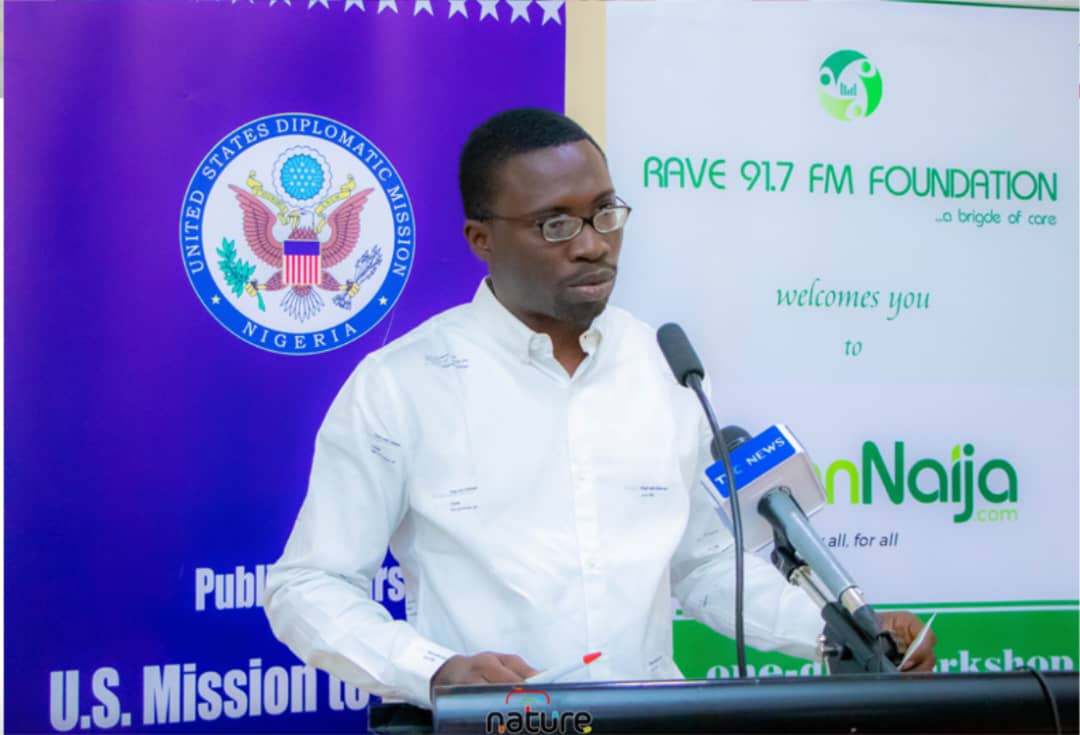
Beyond journalism, Olanipekun has been instrumental in advancing democracy and civic engagement in Nigeria. As the Programme Director of Rave FM Foundation, he secured grants from the U.S. State Department for initiatives promoting good governance, citizen participation, and training for journalists. He also served as Project Coordinator for the Open Naija project, which syndicated governance-focused programming and training across multiple media outlets.
His work with organizations like Kimpact Development Initiative (KDI) on the Osun Youth Agenda among others further underscores his commitment to democratic reform. As a technical committee member, he played a pivotal role in developing the policy framework for a legislative bill that led to the establishment of the Osun Youth Development Commission. “In a country where democratic institutions and good governance structures are often weak, our interviews and reports played a crucial role in fostering transparency and accountability,” he noted. “Despite these challenges, I firmly believe that journalism is the catalyst for an active citizenry essential for a prosperous and developed nation.”
An Internationally Recognized Media Leader
Olanipekun’s expertise and impact have not gone unnoticed on the global stage. In 2018, he was selected for the U.S. State Department’s prestigious International Visitors Leadership Program (IVLP), where he participated in the Edward R. Murrow Program for Journalists on Disinformation. As the only Nigerian in his cohort, he engaged in high-level training at institutions like the Poynter Institute and participated in the Journalism Under Fire conference in New Mexico. “I returned to Nigeria with a firmer belief in my conviction that Broadcast Journalism, especially within the Nigerian context, is a critical pivot to educate, enlighten, and empower the citizenry to demand better deals from their leaders and ultimately evolve a more egalitarian society,” he affirms.
Pioneering the Future of Nigerian Broadcasting
Olanipekun’s tenure at Rave 91.7 FM saw the expansion of the station into television broadcasting with the launch of Western Spring Television. He played a critical role in the establishment of the new television channel, leading the transition from a successful radio startup to a multimedia powerhouse. His leadership in establishing the station—from regulatory approvals to content development—exemplifies his visionary approach to media innovation. He believes Africa should not be left behind in the latest surge of innovation impacting journalism and the media space. “There is a tendency for Africa to be late to embracing technological innovations or adaptations because of our challenges but I intend to leverage my nearly two decades of experience in broadcast journalism—spanning various roles and units—to explore the intersection of digital technologies, Artificial Intelligence, and their growing impact on journalism, media, and media literacy,” Olanipekun shared. “In the very near future, I hope to contribute to this evolving discourse through published scholarly articles.”
Through his fearless journalism, strategic leadership, and commitment to public accountability, Femi Olanipekun has redefined Nigeria’s media landscape. His work not only informs but empowers, proving that journalism, at its best, is not just about reporting the news—it is about impacting society and shaping the future.
Disclaimer
Comments expressed here do not reflect the opinions of Vanguard newspapers or any employee thereof.