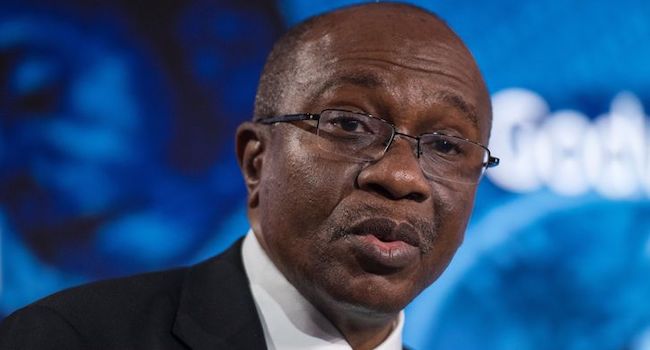
Godwin Emefiele
By Marie-Therese Nanlong
To enhance food security and stability, the Central Bank of Nigeria, CBN has flagged off the Nigerian Brown Revolution, an intervention program aimed at boosting the wheat value chain under the Anchor Borrower Scheme.
The ceremony was held at the CBN ABP Wheat Seed Multiplication Farm, Kwall, Bassa Local Government Area, Plateau State.
The CBN Governor, Godwin Emefiele represented by the Deputy Governor, Edward Adamu, noted that wheat is the third most widely consumed grain in Nigeria after maize and rice; is estimated that the country only produces about one percent (63,000 metric tons) of the 5-6 million metric tons of the commodity consumed annually in Nigeria hence the enormous demand-supply gap is bridged with over $2 billion spent annually on wheat importation.
He added that the intervention was necessary as wheat is the second highest contributor to the country’s food import bill and given the high growth rate of the country’s population and the demographic structure, the demand for wheat is projected to continue to rise and intensify pressure on the country’s reserves unless a decisive step is taken to grow wheat locally.
The Governor lamented that “Over the years, the availability of low-yielding seeds variety locally and poor agronomic practices have hampered successful cultivation of wheat in Nigeria, leading to low productivity, making wheat production unappealing to farmers and unattractive for private sector investment and to change the situation and leverage domestic production to bridge the demand-supply gap in the country, the Central Bank of Nigeria has decided to add wheat to the list of focal commodities to be supported under the Bank’s agricultural intervention programs.
“Improved seeds varieties are the bedrock of any crop production process. We have made some progress in this regard with the acquisition of high-yielding varieties from Mexico with a potential average yield per hectare of 5-7 metric tons as against a range of 0.8-1.8 metric tons yield per hectare of those varieties previously cultivated. The two-pronged approach of seed multiplication and grains production which we have adopted is expected to sustain the propagation of seeds and guarantee the availability of high-yielding seeds to farmers.
“Our strategy for the wheat value chain involves, ensuring availability of high-yield seeds by financing seed multiplication and establishment of seed ripple center, expanding land under cultivation for wheat to a capacity that can meet total national demand through association and collaboration with relevant federal agencies and state governments, pursuing strategic collaboration with key stakeholders in the wheat value chain for sustained local production. This strategy seeks to reduce wheat importation by 60% in two years and ultimately eliminate wheat importation or reduce it to an insignificant contributor to the country’s total food import bill.”
However, President Muhammadu Buhari, represented by the Plateau State Governor, Simon Lalong, stressed that the flag off, coming at the time the 2021/2022 dry farming season is commencing is significant as “food security cannot be attained if farmers are not encouraged and adequately equipped with access to the best inputs and opportunities to learn effective agronomic practices for improved yield.”
His words, “As a country, Nigeria has relied on the proceeds of oil exports for so long. However, with the volatility of oil prices, and its implications on our foreign reserves, we have no other choice but to work towards the diversification of the Nigerian economy by investing in other productive sectors of the economy. The Agricultural sector is one of the critical non-oil sectors which has made significant contributions to the Gross Domestic Product (GDP) accounting for a 22.35 and 23.78 percent contribution to the overall GDP in the first and second quarters of 2021 respectively.
“It was also instrumental in supporting the emergence of our economy from the recession in the 2nd half of 2020, following the COVID-19 pandemic. Ensuring food security means ensuring availability and access across all demographics in the country… The Anchor Borrowers Programme (ABP), managed by the Central Bank of Nigeria is one such mechanism. It is designed to ensure that farmers are guaranteed a ready market for their output and also facilitates finance for players in the next step of the value chain, the millers, to produce.
“… Nigeria is on the path to actualizing sustainability in the production of rice, maize, cassava, soybean, groundnut, oil palm, cocoa, and we are gathered here today because of a breakthrough in wheat cultivation in Nigeria. Through the various efforts of this administration in the Agric value chain, we expect a bountiful harvest in commodities like maize. It is important to stress that Nigeria currently spends over $2 billion on the importation of wheat annually. Wheat cultivation, similar to rice can thrive in Nigeria due to the tropical climatic conditions. Currently, wheat is cultivated in many Northern states particularly in the dry season due to the high heat tolerance of the seed utilized by farmers.
“… wheat can also be grown in the wet season in Plateau state. Research also shows that it can be cultivated in other Plateaus in the country, namely, Gembu Plateau, Taraba State, and Obudu Plateau, Cross River State. I urge these other states to take advantage of this opportunity and key into the initiative.”
Disclaimer
Comments expressed here do not reflect the opinions of Vanguard newspapers or any employee thereof.