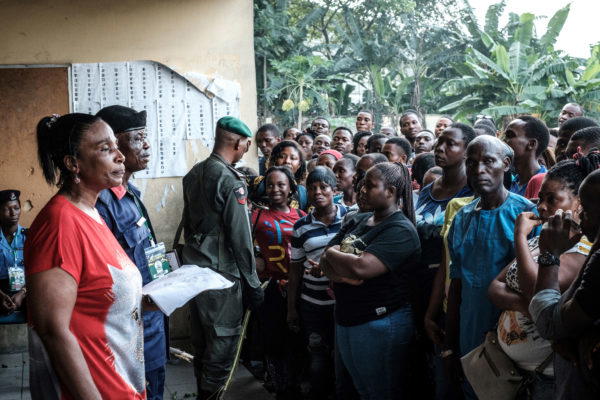
Trained staff of the Independent National Electoral Commission (INEC) are blocked from work as their names are missing in the list at a Regional Area Centre ten minutes before scheduled opening voting time for the Presidential and General election in Port Harcourt, southern Nigeria, on February 23, 2019. – Nigerians began voting for a new president on February 23, after a week-long delay that has raised political tempers, sparked conspiracy claims and stoked fears of violence. Some 120,000 polling stations began opening from 0700 GMT, although there were indications of a delay in the delivery of some materials and deployment of staff, AFP reporters said. (Photo by Yasuyoshi CHIBA / AFP)
Ahead of the March 9 Governorship and State Houses of Assembly Elections, voters in Bauchi have urged INEC to ensure that its smart card readers function effectively.

Nigeria’s Independent National Electoral Commission (INEC) chairman Mahmood Yakubu addresses the audience on February 25, 2019 in Abuja during the presidential elections announcement. – Muhammadu Buhari got off to a winning start in his bid for re-election as Nigeria’s president, as the first result was announced today from weekend polls. The 76-year-old former military ruler won 219,231 votes in the southwestern state of Ekiti, while his main opponent, Atiku Abubakar, got 154,032, the electoral commission announced. (Photo AFP)
They made the call in interviews with Newsmen on Thursday against the backdrop of several incidents when the card readers malfunctioned in polling stations across the country.
A voter, Malam Aliyu Manga, decried the failure of the gadget in the just concluded presidential and national assembly polls when it was his turn to get accredited at a polling unit.
ALSO READ: Malfunctioning Smart Card Readers worry Ekiti APC Senatorial candidate votes
He also witnessed similar situations in Misau at a polling station.
“I witnessed many cases that posed set back during the election where the card reader had rejected fingerprints, and consequently delayed the entire process,” he said.
He urged INEC to tackle the challenges of card readers before the next elections to ensure a free and fair election.
A politician, Alhaji Yusuf Garba, said cases of malfunctioning of card readers were worrisome during the last elections, stressing that such a device needed to guarantee the credibility of the exercise.
He said that manual verification of voters could pave the way for electoral fraud, leading to compromise of results.
“Nigeria should have gone beyond cases of failed card readers to achieve credible elections process.
“Voters are concerned that the card readers are not working; that might cause delay and unpalatable voting process in the country,” he said.
Malam Hashimu Mohammed, a public commentator, said the card readers were meant to be configured for specific polling units.
He said that no two polling units would have the same card reader during an election for the purpose of credibility.
“That means PVCs could not be used in multiple polling units.
“Beside that, INEC officials and ad-hoc staff had issues in some of the poling Units, which is too bad for the system.
“In Polling Unit I visited as an observer at the last elections, voting did not begin until 11:10 a.m as a result of smart card readers’ failure,” Mohammed said.
Another voter, Hajiya Lami Gambo, recalled her experience in the just concluded presidential and national assembly elections.
“ We started voting at our polling unit by 11.55 a.m. due to a faulty card reader which delayed voting in the area.
“I came out by 7:30 a.m to vote but the card reader was not functioning; so, I went back to my house and came out by 11:00 a.m. to vote,” she said.
She, however, appealed to INEC to sort out the hitches before the next Governorship and Houses of Assembly elections.
The News Agency of Nigeria reported that the card reader was initiated as an anti-electoral fraud device and was introduced to enhance the integrity of the voting process and dissuade multiple voting. (NAN).
Disclaimer
Comments expressed here do not reflect the opinions of Vanguard newspapers or any employee thereof.