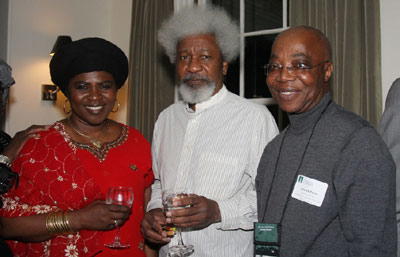
From left, Prof. Tess Onwueme, Prof. Wole Soyinka and Prof. A. Porter (Drexel University) in Vermont at the Ala international Convention where Prof. Onwueme was awarded the Fonlon-Nichols award.
- By Tony Eluemunor
Whether as a mother, Africanist, playwright, actress, Ambassador, public speaker or highly regarded intellectual, Professor Tess Osonye Onwueme could deservedly nod her head and proclaim to herself: “you have come a long way baby.”
Now, having scaled the dizzying heights of the USA’s academia, she’s preparing to re-enter Nigeria. She arrived the United States of America in the 1989 – 1990 academic session as a Martin Luther King, Jr. Caesar Chavez, Rosa Parks Distinguished Writer. From 1990 – 1993 she was Associate Professor of English & Multicultural Literary Studies, Montclair State University, Montclair, New Jersey. Then she lectured at Wayne State University, Detroit, Michigan and later, Vassar College, Poughkeepsie, New York as Associate Professor of English and Africana Studies. In 1994, she got an uncommon recognition; she became the Distinguished Professor of Cultural Diversity and Professor of English, at the University of Wisconsin, Eau Claire, Wisconsin, USA.
- Accounting in Nigeria: A look at its education
-
In 2010, she achieved that rare feat in US academic circles by earning a named chair appointment as the University Professor of Global Letters, in the same University of Wisconsin, Eau Claire. Now the university has archived her works, putting her on a pedestal that only three Africans ever occupied: Chinua Achebe, Wole Soyinka and NgugiwaThiong’o.
She has published almost two dozen plays that have been staged across the globe, and she is a novelist and poet too. She has won the Association of Nigerian Authors (ANA) Drama Prize for plays four times, with Then She Said it (2003), Shakara Dance-Hall Queen (2001), Tell It To Women (1995), and The Desert Encroaches (1985). Her international awards include the 1988 Distinguished Author’s Award for her overall contribution to African literature, the 1989/90 Martin Luther King, Jr. Distinguished Writer’s Award, and in both 2000 and 2001, she was awarded major grants from the Ford Foundation for her creative writing and drama production, the prestigious Fonlon-Nichols award (2009), the Phyllis Wheatley/Nwapa award (2008), the Distinguished Authors Award (1988).In 2004 Onwueme’sShakara was internationally featured by the BBC World Drama Service as a major broadcast for the season. From April 27-May 28, 2001, The Missing Face was staged Off-Broadway. The Reign of Wazobia has been adapted into film/video.
- Afe Babalola advocates unified exams for final year students
-
Accolades have poured in for her from respected intellectuals. To NgugiwaThiong’o: “ Onwueme is eminently a political dramatist, for power affects every aspect of society. She explores these themes with a dazzling array of images and proverbs. Her drama and theatre are a feast of music, mime, proverbs and story-telling, (thus consolidating) her position among the leading dramatists from Africa.”
-
Professor Emeritus, Eugene Redmond, Southern Illinois University, USA situated her among the all-time best writers everywhere: (with) “ Wole Soyinka, Ama Ata Aidoo, Samuel Beckett, Derek Walcott, John Pepper Clark, Albert Camus, Chinua Achebe, Toni Morrison, Anton Chekhov, Femi Osofisan, NgugiwaThiong’o, George Bernard Shaw, Athol Fugard, August Wilson, Amos Tutuola, Gloria Naylor, BuchiEmecheta, Dennis Brutus, Alex LaGuma, Mariama Ba, and Sembene Ousmane.”
To Dr. Sonja Darlington, Beloit College, Onwueme is “the literary soul-mate of Chinua Achebe, WoleSolyinka, and NgugiwaThiong.o. She is the first African woman dramatist to break into their ranks, so that What Mama Said, Tell it to Women, Shakara: Dance-Hall Queen, The Missing Face and The Reign of Wazobia became staples of international college and university curricula in the 21st century.”
Born as Tess Akaeke in OgwashiUkwu, Delta state, She got her Bachelors and Masters degrees at University of Ife and PhD at University of Benin. She lectured at Ife and a few other Nigerian universities before leaving for the US.
In 2007, the US State Department appointed her to the Public Diplomacy Speaker Programme for North, East, and West India to help in the US “soft-diplomacy” effort in Asia. She got the Indian assignment to help enhance US image after the second US war in Iraq, as hundreds of Indians had written their PhD dissertation on her.
It was during the Indian assignment on behalf of the US government that she started thinking of what to do to for Nigeria. Two years later in 2009, the Tess International Conference: Staging Women, Youth, Globalization, and Eco-Literature, which was exclusively devoted to the author’s work was successfully held by international scholars in Abuja, and the urge to return increased.
- Afe Babalola suggests unified exams for final year students
-
A few years ago, she visited Nigeria to check how she could help in changing Nigeria’s unflattering image overseas. What aspects of Nigeria have been hidden from foreign audiences? That was how our parts crossed. Dr (Mrs) Bridget Onochie of the Guardian newspapers, who did her PhD dissertation on Prof Onwueme linked us up.
Prof Onwueme has been preparing for her re-entry into Nigeria for years now. “I’m homeward bound. I have turned my sights around,” she said. She must be preparing for a few acts that should further define her and benefit Nigeria because every human will one day say, “here I stop and retire” —even if that person has the prodigious talent and the volcanic eruption of that rare creative energy that gave Nigeria and the world the renowned Professor Tess Osonye Onwueme.
Disclaimer
Comments expressed here do not reflect the opinions of Vanguard newspapers or any employee thereof.