BY OSA AMADI
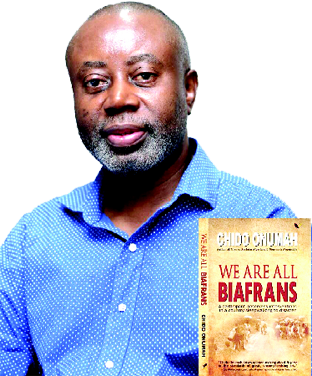
We are all Biafrans, a book written by Chido Onumah and published by Parresia Publishers Ltd and African Centre for Media and Information Literacy has already been presented to the public but it is a book more relevant than ever, at this juncture when the fate of the country is on the balance.

*Chido Onumah
The book is aimed at reinforcing the debate about federalism and national reconciliation.We Are All Biafrans is a collection of essays published by the author in various newspapers focusing on the crisis of nationhood in Nigeria. His two previous books, Time to Reclaim Nigeria and Nigeria is Negotiable, are in the same category as We are all Biafrans.
An unapologetic advocate of true federalism, Mr. Onumah in this book argues that most, if not all of Nigeria’s problems today are traceable to the political and economic structures of the country.
As in his previous books, the author recommends an urgent socio-political restructuring of Nigeria in order to save her from a looming catastrophe.
But Chido’s concept of Biafra in this book radically differs from what Biafra means for many Igbos and other Nigerians. “Even the man who led the Biafran agitation, the Ikemba Nnewi, Dim Chukwuemeka Odumegwu Ojukwu said, before he died, that the idea of Biafra has changed. Rather than talking about the Biafra of Igbos, Ojukwu talked about the Biafra of Nigerians – the Biafra of the mind, instead of the Biafra of the field,” says the author.
“What Ojukwu was saying is that if you look at Nigeria today, different people are agitating about different things; people are clamouring for one thing or the other. His idea was that time has come for us to sit down as brothers to reflect on these agitations rather than each group fighting for its own interest. This book therefore seems to re-echo those ideas expressed by Ojukwu.
“There are some people who see this book and say ‘No o, I am not a Biafran’ but I tell them it’s a metaphor (for Nigeria’s problem). My idea is to provoke a debate, a conversation, a national discourse around the issue of Biafra. Biafra is part and parcel of Nigeria’s history. It is not something we can wish away. So rather than closing our eyes and minds to it, time has come for us to confront the issue. There is no need for people to be scared to talk about Biafra or about the nature of our federation or about the unity of this country.”
Nigeria is negotiable
“I talked about the unity of Nigeria in my second book: Nigeria is negotiable. Nation-building is not a tea party. Nigeria came into being for a specific reason – purely for British imperialist interest. The time has come for us to recreate Nigeria in the interest and image of Nigerians. The purpose of this book is to pull Nigerians out from their comfort zones. Let’s have a discussion, because Nigeria is not working. How can we make it work? So the discourse is about debate.
“Two issues I raised are, first, the federation is flawed; let’s deal with that (problem). Second is the issue of who is a Nigerian? There is no common agreement as to what Nigeria means to us. This is time to define what Nigeria means to us. Unfortunately, Nigeria has only remained a country of great potentials. Each and every one of us pretends that we are Nigerians, but in reality, we feel more comfortable in our own ethnic tribes as Yoruba, Hausa or Igbo, rather than see ourselves as Nigerians. So the question is; how do we bypass that to build a Nigerian brand?
Every part of this country, has a grievance. Why then should we allow ourselves to talk about these grievances in isolation? Why can’t we come together as a people and address these problems? The problem of Nigeria is fundamental. Some of these problems are rooted in the structure – in the constitution of the country. A good starting point is to agree that we need a brand new constitution to reflect the new structure of Nigeria.
Mr. Onumah is a journalist, human rights activist, and coordinator of the African Centre for Media and Information Literacy (AFRICMIL).
We are all Biafrans is made up of five chapters: “The Politics of 2015”, “Dancing on the Brink”, “Unmaking Nigeria”, “Of Scoundrels and Statesmen”, and “Last ‘Missionary’ Journey”.
Disclaimer
Comments expressed here do not reflect the opinions of Vanguard newspapers or any employee thereof.