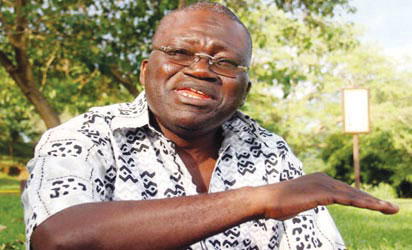
Comrade Issa Aremu
…Explains the contradictions in Nigeria’s federal structure
…Says NLC’s intervention comes with huge potentials
Comrade Isa Aremu, a NEC member of the Nigeria Labour Congress, NLC, and also a member of the executive of the alumni of the National Institute for Policy and Strategic Studies, NIPSS, in this interview, explains why the restructuring debate must be properly structured with a view to ensuring that channel noise does not drown its real essence.

Comrade Isa Aremu
Why did the NLC feel a need to organise the forum on restructuring?
Well, it is about the country Nigeria, we are a pan-Nigerianorganisation and our motto is ‘labour creates wealth’. We are not just factors of production, we are citizens and there couldn’t have been any other organisation better positioned to discuss the issue of Nigeria other than the NLC. We saw the need to really restructure the debate in a well organised manner. The audience was very robust and you could also see that it was very all inclusive with His Eminence and intellectuals. We are tax payers too and we needed to add our views.
Was it just to also participate in the growing agitation or…
No, no, no. This is a continuation of some efforts that we had put in earlier. We had had a march for good governance, for anti-corruption and now it is so fashionable for people to jump on the restructuring bandwagon. But for us, there are many things we need to get right – he issue of uninterrupted power supply, employment, looting of the nation’s wealth. There are discordant views about the future of Nigeria and we as a body felt the need to help restructure the debate.
One take away from the conference was that the unity of Nigeria is real and we need to nurture it. Yes, we can discuss about the quality of governance, but this is an heritage that has been given to us.
So, what precisely is the NLC looking to achieve as an outcome of yesterday’s output?
First is to have a much more organised discussion in an organised manner. What we’ve been doing all along is that we’ve been talking at each other instead of talking with each other. That’s why we had an open mind on it.
What came out yesterday was that we needed the knowledge of the past to help navigate; though you don’t have to be romantic with the past because if the old regions had been very good, there wouldn’t have been a clamour for more regions or states. In fact, one consensus that also came out is that Nigeria is constantly evolving – from three regions at independence, we had four regions, then we had 12 states and now we are 36 states. So we have been restructuring, though politically. Now we also know the present because one of the issues now is that of viability of some of the states and how do we deal with that. It is about knowledge, knowing where you are and how to advance. There are series of actions needed.
One of the major issues is that of development and you cannot develop with this epileptic power supply. No energy, 180 million people, generating 3000megawatts of electricity when you have a country like South Africa, with a population of 50million generating 60000megawatts, I think we should march against wastefulness because billions of dollars have been pumped into this energy challenge and we are yet to see any meaningful progress made.
Another thing that came out yesterday again is the issue of the indivisibility of Nigeria being a necessity for the African continent, so how can we be talking about an insular Nigeria. Who is going to fix South Sudan? Who is going to fixSomalia? That is why we are saying that even on October 1, we are planning to come out in a good number to reclaim the independence of Nigeria. If China, which is bigger, 1.5billion people or America with over 300million people can deliver prosperity, what is wrong with Nigeria. Yes, people say we are big, but big in relation to togo or Ghana but of other countries are delivering, we need to ask ourselves how are they doing it? What is clear is that we must walk our talk.
But during the forum, Adams Oshiuomhole drew the ire of the crowd when he said those calling for restructuring are those who lost out in the 2015 election….
I’ve seen the reports and some have said the place became rowdy. That was not the case. People only expressed their objections to his point of view in an orderly manner. If Comrade Oshiuomhole were on the other side – among the crowd – he would have done the same thing in that orderly manner. He is entitled to his views just as we are to ours.
Some of us believe that he was off the mark by saying those calling for restructuring are those who lost out in the 2015 election; I do not think so. But from his narrative, he said as state governor, he nominated people to the Jonathan constitutional conference, a conference which was also about good governance and the likes. He had a right to express his views and those who rejected his views in that orderly manner also did. Our tradition is oneness contestation in an orderly manner and that is the beauty of democracy.
What aspects of the indivisibility of Nigeria does Labour think we should re-work?
Our national anthem says ‘arise O’Compatriots Nigeria calls obey’, this is for all of us Nigerians.
There are forces that really want to cause this nation to disintegrate for obvious reasons. Firstly colonialism dealt us its blow, before then slavery; and there are countries in the world that would not want to see a united Nigeria – that is apart from our own local issues, legitimate grievances. We’ve re-affirmed commitment to that. Can you imagine at a time when the African Union, AU, is planning a common passport, that is when Nigeria is planning to disintegrate. We are better off as a united Nigeria.
This federation is work-in-progress and it is time for us to deepen development.
First we must begin to respect each other’s views; let there be debate in a constructive manner. We can disagree with our views but not with the individuals.
Secondly, we wondered why the federal government would be building healthcare centres, which should be the responsibility of municipalities, that is local government. Even for you to contract marriage, it is on the federal government’s exclusive list. Our view is that we need to devolve some of these things and in doing so, we need some irreducible for the federation to be intact – common defence, common social security and so on. So, inspire of true federalism, we must have minimum labour standards, that will grant you some entitlements no matter where you work. Labour’s take is that we must retain labour’s standards that have been achieved over years.
When people shout devolution of powers, we ask, power to do what? This economy is not a productive economy and it is necessary for people to understand that. We are just consuming. We are the only OPEC member without a functioning refinery.
Labour is recommending that for you to drive this economy, you need to pay well. Some workers are not paid in some states and we think for labour to be more productive, you must pay well.
We also need to skew national resources to create common wealth. This means, looking at the budget we have now, over N7 trillion but when you say budget per capita, it is even lower than that of Ghana and that is embarrassing. Ghana’s is about $600, South Africa is about $1000 or higher so the issue is how do we distribute resources in Nigeria?
People believe that if states are able to take charge of their resources development would be more evenly spread?
Professor G. G. Dara, one of the panelists mentioned the fact that states all over the country have resources that they can tap into and which can fetch them good revenue for development and we need to look at our legislation to allow for mining rights to the states.
Even Comrade Adams brought an insight into implementation of what we even have in the constitution. For instance, the derivation that is on going, where and what are the governors spending the money on.
We talk of resources in terms of minerals but the greatest human resource is the human resource. Why are we not so concerned about developing the human resource and unleashing the potentials which is what some countries have tapped into. The best way to motivate and retain the workforce is to train them well and pay them well and have standards for imposing discipline. Look at what the Dangote Refinery is going to bring to the table when it comes on stream. In times past Nigeria used to be one of the best manufacturing countries in the world. What did we do right then that we are not doing well now.
*This interview was first aired on Channels Television
Disclaimer
Comments expressed here do not reflect the opinions of Vanguard newspapers or any employee thereof.