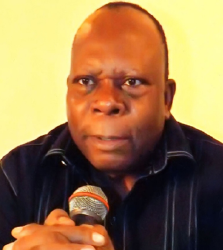
Prof. Emeka Nwabueze
With specific examples can you tell us how you became an authority in Arts? Experience, I believe, is the soul of achievement that leads to excellence. I have been fortunate to attend institutions of higher learning that made a tremendous impact in my intellectual development.

Prof. Emeka Nwabueze
As a student at the University of Nigeria, I had the opportunity of being the editor of The Muse which is a literary and creative journal. I felt I needed to make my own edition unique, and introduced The Literary Forum which was designed to be a commentary on previous editions and an avenue towards improving the quality of the journal. To be an effective editor, I had to acquaint myself with the exigencies of editing and the matter and manner of creativity in the three genres of literature.
Dramatic infiltrations
When I went for my national service in Kano, I was appointed to edit the school magazine and despite the poverty of the quality of the submissions I was confronted with, I was able to wade through the submitted materials to produce an enviable material that made everyone proud. During my postgraduate studies in Michigan, I submitted an article to the campus magazine, Eastern Echo, and after its publication, I was invited to be a part of the editorial team.
In Ohio where I went for my doctorate in Theatre Arts, I wrote and directed my own play, Spokesman for the Oracle under the Third World Theatre Programme. What started as an experiment I viewed with trepidation eventually became a campus phenomenon with the result that when I left Ohio I was constrained to replicate the play in Florida even before it was published by Evans. When I returned to my alma mater.
As a lecturer the idea had already been entrenched in my system – to carve a niche for myself, to introduce innovations in whatever I do, and to strive to be emulated.
When I became the University Orator even as a Senior Lecturer, I decided that citations ought to be orated, not merely read, with sprinkles of dramatic infiltrations. So you see, it is a matter of deciding, each time you are faced with a new experience, that it will not be business as usual, that you have to be unique and create the self-image necessary for the experience and use it to add to your bag of action.
On Arts and recession
Art is light seen through the temperament of an individual writer and the temperament must have to be in consonant with a situation in a particular society. The artist is the custodian of the moral conscience of the society and a recorder of tradition and culture.
The artist is a devoted psychoanalyst, who looks into the society with that pungent eye of a person searching for situation which cannot come to an ultimate conclusion unless there is a solution.
So I do not believe in arts for arts’ sake, I believe in arts as having utility for the promotion of society and that is why I believe your question is apt. If we are talking about arts for arts’ sake, we wouldn’t be asking how we can use it to harness society.
Now, all these trends we’ve been talking about in society, they are unable to reach the people, you can be tragic about it but we tend to be too serious about it, we tend to be too serious about it, we tend to be incomprehensible in our explication of what we want the society to be.
That is why sometimes people tend to get tired of listening to copious dialogue or monologue from ministers or people who say they are in charge but if we employ the use of arts, all these issues about corruption and the consequences of corruption should be laid bare through a dignified dramatic production and the people will sit in their houses and watch the television and see their preoccupation being destroyed in a single dramatic production.
A show of meaningless gesture: The carnivals I see going on in Abuja is not art because art is supposed to be dedicated to art to create a situation for an understanding of a society. In Trinidad and Tobago, carnivals may be necessary because it is historically viable and everything used in Trinidadian carnival is a reflection of the historical antecedents of that society but Nigeria’s own is a show of meaningless gestures because we want to promote culture and the things are not even cultural, but a completely incomprehensible display of action without form.
Creation of jingles
The government should pay attention to that. The government should pay more attention to the creation of jingles in the appropriate manner that would reflect the situation they are trying to deal with. A society without arts is like a society that is in a constant state of confusion.
The level of patronage seems to be very poor in Nigeria. What is your take on that?
A lot of things are responsible for the destruction of live performances in Nigeria. When a society has gone so down intellectually, what you see them do is to prefer people dancing, appealing to the eyes and not to the mind. In that kind of a society, it becomes difficult really to talk about good arts in the dramatic form because people want to watch a film where there is a girl that is half naked.
Again, we should try as much as possible to appeal to our audiences, different kind of audiences, children, adults and the rest of them, and make the theme of what we are presenting to them relevant to the situations of the society and relevant to the possibility of a person using the ideas in progressing.
Finally, another major thing is the right people doing productions. I saw it coming and I raised an alarm that drama has become everybody’s affair. So the idea that drama is all comers affair, anybody can act, is a problem.
On the study of arts: What the government doesn’t know is that you can’t create a medical doctor and leave him to work without appropriate equipment. The Chinua Achebe, the Wole Soyinkas, the Chimamadas, and arts reflect the society.
Quality of the private hospitals
Medicine is maybe a reflective profession and people rush into that with usually the philosophy that people definitely get sick, especially in a society that is not healthy and therefore it is necessary to create doctors but what are those doctors doing?
Has the government taken a census of doctors in this country and how they are operating, has the government taken a census on the nature and quality of the private hospitals in the country?
Why has it been difficult to fill the vacuum that the death of Chinua Achebe created?
It is because master of arts is not easy to achieve. The propensity for style no matter how you try to copy that person is not an easy thing to achieve. Remember that Achebe first went in for science and changed. So deliberately that was what he wanted. Some of us in the contemporary society took to whatever we have because we want to be like them.
Nobody tries to see profundity in what he is doing and Achebe had his tutelage right from the university.
He started writing early, polishing what he has written and has a consistent style which he uses and he is not interested in pouring out bundles of nonsense but small pieces of excellence.
It is difficult to fill his place because the society has changed tremendously, people now write to earn money, they even do self-publishing, I don’t see how many good works now in publishing houses, and how many are in Heinemann where Achebe started? Achebe could have printed his novels with a local printer like Onitsha market literature but he chose an international publishing.
Again, Achebe knew where he was going right from the beginning, remember the conference where he stated the nature of his art ‘I write to make my people know that their past was not one long night of savagery from which Europeans acting because they have delivered them.’
So he wants to recreate the African past and in such a situation, one needs research, not to just to sit down and write a story. It may have cost him the Nobel Prize but I am not sure he was worried about that.
How did you come this far in the academia?
It pains me when I see people wallow in academic in-breeding. People receive all their degrees in the same institution and get an appointment there. It is killing academe in this country. Academics should be caused to circulate, at worst nationally, to know what is happening in other places and remove the false sense of self-achievement which in-breeding imposes on them.
To me, principles do not merely encompass platitudes. They involve values and the matter and manner of free-choice. I agree with Ernest Hemingway that what is ethical is what we feel good after doing. Since knowledge is not static but continuously evolving, the mind of a principled man has to be in continuous state of flux.
Even implying Immanuel Kant’s theory of categorical imperative or Universal sense of Ought, we know that everyone knows the right thing but everyone does not do the right thing. Striving to do the right thing for myself and assigned duties is the foundation of my principles. I believe in the Socratic dictum which says that “We are what we repeatedly do. Excellence, then, is not an act but a habit”. My life has been structured under this philosophy of excellence. Another principle I cherish is being a voracious reader. I do not discriminate with what I read, and I endeavour to carve out time every day for reading, even when I am sick. I have produced enormous academic work, and yet I try to read more than I write.
The statement that traveling is part of education has proved axiomatic to me. Each time I visit a new institution around the globe, I learn new things which help me not only in my scholarship but also in being a better mentor. An example is necessary here.
In 1993, I was a Mary Kingsley/Zochonis Lecturer at the School of Oriental and African Studies of the University of London. By 1994, I was invited as a participant in the World renowned International Writing Programme and I spent a semester at the University of Iowa and the United States of America. Then I spent two years in the Southern region of Africa as Visiting Scholar at the University of Swaziland where I introduced the rudiments of African drama. After Swaziland,
I was lucky to be invited to Randolph College, Lynchburg, Virginia where I spent a year as Quillian Visiting International Professor, and introduced the teaching of African Literature in that renowned institution of Higher learning. In 2007, University of Trinidad and Tobago set up the Academy for the Performing Arts and invited me to superintend it. I spent three years setting up an enviable theatre programme in that beautiful West Indian carnival country. So you see, it is a matter of acquired superlative locomotion. Mind you, I do not merely give when I travel. I also take away what will help me develop academia in my own country and be a veritable academic mentor.
Disclaimer
Comments expressed here do not reflect the opinions of Vanguard newspapers or any employee thereof.