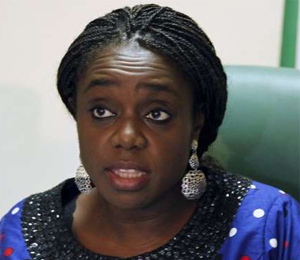
Kemi Adeosun
By Tabia Princewill
When will we, the people, free ourselves from our Stockholm syndrome and stop celebrating our captors? With the intensity of the debates surrounding the economy (debate is a big word, all we’re really saying is that something needs to be done, very few solutions are ever truly proffered), it must be pointed out that yet again, we limit ourselves to surface issues and seemingly refuse to broaden the scope of our interrogations. I am not one of those who believes Buhari must stop blaming PDP or Jonathan for the mistakes made in the past 16 years.
We must be mature enough to see and know the truth about what really happened to this country. We must be serious enough to realise the complete destruction of our country which corruption has orchestrated over the years. In fact, if we truly realised or understood just what corruption has done to us, we wouldn’t be so willing to defend or excuse those who are either guilty of corruption themselves or those under whose watch such crimes occurred.
As I’ve often said, just because Mr. A got away with murder in the past, doesn’t mean Mr. B should be exonerated till Mr A. is prosecuted for the same crime; that is absolutely not how justice works and it simply shows how warped the Nigerian psyche has become when one continues to find so many who reason this way. Our economy and society have always been based on distortions: consumption rather than production, and mostly unsustainable elite consumption at that. When will we push the envelope, and ask the question, what about the poor?
The Nigerian economy is discussed in purely financial terms which concern only the rich. The real economy, the average man on the street’s purchasing power is of little concern to most people at the top, beyond a few trite statements in the media.
The idea of a cycle of poverty, a well sprung trap which ensures that a child born to poor parents will also be poor, is hardly discussed. Bemoaning the cost of a bag of rice, or of fuel is too simplistic. Even pre-recession, 70% of our population was already living with less than a dollar a day. So, it might seem like a form of kindness to point out that things are even more difficult or more expensive now but the question still remains, what will be done about it? Africa’s specialty is generational poverty.

Kemi Adeosun
The discourse surrounding the poor is still too simplistic if not to say elitist: “the poor should farm”. This phrase is repeated time and time again on the pages of newspapers: “politician A encourages the youths to go back to farming”. It’s often a smaller headline just beneath “embattled politician B cries witch-hunt”. Take any headline from any decade in Nigeria, you are bound to find one man (or woman) claiming to be falsely accused while in the next breadth he or she, or their colleagues sends young people to farm with tools from another century.
Beyond subsistence farming, using tools from the middle ages which hardly provide sufficient yields, how do we ensure, for example, that agriculture in our country modernises and that from small, poor holdings,
Nigerians graduate to running mechanised farms and businesses? So many of our fruits and vegetables go to waste not only because of bad roads which ensure products don’t get to the market on time, but because farmers do not have the available tools for value added agriculture which turns a cheap, raw commodity (tomato) into a processed, more valuable product (e.g. tomato paste). The poor can’t escape the cycle of poverty if all they are given are fertilizer and basic tools, or in the case of the urban poor, tricycles or sewing machines. Beyond throwing the poor a few bones every now and then, there needs to be a decisive national policy which looks at poverty from different angles: from education, to health, housing and water resources, all of these benefits which citizens take for granted in other climes contribute to either keeping individuals in poverty or lifting them up. But there is still too little coordination between ministries and agencies which is why real change remains elusive.
Nigerians have a serious complex about poverty. Even the poor deny being poor. They copy the boasts and “bigmanisms” of the rich (only in Nigeria does a security guard’s self-esteem increase based on his oga’s social prominence). Americans readily admit to poverty or difficulty but not Nigerians. It stems, in part, from our superstitious ways: it’s bad luck to publicly admit to a problem.
But when some of these archaic ideas about appearances enter the realm of public policy, then one better understands why countries like Nigeria continue to comfortably inhabit the danger zone called poverty. Our feudal mind-set justifies corruption and its corollary, poverty. Many of us truly believe that some are born to be rich and others poor.
It’s the reason Nigerians tithe and watch their pastors drive a Rolls Royce while they’ve given away the last of their savings and therefore can only afford public transport. Meanwhile, the pastor and his wife go on holiday several times a year (in first class mind you) then come back to preach about hard times. We celebrate the wrong things (and most of all, the wrong people) and focus on meaningless delusions rather than the truth.
So many talented people in this country lack the opportunities taken for granted by the children of the elite. You might say it is so all over the world. But it is only in Nigeria where it is accepted, almost an unspoken law, that the rich shall sacrifice the poor for all eternity. If one was to do a poll of successful young people today, one would find that most benefited from a leg-up from their parents. Hardly anyone is self-made in Nigeria.
This wouldn’t be so outrageous if the real stories behind success were not almost always sordid or further examples of just how much corruption short changes the masses. How long will injustice continue to replace justice as the law of the land? I really want to believe, as Martin Luther King Junior said, that the moral arch of the universe tends towards justice. Hope is all that keeps most people afloat.
Governor Fayose
A statement from his
media aide regarding his decision to present the Ekiti State budget dressed in military fatigues reads: “if your concern is what a man wears to the office and not how well he performs his duties in the office, I doubt if your head is correct!”
The language alone is unfit for a governor, or the would-be number one citizen in any state and simply shows the total lack of respect or understanding which some politicians have when it comes to public office. Of course, what a man (a governor no less) wears to work matters.
As for performance, that remains to be seen. Ekiti’s poverty and unemployment indices don’t seem to have shifted dramatically, no matter how many road side joints the governor frequents at lunch time, in an effort to be “pro people”. When will we cease to prefer illusion (or delusion) to reality?
Finally, Edwin Clark says the needful
Chief Edwin Clark said over the weekend that it was time for people to hold South-South governors accou ntable. He even questioned the proper use of the 13% derivation funds.
He spoke of the mismanagement of the region’s resources and linked this to poverty. If only he could have said this when a Niger-Deltan was President rather than seemingly encouraging blind support based on tribe and religion. Underdevelopment caused by corruption, which is in fact stealing, (one wonders if Mr Clark’s views on the “is stealing corruption” matter differ from Jonathan’s) knows no religion, gender or ethnicity and it’s time we all realise that.
Disclaimer
Comments expressed here do not reflect the opinions of Vanguard newspapers or any employee thereof.