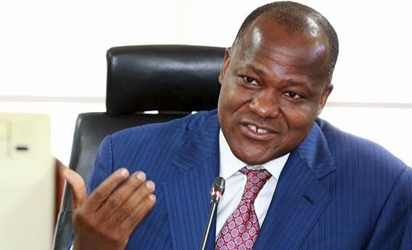
Yakubu Dogara
By Donu Kogara
Earlier on this week, the Right Honourable Yakubu Dogara, Speaker of the House of Representatives, addressed a National Stakeholders Summit on Petroleum Industry Reforms in Abuja. Here are some excerpts from his speech:
…The agenda of the present administration is to bring CHANGE to Nigerians. For us [legislators], change means work…[and] meaningful change is never about what you abandon but what you embrace. It is never about what you are turning from but what you are turning to.

Yakubu Dogara
…We are determined to take this cause across vital sectors of the economy with specific attention on the Petroleum industry. This has become urgent because the industry has not been forthcoming in meeting expectations and actualisation of its great promises. Instead, it has become the classic case of inefficiency, mismanagement and ineptitude.
Sec.44 (3) of the Constitution of the Federal Republic of Nigeria apart from vesting the powers to make laws in the legislature went further to clearly invest it with powers to make laws for the management of the oil and gas sector.
…Nigeria is one of the richest petroleum regions of the world. Paradoxically, it has never been able to maximize effectively its immense oil and gas potentials and the revenue accruing from it. The downstream operates in a state of almost continuous malfunction, and for years has been characterised by comatose refineries and an inefficient downstream.
It operates under an inadequate legal framework, with an inefficient and poorly maintained pipeline network and depot system. The result is that Nigeria is both one of the world’s largest producers of crude oil, and one of the world’s leading importers of petroleum products, a dependency that has enriched the elite at the expense of the increasingly impoverished masses.
…In addition to being administered in a very opaque way, shortages and inadequate supply have characterised the Nigerian downstream for over two decades and can be described as an example of system failure.
The upstream has not fared better either. Pipeline vandalism, large-scale environmental degradation, and the world’s highest levels of crude oil theft have been constants for several years. Decades after the advent of Nigeria’s petroleum industry, problems which led to host community agitation remain unaddressed and highly politicized, and the question of the extent to which revenues from the industry should be shared among the three tiers of government and the people remain, as do the content and limits of corporate social responsibility.
These examples represent just a few of the present problems of Nigeria’s petroleum industry, and are reflective of an industry that is in critical need of total restructuring, which can only be commenced through the enactment of laws that provide the legal framework that will promote the emergence of an optimal petroleum industry. The existing laws are outdated, anachronistic, and out-of-sync with international best practices and current technological advances for decades, with the primary laws being the Petroleum Act of 1969, and the Petroleum Profits Tax Act 1958.
Legal reform, which is the bedrock of meaningful restructuring of the industry, is thus a dire necessity. Unfortunately, it has not happened, even though activities towards reform have been taking place since 2000. For reasons which will be made apparent in the course of this Summit, these activities have ended up in failure, evidenced by the non-enactment of either the Petroleum Industry Bills of 2008 and 2012, which were before the 6th and 7th National Assembly respec-tively. In the meantime, the situation in the petroleum industry and Nigeria’s sustainable development, have progressively worsened.
I have on at least three different occasions publicly requested the Executive to as a matter of urgency send an Executive Bill on his intended reforms in the Petroleum sector. We had hoped to avoid the situation in the past two Assemblies (6th and 7th) where the PIB was sent to the National Assembly very late in its tenure thereby guaranteeing failure to pass the Bills. In the absence of an executive bill on the matter, two private member’s bills have now been introduced.
We urge participants to familiarise themselves with these bills and make necessary inputs at the public hearing stage of the bills…In this regard therefore I wish to correct the erroneous impression in the media that there is a pending executive bill on PIB on the floor of the National Assembly. The intention of the House of Representatives is to revisit the process of petroleum industry reform, and to work towards the successful enactment of laws that will regulate the Nigerian petroleum industry in accordance with the rule of law, good governance, and due process, for the sustainable development of Nigerians and the total advancement of the Federal Republic of Nigeria.
It is our conviction that the reform of the petroleum industry is a vital necessity, if Nigeria is to realise its God-given potentials. While not downplaying the critical and inescapable need for diversification, for a country that depends largely on revenues from petroleum industry, there is no alternative to reform.
It was the most celebrated English Judge of the 20th century and Master of Rolls, Lord Denning, who said: “You cannot place something on nothing and expect it to stand”. In the same vein, one cannot place something heavy on a weak base and expect it to stand. For many years, we have placed our petroleum industry on laws that are not in tune with today’s realities and completely out of sync with international standards and best practices.
We have hoped against all hope that the systemic failure in the sector will somehow be fixed by extant laws which are grossly inadequate. Our hopes did not materialise and there can be no holding back in our quest to sanitize the petroleum sector through effective, efficient and effectual legislation.
There is no gainsaying that laws set the proper foundation for a functional society. So a defective or inadequate legislation is akin to building a house on a shaky foundation with the expectation that it will stand nonetheless. We cannot afford to continue with such faulty expectations. The present leadership and members of the 8th National Assembly are poised to enact good laws that will enable the petroleum sector to stand.
I couldn’t have put it better myself. As a member of the Oil/Gas Sector Reform Implementation Committee that created the original version of the Petroleum Industry Bill, I have been dismayed by the lack of progress on the reforms front.
As Honourable Dogara has said, reforms are the only way forward within the context of the oil industry; and I pray that change is on the horizon, at long last.
Disclaimer
Comments expressed here do not reflect the opinions of Vanguard newspapers or any employee thereof.