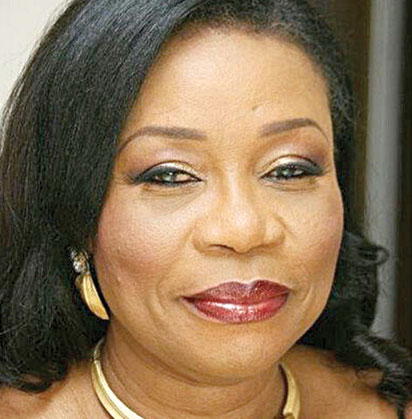
Mayen Adetiba
Says: “You’ll always stand out if you aren’t sloppy”
IN the early 70s when engineering was still perceived as the boys’ club, the only black girl studying for a degree in Civil Engineering in one of the world’s most respected institutions, Columbia University, USA, was a Nigerian. That girl is today 65-year-old Engr.(Mrs)Mayen Adetiba, an icon who has led the engineering profession at different times, both in Nigeria and beyond.
A former President of the Association of Consulting Engineers of Nigeria and three-time Vice-President of the Nigeria Society of Engineers, NSE, Adetiba has also presided over the African regional body of the International Association of Consulting Engineers. Principal Partner at Delkem Associates, a foremost consulting engineering outfit, she is also Chartered Secretary-General of the Association of Professional Women Engineers in Nigeria, APWEN. In this interview, the amazon who sits on the board of several multinationals and who was the first female to be elected into the executive committee of the NSE, shares her experience working in a male-dominated field in the last 41 years.
Read on:
By Josephine Agbonkhese
WHAT inspired you to study a course considered the exclusive preserve of men?
I left Nigeria in October 1970 and started studying Civil Engineering 1971. I didn’t actually set out to do engineering. I was going to read Accountancy but later changed to Computer Science. I was then inspired by a Nigerian, Engr. Ojo to do Electrical Electronics but later settled for Civil Engineering. I must admit that at that time, it was pretty rare and in my class, when I got in, there were just two of us who were girls. Like I said, I didn’t set out to do engineering; I kind of broke into it.

Mayen Adetiba
So how did you cope as a female in department, plus the fact that you just broke into it?
My case was funny because aside being among the only two girls in the class, I was also the only black. For a very expensive school like Columbia, where you have sons of presidents, senators and so on, it wasn’t easy because they spoke American English as upper-class children.
Different intonation
So, coming from Africa, they had difficulty understanding my English because of the different intonation. For that, I also needed to horn my English (in terms of intonation) as much as possible so I could communicate. Sometimes, it barred me from asking questions in class, so that people won’t laugh at me. I would later go to see the Professors in their offices.
In terms of academics, did you compete favourably with your male classmates?
I have always been an intelligent person. So, I didn’t have problems measuring up academically. There were times I was one of the best in class and at other times, I was among the average; you know grades sometimes fluctuate. I always took much more academic loads than most people in terms of units. I was registering like 24 points, which was double what anybody would take. Plus the fact that I had to work because at the time I left the country, which was just after the war, it was forbidden for money to be sent abroad. Even though my mother knew the then Central Bank Governor, it was almost impossible to send me money.
Scholarship from Nigerian government
I had to work until they lifted the ban. Even in secondary school when I still had to participate in different sports, I did well academically. Besides, you must be among the top ten in your secondary school to be admitted to the likes of Columbia, Harvard and the rest of them. I got a scholarship from the Nigerian government immediately I graduated in 1975, to do my Masters and Ph.D at Cornell University, also in New York. After my Masters in May 1976, I returned to Nigeria.
What was it like practicing Civil Engineering in a non-egalitarian society like ours in the 70s?
I have not been discriminated against. I have been a lot luckier than most male and female civil engineers put together. I think people always like to patronize me since I started my own company 33 years ago. There were quite a number of complaints from female engineers about discrimination, but personally, I did not experience such.
More importantly, I think one’s attitude towards work also matters. If you’re hard-working and people find that you put in all your efforts into your work, you will get patronized to a large degree. All through my 41 years in the industry, I’ve always been busy with work. There’s never been a time I have no job to do.
Most of your male contemporaries have not achieved as much as you have; what distinguished you…?
First of all, I would give God the glory. Secondly, I would say I like being thorough. In those days, people described me as “too finicky”, “proper”. Before any sketch left my office in those days when we were still using manual, I personally checked critically to make sure it was perfect.
So, if there were problems at all, it would be very minimal. I think if we are not being sloppy, we will always stand out. If I see an error on a job, I won’t say it doesn’t matter; I make sure it is fixed before it gets out of the office because I know I will have to take the blame for whatever happens. Your work goes a long way in telling what kind of person you are. If you’re a sloppy person, it will manifest itself in your presentation.
You’re invariably saying drawbacks come from personal attitude to work, more than gender?
If I say that, then I’m not being fair to other women because gender does have a lot to do with most people giving one a chance. A lot of women are actually being discriminated against. But personally, I am a fighter and I come from a family where I was so much favoured by my dad who thought I was superior.
So, I didn’t have any negative concept abinitio. My father made my younger ones come to me each time they needed any favour. Because of that, it was difficult for anybody to make me feel inferior. Aside that, personally, I feel a woman is first and foremost a human being before being a woman.
But I must also say that we’ve come a long way as women in the engineering profession, as well as other male-dominated fields. In those days, women were only in the teaching, nursing and secretarial professions.
Secretarial professions
Now we have women heading banks. We have women pilots, truck drivers, and very soon when we have our trains, we’ll find women driving them. In the classroom also, girls constitute 25 percent of students in engineering classrooms. So, we’ve come a long way and it can only get better whatever the men like it or not; whether or not they approve the Gender & Equal Opportunities Bill.
What landmark projects can you recall you’ve handled?
I was the resident engineer during the construction of Durbar Hotel in Festac, Lagos. That was during Festac 1977. Then I was in my 20s and was working for Late Engr. Fajemirokun because I had just returned from the US.
The Akwa-Ibom Liason Office and the governor’s lounge in Abuja were done by me. The E-Library the immediate past governor talks a lot about was one of my projects. We’ve done quite a bit of roads as well. Amongst others, I’ve also handled quite a number of the NNPC projects in different parts of the country.
Disclaimer
Comments expressed here do not reflect the opinions of Vanguard newspapers or any employee thereof.