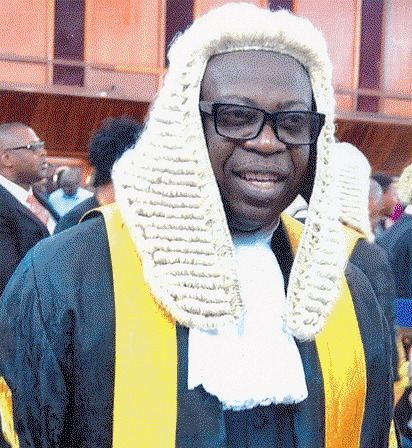
Adedeji- We have to make a choice as individuals
Ade A. Adedeji is a Senior Advocate of Nigeria. He is a highly skilled litigation and corporate commercial lawyer. The Learned Silk has distinguished himself in several areas of the legal Practice and he is currently involved in many contentious litigation for both local and international corporate entities. In this interview, he spoke on the judiciary budget in 2016; the need to institutionalize judicial reform and infrastructural challenges facing the institution as well as other related issues. Excerpts:
By Bartholomew Madukwe
PRESIDENT Muhammadu Buhari has said that the judiciary is his biggest headache in the fight against corruption, what is your reaction to this?
The judiciary as an institution is a victim of the society. Why do I say so? Quite often, the judiciary receives all sort of knocks from parties when decisions do not swing in their favour. I want to believe that the reason for this statement by the President, with due respect, has to do with certain decisions of the court, which of course are not in favour of government at this time.
Judicial reform

Adedeji- We have to make a choice as individuals
Therefore, I am not surprised that the judiciary is getting a knock on the head doing what it ought to do.
There is no doubt that the need for judicial reforms have become very urgent and important, especially to strengthen the fight against corruption. However, are you satisfied with the way corruption cases are being handled?
To be honest with you, in my opinion, judicial reform needs to be institutionalised. As part of political reform of the country’s judiciary, it must constantly be reviewed or reformed to reflect the constant dynamics of the society. It should not be treated like one off project and be left in a state for a century. Efficient justice delivery is central to the nation’s economic growth and development. The administration of justice in Nigeria craves for serious reform to meet with the exigencies of growth; hence delay of cases in courts and in some cases failure to deliver justice.
The Federal Government has budget N70 billion for the entire nation’s judiciary in the 2016 budget, which is N3billion lower than the 73billion appropriated for it in 2015. What is your reaction to this?
My opinion is that this is not in conformity with Mr President’s promise when he came to power and said he was going to reform the judiciary. I wish that the government will drive home the point that a lot will be done in the coming year, starting from this year, for the judiciary. Of course, money has to be spent. In a situation where the budget of the judiciary is dwindling by the year, then I think that, if anything at all, it will negate the expectations of many of us.
We have seen conflicting judgements from the Court of Appeal, especially on election petitions issues. What is your view on this?
There is nothing conflicting about the judgement of the Court of Appeal. The judgement of the Court of Appeal can be reversed at the Supreme Court, which was exactly what happened. There is nothing new or strange about it.
Constitutional power
The system of adjudication that we have, puts the Supreme Court in a position to review judgements of the Court of Appeal, and where something is amiss, they have constitutional power to reverse such judgement. That was exactly what happened in the Rivers and Abia State governorship elections. The judgement was reversed as they rightly view it.
Does this suggest that some judges of the Court of Appeal lack basic knowledge of the law, hence, their judgements are reversed as seen in the Rivers and Abia State governorship elections?
I do not believe that a justice of the Court of Appeal lacks basic knowledge of the law because his judgement was reversed by the Supreme Court. Yes indeed, I have read in newspapers that there are certain conflicting judgements from different panels of the Court of Appeals. Those judgements could be conflicting among panels of the Court of Appeal and I think that is what happened. The card reader was not contemplated at the time of the passing of the law. What is expected from the electronic card reader should now be part of the Electoral Law.
Undoubtedly, the infrastructural challenges facing the Nigerian judiciary are enormous and addressing them should be done holistically by the National Judicial Institute and various administrative heads of the judiciary, but how would you describe the state of infrastructure of courts across the country?
You have just said it the way it is. The advantage is that we have a Vice President, who is not only experienced in this issue by virtue of his track record, but also committed to getting us there. From what happened in Lagos State for instance, I remember the Lagos judiciary of 15 and 20 years ago and I know what it is today. Within that period, sometimes lawyers would not bringing their clients to court because they did not want them to come and see its poor state.
But now I know of judges who can confidently say that nobody can walk into their chambers to influence their decision. The Vice President did all that as Attorney General of Lagos State and I believe he is going to do it again. As Vice President, I believe he has enough power to ensure that all these things are put in place.
Infrastructural development
I totally agree that there is need for infrastructural development across the board; not only at the federal level but even at the state, including the customary court. I believe that we have a huge advantage and that should be done in coming years.
Since inception of the administration, we have seen the EFCC arrest suspects and take them to court. But after the court grants bail and same is perfected, such persons are re-arrested and charged again. In some cases, the suspect is asked to return certain money to the commission before any release can be made. What do you make of this?
Few days ago I was looking at the Administration of Criminal Justice Act, you may be shocked that the new law actually allows for that. I am one of the people who argue that the EFCC, as it is today, should be restructured to enable them function more effectively. I do not think they are on top of the game. I do not think they are effectively performing their duties as expected by the citizenry of this country.
One thing is very clear, the EFCC of 2016 is better than what it used to be in the past. We never hear of cases of high calibre politicians being openly prosecuted, but now you can see the kingpins are being prosecuted everyday, charged, and some of them convicted. I think that is the direction. I can only imagine that as years roll by, more and more will be done to actually give more confidence. Before then, we need to have our eyes on the ball to continue working hard on what we have and develop them.
Do you have any fear in this administration’s programme of ‘change’?
Looking at the men and women in government today, which I am not saying that we won’t have discomfort, I have anxieties and do not have any doubt whatsoever of their doing well. I know for a fact that any government that decides to fight corruption is going to encounter a lot of resistance and I think that is exactly what is going on.
Responsible citizens
If you want to fight the established institution, you must be ready because they are going to show you and hit you. That is exactly what is happening. We have to make a choice as individuals, as responsible citizens of this country, whether we want to go forward or back to what it used to be. In which case, of course, we must constantly remind ourselves that if we decide to go back our future generation will not be happy with us because we have a chance to go forward.
The issue of creating state police remains an argument and many Nigerians have said that such is what is needed today. What is your own position?
I think everybody knows this as a fact that the country is under policed. Most of the time people get away with murder in every aspect of our lives. Yes, I believe that the creation of state police is now. We can then look at which of the police is to handle what matter. Whether we like it or not, we have reached a point where the state is constitutionally empowered to have a state police. Since independence in 1960, a lot of things have changed. You need a lot to be able to control some of these crimes which are intelligence driven.
You really cannot afford to wait for all the bureaucracy in a single police structure to control a lot of things. I think we have passed that stage and we need to come into full realization of the fact that we have moved from that age. This is a new age, a lot of things have to change before we can really say that we are serious in combating crimes.
Disclaimer
Comments expressed here do not reflect the opinions of Vanguard newspapers or any employee thereof.