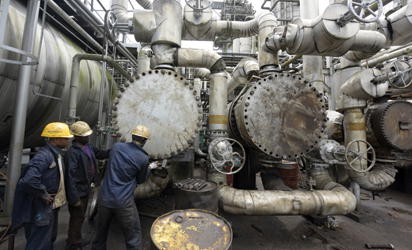
File image.
By Sebastine Obasi
NIGERIA is said to be losing about N40 billion yearly due to the poor performance of the nation’s four refineries. The Group Managing Director, GMD, of the Nigerian National Petroleum Corporation, NNPC, Dr. Ibe Kachikwu, who stated this during an interaction with journalists in Lagos, also said that the NNPC must be run as a profitable organisation to add value and be of benefit to Nigerians.

Refinery
He said: “My records showed that we are losing N10 billion for each of those refineries. That is where we need to move from the areas of emotion to the areas of business. Sometimes people say that I talk a lot of business, instead of social services. No, not as a Corporation.
The day NNPC is called NNPC Social Services, then, I would not have to have this conversation. But if it is called a corporation, it means that the country expects them to make a yield, make profit and manage the company profitably so that people can benefit.”
The GMD explained that NNPC is faced with numerous challenges, one of which is how to make the refineries work effectively and optimally. “There are lots of issues we deal with, the refineries being one of them. How do we make them work? My first belief as somebody who must see the refineries as a businessman was simply: they don’t work, you get somebody who will make them work.
‘’The reality is, if you give me 450,000 barrels of allocation, the models must be straight forward. I go out and process them and get a better yield and the government makes profit out of that yield and I keep back what I will use to run the refineries. It is a straight forward deal.
But the model we have been running is you throw in the barrels, either for reasons of pipeline issues or for reasons of ageing facilities in the refineries, I throw in a $40 barrel oil and get $50 result. You are dead before you start because you are already unprofitable,” he said.
He further explained that the biggest challenge is the debt factor, followed by the low performance of the refineries.
Disclaimer
Comments expressed here do not reflect the opinions of Vanguard newspapers or any employee thereof.