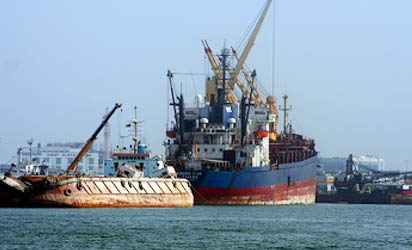
Sea-port
You are the CEO of Petro-Carbon Engineers Limited. What does the company actually do?
Currently, we are into deep water engineering consulting. We have been doing trainings for some IOCs here in Nigeria. We have trained some students in universities in the UK. We have done trainings in Egypt and Moscow. Currently, we are into a kind of partnership with an American company in Houston, and we are looking at doing a lot of things, especially in the deep water engineering, sub-sea engineering and naval architecture.
 So, basically, that’s all we are doing as a company. We are still expanding, like I told you, we started in the UK and we just came into Nigeria around July last year. So far things have been going on well; we are expanding and even hoping to expand further. We have some plans with companies and institutions like the University of Port Harcourt, the Offshore Technology Institute.
When did you start in the UK?
In 2012, while I was still doing my Ph.D. I started the company with some of my other Ph.D colleagues.
Are they Nigerians?
Funny enough they are Nigerians. One of them is a British-born Nigerian. We were three, but currently we are eight Nigerian engineers in total.
Since you came to Nigeria last year, what has Petro-Carbon done?
Our area of specialisation is very professional and specific in the industry. We cover the sub-sea engineering and naval architecture. That is a very specialist area. The challenges we have faced since we came to Nigeria is that we have not been able to get the actual engineering consulting jobs, because the area of our specialisation is very specific and highly skilled.
We have not yet gotten the confidence of the companies here in Nigeria to give us some of those jobs. Part of the reasons is because we are just starting. You need to consult in these areas, you need to have some proven track records of jobs you have done before the IOCs can give you jobs. The kind of jobs that we do, we cannot get them from indigenous companies because they don’t handle the deep water projects. We can only handle deep water projects.
What we decided to do was to start with training. So, we are good in this area, and we can train in it, during the training process, we can prove that we are proficient in this area. Some of the clients who attend the training programmes, who obviously are from these IOCs like Total, Chevron and Mobil, will be able to test us by giving us the pre-feed and preliminary design to do. These are to text our competence and hopefully give us something a bit larger.
So that is what we have been doing in Nigeria for now; we have been training. In January, we trained some staff of Total and Saipem. We had a discussion with Delta Afrik, but we have not yet finalised and we have also trained the general public. Since we came to Nigeria, we have trained about to 150 people. We have an average attendance of about 20 per course. In the area of training, we have done quite well and we have proven that we are proficient. Also, we are doing some consulting jobs for some UK companies, because we are registered in the UK.
Can you mention these companies?
For confidentiality sake, we don’t want to mention them now because most of the projects are ongoing. When we finish them, we can announce that we have been able to do, so and so project.
Are you also thinking along the line of opening a training school?
We have thought about it, but the process of getting accredited is a long one from the NUC. I do not mind if we have a training institute that can award diplomas, B.SC and Masters degrees. What we are doing now is to see how we can partner with some existing institutions and then we can offer some courses that are specialised with the deepwater and offshore job area. We can partner with them and offer some of these courses where we can serve as facilitators or course advisors or even teach some of the courses.
The reason why we set up the training arm of our business is because there are not a lot of people in Nigeria who are proficient in these areas; the technology is alien to Nigerian. What we did as engineers is to set up this company, bring it down to Nigeria to see how we can create awareness, start to teach Nigerians, especially professionals, to see how these things work. The whole idea is to improve on human capacity building in these areas.
What has been the impression of the companies you have worked for in Nigeria?
We have gotten very good feedbacks and I think one of the reasons we are getting good feedback is because our area of specialisation is new in Nigeria. Deepwater, sub-sea and naval architecture is new in this part of the world, although there are some Nigerians who are proficient in this area.
To the best of my knowledge, we don’t have enough institutions that have the content to teach this curriculum. Most of the people who are proficient in these areas gained the experience from foreign companies, and this is what we are trying to do. Nigeria is a major country as far as oil and gas is concerned, and we have a lot of offshore activities. We must also lead the way when it comes to areas of research and local content involvement in deep water engineering, design analysis and also operations.
So what we are trying to do is to bridge the gap. There are a lot of expatriates that are handling this area because it is a specialised area. However, we should get to the point where we can balance between local content participation and foreign participation. It is our own way of saying we want to bridge the gap, we have the knowledge and want to get the knowledge out there.
To a layman, what is naval architecture all about?
Basically speaking, engineering to a layman is designing a system that makes things to work easier. When we talk of sub-sea engineering, we basically talk about engineering section that deals with everything that has to do with what is going on the sea-bed. For you to bring out oil from the earth, which is covered by water, the technology is different from when you have the wells in an onshore environment. The offshore environment technology already existed for many years. The deeper we go for our quest for oil and gas, the more complex and the more complicated the technology gets.
Sub-sea engineering is an area of engineering that deals with how to solve the problems of getting the oil out from the earth that is under the water. You put a lot of equipment and there is a way the equipment work. The water depth is very deep, about 1,500 meters and normally speaking human beings don’t have access to the equipment on the sea-bed. Sub-sea engineering deals with how we can control these equipment and still get our oil and gas out of the reservoir up to the host facilities.
Naval architecture mostly deals with the design of the ship. We have the vessels, we have what we call FPSOs; we have barges and geo-ships and semi-subs. All these equipment are designed by naval architects. Naval architecture mostly deals with ships, operation and manufacture of ships. So these are technical and very highly skilled areas that did not exactly originate from Nigeria.
We need a lot of information if we are talking about Nigeria being the giant of African on oil and gas. We need to start building our own ships. I am aware that one or two companies in Nigeria have started building ships. We can expand our reach for more companies to be involved in sub-sea engineering and naval architecture.
From your explanation, this is a new field in Nigeria. What motivated you to go into Naval Architecture?
I will say it was curiosity because personally, I have always been inquisitive about oil and gas. I read petroleum engineering as my first degree in the university of Port-Harcourt. I have been very curious about deep water. Also, sub-sea is the future. A lot of what we did in my under graduate, we dealt with oil and gas exploration and production and the onshore environment.
I saw that the sub-sea engineering is the future and everybody is going deeper. In Nigeria now, we are expecting Egina which will actually be in the deepest water depth in Nigeria of about 1,750 meters. I know that there are projects that are being planned for the future. These other projects are deep water. Probably in another 10 years, if you don’t know anything about sub-sea engineering, you will probably be lost in the oil and gas industry. Personally, I was trying to meet up and be current in the industry. That is why I decided to do my Masters and Ph.D in sub-sea engineering and naval architecture.
There has not been a major exploration in the country for some time now. How has this affected the job indigenous oil servicing companies get?
It’s been a problem because if there are no projects, there will be no jobs. That’s what has been affecting the employment market as far as oil and gas is concerned in Nigeria. We have few Nigerians who go abroad to do Masters and Ph.D in sub-sea engineering and still don’t have jobs in Nigeria.
One of the reasons apart from what everybody will say is politics in the companies, is that there are not many projects going on to employ these people. I am speaking personally. I may not have all the information but I have been in places where people made statements to the effect that Brass LNG, for example can employ all the graduates who studied in the UK and the US.
From what I know about the projects going on in Nigeria currently, compared with the UK and the Gulf of Mexico, we do not have many projects. When projects are not going on, you cannot give jobs to the people who are proficient in the needed areas.
The major thing is that we need projects to be commissioned, so that some of the youths who are qualified will be employed, even if it is not highly skilled engineers position, they can start with graduate engineering position and build them up from there.
Some of my colleagues who studied in the UK still don’t have jobs and they have spent so much money to gain these levels of experience and academic qualifications. It is sad that they come here and sit at home because they don’t have any job to do. It is very sad. We need more projects and local content participation to be highly improved. The NCMB has done a good job to train some Nigerian youths who have been able to prove that they have certain qualifications.
Disclaimer
Comments expressed here do not reflect the opinions of Vanguard newspapers or any employee thereof.