blind people
According to the Nigerian Optometric Association, 20 million Nigerians are blind. It is easy to see this number as a statistic, or worse, to make it synonymous with the visually impaired beggars on the street without a hope for tomorrow. But the voices of students from the studios of Vocational Training Centre run by Nigerian Society for the Blind echoes hope from their base in Oshodi, Lagos to the ends of the earth.
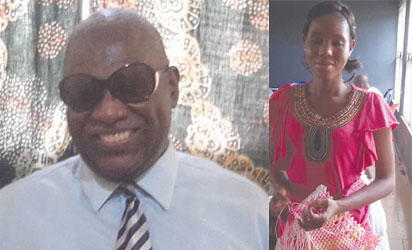
When this reporter visited the centre earlier this week, the students were rehearsing in the studio for a ball in honour of the school’s upcoming 60th anniversary celebrations. It was a rendition of Baby Jowo that Victor Olaiya himself would be proud of. Their Scotland trained music consultant, Mr. John Yekini, is a perfectionist to the core. His fingers move seamlessly across the keyboard, his dark glasses and wide smile, very much seal his similarity to Ray Charles. “You are too fast for the instrumentalists,” he tells the singers, “let’s take it a bit more slowly this time.” The choir is all too willing.

John Yekini and Taiwo Talabi
“This bunch has been selected to practice for our upcoming event while the others are in class,” whispers the Head Teacher, Mr. Nicholas Obot. The plan is not to distract the students who can recognize his voice from a mile away. The students are not easily distracted anyway; they prepare to sing Baby Jowo for the umpteenth time. Yekini is on the keyboard; the keys seen only with his mind’s eye. Another student hits the Konga; another perfectly content with a tambourine, and yet another complements the music with the sekere, the native beaded tambourine.
A trumpeter is not left out of the bunch, Izuchi Maduneme, who lost his sight in an accident the year before he was to graduate from the department of Arts at the Yaba College of Technology admits that he is “just learning” to play the instrument.
There is also a saxophonist, Akinpelu Akinjide, an alumnus of the centre who now works there as a business studies teacher. The singers are mostly female, perching around microphones in twos and threes like they are performing for a live band. One of them is Mrs. Adegbola, a mother and graduate of Theatre Arts. Unlike Aikinjide, she is not a VTC alumnus, but like him, she is a visually impaired member of faculty.
Principal of the school, Mr. Sola Ogunsiji says the centre has no qualms hiring visually impaired professions who are qualified for available jobs. The choir takes Baby Jowo again, and this time, Yekini is all too pleased. “This is the best you have done so far,” he tells them.
The studio, however is only a part of the newly built workshop complex commissioned by the Lagos State Government for this non-governmental home. Others like Taiwo Talabi find solace in the Arts and Crafts department. She is clutching a half-finished hand-made bag, a by-product of her last class when she runs into this reporter at the dining hall. Her bag is pink and white, pretty much akin to the colours she is wearing. Although she has been in class all day, her makeup is intact. “I did the make-up myself” she says, weaving her bag like it’s the simplest thing ever done. Visually impaired or not, this lady knows style…and joy.
“I am very happy now. I have been blind since 2006 and I did not know there was a place like this one where I could learn all these things. I had just been at home, doing nothing.” She says. Talabi plans to go into the bag making once she finishes her training at the centre. She says the one in her hands will go for N1, 500, but the centre’s Student Affairs Officer and Resident nurse, Mrs. Victoria Aregbe will have none of it. “Taiwo, you shouldn’t sell it so cheap, something around N2, 500 to N3,000 will be better.”
Just like the rest of the staff, Aregbe knows all the students by name. “My job entails looking after the students,” says the 70 year old, “I have been here for about 14 years. As you can see, I am here with them at the dining hall. It’s my job to make sure that their food is ready on time. Like a nurse, I look after their health. If anyone is ill, I give them first aid if needed and take them to the hospital. I had just retired from the Federal Ministry of Health when I heard that the centre was looking for an old nurse.”
Despite the poor pay associated with special education in Nigeria, staff at the centre feel very much at home and are in no hurry to find employment elsewhere. Principal Ogunsiji has also been at the centre for more than a decade. Growing up, he had two physically challenged relatives who were very close to him. It was because of them he went into special education. He has now spent thirty four years in the field, and his challenged relatives? “One of them works at the Federal Ministry of Finance, and the other is a teacher,” he says with pride.
It is the same pride with which he speaks about students who have graduated from the centre. Like the Information Technology expert who had his own outfit before he was shot and lost his sight. And the medical doctor who went back to consulting after his rehabilitation programme at the centre. The law students who passed the bar with flying colours; something no one thought they could achieve when they suddenly went blind in the middle of their academic careers.
He remembers Barrister Uche Obinna who used to be a student at the centre. “The wife works at the office of a member of our board who introduced them to this place when the husband became blind. During the interview, the wife was weeping profusely. I told her to take it easy. I joked with her, and she cleaned her face and smiled a bit. I told her: “You will smile again when he is done here.” It was like a joke. The husband was admitted and spent a year with us. This was a man who had been called to bar and was operating a successful law firm before becoming blind. But he put a lot of effort into learning everything he was taught here. Today, he works at the registry of the National Open University of Nigeria, NOUN.”
Ogunsiji’s words: “These special people are very good. Anytime you spend time with them, it is an opportunity to get them out of their shell and if you receive them with open hands, you find it joyful. It can be very fulfilling watching them grow to live a life worth living despite the disability. The key thing is to handle them professionally with love and care.”
The Nigeria Society for the Blind is a voluntary, non-governmental, non-profit making organisation, which set up the Vocational Training Centre for the Blind at Oshodi in Lagos nearly sixty years ago. The VTC is designed for adolescents and adults who were sighted but got blind along the way. Since inception, the centre has trained over 2,000 blind men and women to acquire skills in Braille writing and reading, type writing, handicrafts, telephone switchboard operation, computer operation, mobility skills, tie and dye and various crafts necessary for self-employment.
The VTC boss says that after a selection process to ascertain whether a candidate is fit for the programme, placement begins. “The students spend one or two years here. Those with lower qualifications spend two years while those with higher qualifications spend a year here. The ones with SSCE, undergraduates, as well as professionals spend one year.”
For now, the centre can only accommodate 60 students: 30 males and 30 females. All students are on a scholarship of N50, 000 from the Lagos state government-a very close ally of the home in recent times. The N50, 000 is however at a subsidized rate as it costs about N200,000 each to cater for each students. Apart from a meager sum to purchase their entrance forms, the students do not pay for the services.
“Funding special education is not easy. The programme of special people takes twice the time and effort than that of regular people. The teaching aids for students with special needs are very costly and not readily available. We have to order for them from abroad. The custom duties for the equipment are also very exorbitant. So after trying to get funds for equipment, we still have to again look for more to pay custom duties. We have very few teachers in the area of special education, and the reason is not far-fetched. It takes a lot more work to take care of students with special needs, but special needs teachers are not well remunerated. The pay is not attractive and as a result, there is an issue of personnel. To resolve all these, we would like the government and private organizations and individuals to come to our aid. We need to improve the welfare of our staff and continue creating conducive environment for students. The government has to do something about the high import duties.”
A conducive environment for the blind requires specifics. There are no staircases anywhere in the centre. The slightest elevation can be observed by the collapsible cane of an experienced student. One student even passes the courtyard with a bucket of water in one hand, and his cane in another. Yet the staff are very keen on leading the way when they can.
Three times during this reporter’s visit, Prinicpal Ogunsiji reminds students to go get their canes. Head Teacher, Mr. Obot, out of habit even warns this reporter of a small obstruction in the Centre’s courtyard. Obot laughs when he catches himself. “My wife always laughs at me when I do something like this. She would tell me, do you think everyone in the world thinks about blind people the way you do?
One thing I have learnt about teaching special students is that one must have a passion for it. People say all kinds of things. They believe that if you are working with blind students you’ll become blind or your children will become blind. But that’s not true at all. I am not blind and I have three children, none of them are blind.”
Obot, whose family stays in the staff complex on the compound, was the head of the Braille section at a special school in Zaria before coming to the VTC nearly fifteen years ago. Braille, which is form through which the visually impaired read and write, is no mean feat. Yet, Obot says that it is “very easy.” Some students seem to think so as well. Like Kehinde Adegboye who says Braille is her best subject. It’s no wonder she is thinking of studying to become a special education teacher after her programme at the centre. “If I don’t study Special Education, I will study Mass Communication,” she tells Saturday School Life, SSL.
Maduneme, the trumpeter, also has his life planned out. A sculpting major, he hasn’t made a piece since his accident two years ago. But he plans to sculpt something for the school’s anniversary this weekend. “Alongside being a student,” he says, “I used to work as a mechanic as well. I am looking forward to going back to school and work when I’m done with programme.”
Maduneme’s plans also go beyond work and school. He plans to marry his girlfriend before the end of next year. Despite the fact that his eyes have been blinded by glaucoma, one can see in them a depth of appreciation for that special girl that has stood by him throughout the most difficult time of his life. “She has been extremely supportive,” he says, “I never expected that she would still stand by me in a time like this. When the incident happened, I told her that I wouldn’t like to draw here back with my condition. But she insisted. She said she was with me before this and that my sight was not a criterion for her love for me.”
It is hours before the VTC choir is done with the rehearsals for the ball. Yekini comes into his office to be interviewed by this reporter. “Someone put off the air conditioner” he says, and feels for the switch without ceremony. He has been blind all his life, but is now at the peak of his career and loving it. He says: “Life is hard for everyone, including the sighted people. So it’s no surprise that it’s hard for the blind as well. Education empowers people, whether blind or sighted to be all that they can be. There’s nothing as good as education.”
Disclaimer
Comments expressed here do not reflect the opinions of Vanguard newspapers or any employee thereof.