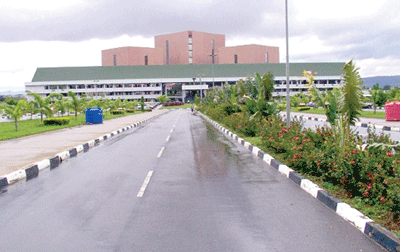
File photo: Supreme-Court-Abuja
Compiled by Dayo Benson & Bartholomew Madukwe
AS the year 2014 creeps to an end, there are many events that have shaped the polity in the last 12 months, and it is a combination of the good, the bad and the ugly. The nation’s judiciary, like other the arms of government, recorded its ups and downs in the fading year. In our tradition, Vanguard Law & Human Rights, reviews these major events, some of which may still ripple in the coming year.
Excerpts:
AS the year 2014 began, precisely on January 7, Nigerian President Goodluck Jonathan signed the Same-Sex Marriage Prohibition Bill into law. The law was passed by the national assembly earlier but the presidency had delayed signing it.
According to the Same-Sex Marriage Prohibition Law, homosexuals are prohibited from meeting in groups of two or more. It bans marriage or civil unions between people of the same sex, and criminalises gay clubs, events and shows of same-sex public affection. Those convicted are liable be imprisoned for 14 years.
Despite its condemnation by the United States of America, an Islamic court in Bauchi State wasted no time to put on trial 11 Muslim men accused of being homosexuals in violation of their religion.
Violation of religion
While Nigerians were still busy arguing over the said law, in the early hours of January 6, an explosion rocked the Rivers State High Court, Ahoda, premises, though no casualty was recorded in the blast. Also affected by the explosion was the Nigerian Bar Association, NBA, building.
The court was to have heard the application by the factional Speaker of the State House of Assembly, Evans Bipi, for the vacation of an interim order granted by the court, restraining him from parading himself as Speaker.
 Not left out in issues that rocked the Nigerian judiciary in 2014, the National Judicial Council, NJC, On February 26, found two high court justices (Justice G.K. Olotu of the Federal High Court and Justice U. A. Inyang of High Court of the Federal Capital Territory, Abuja) guilty of judicial misconduct and asked them to vacate their various offices.
Consequently, NJC, in a letter it wrote to President Goodluck Jonathan, pleaded that the two justices should not be allowed to adjudicate in any court in the country, stressing that pursuant to its findings, they ought not to sit on the Bench.
Another issue that came up in 2014 was the case involving the former Governor of the Central Bank of Nigeria, Sanusi Lamido Sanusi, on February 25, as he approached a Federal High Court sitting in Abuja, to challenge the powers of President Jonathan over his suspension.
In the suit he filed through a consortium of lawyers led by a Senior Advocate of Nigeria, SAN, Chief Kola Awodein, Sanusi told the high court that his purported suspension was as a result of some discrepancies he discovered in respect of amounts repatriated to the federation account from the proceed of crude oil sales between the period of January, 2012 and July, 2013.
Since April, the Rivers state judiciary has been enmeshed in crisis over appointment of the Chief Judge of the state. Just when most people in the state thought the problem had come to an end with the appointment of Justice Peter Nwoke Chukwuma Agumagu as the state Chief Judge by Governor Rotimi Amaechi, another chapter of the crisis opened this time with the suspension of Justice Agumagu by the NJC.
The NJC also issued him a query to explain why he should not be sanctioned.
Judicial activities
It would be recalled that Governor Amaechi appointed Justice Agumagu same day he secured a court judgement that gave him the right to do so. This was after some pro Amaechi lawmakers had held a sitting in Government House, Port Harcourt on the day the judgement was delivered by the court to screen and confirm Justice Agumagu as Chief Judge of the state.
Till date judicial activities in the state remain paralyzed, as courts are under lock and key, thereby denying litigants’ access to justice.
Earlier, the NJC had recommended Justice Daisy Okocha to the governor for appointment, as Chief Judge, arguing that she was the most senior High court judge in the state, an act the governor challenged in court.
Also, on July 9, the legal profession suffered a great loss with the sudden death of one of its rights activist, Bamidele Aturu. Aturu who was billed to attend the Nigerian Union of Teachers, NUT, delegate conference in Uyo, Akwa Ibom State, fell ill at the domestic wing of the Murtala Mohammed Airport and died while he was being rushed to the hospital.
On July 15, the Nigerian Bar Association elected Mr. Augustine Alegeh (SAN), as its 27th President. Alegeh, who is of the Benin Branch of the NBA, polled 691 votes to defeat four other candidates in the election. His runner-up, Mr. Oladele Adeshina (SAN), polled 370 votes. Mrs. Olufunke Adekoya (SAN) polled 255 votes. Chief Adeniyi Akintola (SAN), 126 votes and Mr. Osas Erhabor, 17 votes.
On August 27, barely a week after President Goodluck Jonathan received the final report of the Justice Idris Kutigi led 2014 National Conference and a minute silence was observed for delegates who died during the exercise, the fifth person, Alhaji Magaji Dambatta died.
And September 25 remains a date that the sanctity of the judicial arm of government was brazenly violated, as suspected political thugs invaded the Ekiti State High Court premises, and molested a judge.
Immediate closure
Consequently, the state Chief Judge, Justice A.S. Daramola, ordered immediate closure of all courts in until adequate security were provided.
The assault took place at the hearing of an application filed by Ekiti State wing of All Progressives Congress, APC, seeking nullification of the election that produced the governor-elect, Mr Ayo Fayose.
Another event was the ongoing coroner inquiry into the collapsed building of the Synagogue Church of All Nations (SCOAN) at Ikotun Egbe, Lagos. The State Government on September 26 constituted a Coroner Inquest to unravel the cause of the incident and the several deaths that followed.
Lagos State Attorney-General and Commissioner for Justice, Mr. Ade Ipaye, who constituted the Coroner court in line with the provisions of the Lagos State Coroner’s System Law No. 7 of 2007, noted it will investigate the cause and circumstances of deaths and bring his findings and recommendations to the appropriate authorities.
On October 11, immediate past President of the NBA, Mr. Okey Wali, SAN, was kidnapped in Port Harcourt, Rivers State. He was abducted around Rumuologu Road in his vehicle, which was later abandoned by the kidnappers at Ozuoba area of Obio/ Akpor Local Government Area. However, he was released 13 days after. As a result of Wali’s kidnap the successor, Mr Alegeh could not attend the International Bar Association conference in Tokyo, Japan because of his involvement in efforts that culminated in Wali’s release.
In sports, Nigeria was in danger of another FIFA ban after a court ruled that elections that ushered in Delta FA chairman Amaju Pinnick as president of the Nigeria Football Federation (NFF) was illegal.
Indeed, one of the most significant events in the nation’s judiciary was the appointment of Justice Mahmud Mohammed, as the new Chief Justice of the Nigeria (CJN), following the mandatory statutory retirement of former CJN, Justice Mariam Aloma Muktar, who clocked 70 years on November 20. This was in line with the provision of the constitution for Supreme Court Justices. There is no doubt that her tenure recorded so many achievements, particularly her acknowledged efforts in sanitizing the judiciary, in her capacity as the head of the NJC.
Following that, on December 17, a General Court Martial sitting at the Army Headquarters Garrison in Abuja sentenced 54 soldiers to death after finding them guilty of mutiny.
59 soldiers stood trial on a two-count charge of criminal conspiracy to commit mutiny and mutiny. Four of them were however acquitted.
Disclaimer
Comments expressed here do not reflect the opinions of Vanguard newspapers or any employee thereof.