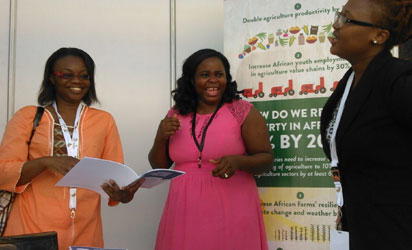
Ms. Carol Jilombo of the Comprehensive Africa Agriculture Development Programme (CAADP) with Precious Nkabinde and another participant at the just concluded 5th Africa Day for Food and Nutrition Security in Kinshasa, Congo DR.
By JIMOH BABATUNDE
More than three quarters of Africans who live in rural areas depend on agriculture and natural resources for their livelihoods. Agriculture and environment contribute the lion’s share to the GDPs of most of African countries. Correspondingly, the performance of agriculture and the economy has a direct and consequential impact on overall performance of the economy. This will have far reaching ramifications on the achievements of the inclusive growth, transformation, poverty reduction, social development and other goals.
But African agricultural production and productivity have been one of the lowest in the whole world despite the continent being blessed with abundant land and natural resources. Part of the reason is because little investment goes to African agriculture with farmers using less fertilizer while drought has become recurrent issue that has impacted negatively on production

Ms. Carol Jilombo of the Comprehensive Africa Agriculture Development Programme (CAADP) with Precious Nkabinde and another participant at the just concluded 5th Africa Day for Food and Nutrition Security in Kinshasa, Congo DR.
Largely due to such an under performance, Africa finds itself as the continent which fails to grow enough food to feed its own citizens. Based on these facts, food and nutrition security in Africa faces multiple threats stemming from entrenched poverty, environmental degradation, rapid urbanization, high population growth rates and climate change as well as variability.
The intertwined issues of markets and food security have emerged an important issue in Africa. The trends of malnutrition during the last two decades show a global but slow decrease in stunting rates worldwide, but at the same time an increase in overweight and obesity which raises serious concerns.
Although decreasing, stunting rate is still as high as 27 per cent in girls and 30.9 percent in boys in the world, but Africa is the most concerned because unlike the other continents, stunting rate is on the rise.
In addressing the issue of malnutrition in the continent and the importance of food and nutrition security in Africa’s inclusive development, African Union (AU) Assembly of Heads of State declared the year 2014 as the “Year of Agriculture and Food Security in Africa.” Following this, the African Union Commission (AUC) also declared October each year as the Africa Day for Food and Nutrition Security (ADFNS).
The leadership of the AUC in collaboration with other stakeholders converged last week in Kinshasa, Congo DR for the 5th Africa Day for Food and Nutrition Security.
African Union Commission’s Commissioner for Rural Economy and Agriculture, Mrs. Tumusiime Rhoda Peace said the Kinshasa event with the theme “Accelerated Action for Hunger Free Africa” was an opportunity for stakeholders and experts to discuss the importance of sustainable diets for Africa’s nutrition security, with special focus on traditional and indigenous diets.
“The commemoration of the Africa Day for Food and Nutrition Security is grounded on a very sound moral. Our continent has continued to experience worsening episodes of under-nutrition, vulnerability to famines and harrowing statistics of stunting’’, Mrs. Rhoda Peace noted.
She regretted that despite success stories recorded of steady overall economic performance in Africa with seven of the world’s 10 fastest growing economies, its populations have continued to experience low resilience to natural and man-made shocks.
According to her, among the important contributors to Africa’s high burden of malnutrition is poor nutrient intake resulting from nutritionally inadequate diets and poor feeding practices.
“Dietary diversity, which entails the intake of a variety of foods across and within the different food groups and species, is shown to be crucial for adequate nutrient intake and optimal nutritional status, especially in developing countries.
“However, for a long time, food production systems in the majority of African countries have focused mainly on few species of crops like cereal grains and cash crops with little attention to production of nutritious non-food grain commodities including pulses, vegetables, fruits, oilseeds, fish, livestock and poultry.”
Rhoda Peace noted that several indigenous species of crops and animals, which play vital role in the diets of most African communities, have been gradually neglected from mainstream agriculture, and as such, are now collectively called ‘Neglected and Underutilized Species.
Ambassador Yahaya Olaniran, Nigerian Permanent representative to FAO, said non-consumption of the ‘Neglected and Underutilized Species which are rich in proteins, vitamins, minerals and high in unsaturated fats, natural sugars as well as antioxidants, has led to non-communicable diseases, including diabetes.
He added that supermarkets and fast food chains which often serve as the distribution channels for such processed foods and unhealthy snacks are also rapidly spreading across the continent.
“Excess sugar in our food, in our drinks, excess salt in the processed food we are eating is also causing death and diseases just like tobacco. Why can’t there be concerted effort of war against sugar and salt intake? I don’t see any reason why that should not be.”
Ambassador Olaniran said apart from controlling intake of sugar and salt, there is need to make food accessible and available to Africans, arguing that this can only come about with creation of jobs that will provide purchasing power for the people
He said situation where Africa spends over $80 billion to import food and juices is unacceptable as the “aids we are said to be getting is about $1.8billion. We can do better by looking at the relevance of agriculture to our economies.
“I know if we eat local and drink local some of these problems we are having today will not be there and our bill in terms of health care will reduce.”
Ambassador Olaniran explained that diets prepared using indigenous food commodities have been identified to have many nutritional and health benefits.
The organizer of the summit disclosed that Africa has a wide variety of indigenous foods that are prepared in various ways across the continent.
“The production, consumption and commercialization of these indigenous foods can help farmers and consumers alike manage economic and environmental risks, including presenting important options for adapting to changes in climate.”
On scaling up
Agriculture has been identified as one of the pillars in reverting the current stunting and overweight trends in Africa with a call on African leaders to renew commitment to the growth of the sector.
“The goal of a Hunger Free Africa is set to motivate firm action toward improving food security and nutrition indicators and targets.
“For this to happen, partners at all levels must have concerted efforts to develop and implement comprehensive plans of action for improved food availability, access, quality and sustainability.
Rhoda Peace said the theme of this year’s celebration “accelerated action for a hunger free Africa” should send a strong message that 10 years after the 2003 Maputo Declaration by African leaders to reduce hunger, poverty and malnutrition through increased public and private investment in agriculture that it is time to scale up.
The theme, according to Rhoda-Peace, called for ‘business unusual’ in their efforts to end hunger, which is by no means a simple task.
“Accelerating Action’ means working strenuously and progressively to overcome obstacles, doubling efforts for meeting the planned objectives, committing more resources for delivering services to target groups.
Sharing knowledge on what has been done in other parts of the world that can be replicated in Africa, Fred Grant from Helen Keller International, said its food production initiatives implemented with great success across Asia for the past twenty years can lead to food and nutrition security in Africa.
Greg disclosed that they are working in Burkina Faso on practical and sustainable means for the production of nutritious foods through what they called Village model farms.
He said with the Village model farms established, they have been able to show techniques that support diversified, year-round production of micronutrient-rich crops and improved breeds of poultry to community members.
Another success story shared is that of Scaling Up Sweet potato through Agriculture and Nutrition (SUSTAIN) in Mozambique, Kenya, Rwanda and Malawi which is achieving a better nutrition status through the production, marketing and consumption of biofortified crop.
Disclaimer
Comments expressed here do not reflect the opinions of Vanguard newspapers or any employee thereof.