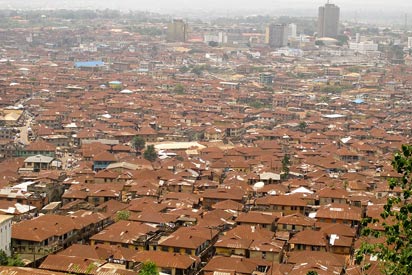
*Ibadan skyline
IBADAN – Ibadan, the largest city in West Africa is an ancient city in Oyo State. As a result of the unique way it plays its unique politics which has been tagged ‘Amala politics,’ it is often described as the political headquarters of Yorubaland, where amala is a popular dish.
Apart from politics, other things like the topography, landscape of the city and attitudes of residents are other factors that catch one’s attention. Take a trip to remote areas like Inalende, Abebi, Oniyanrin, Gege Oloorun, Yemetu Alaadorin, Ogbeere Tioya, Amuda oojere and many others and see how houses are clumsily built with little or no attention to town planning rules and regulations.
Also, major roads in the sprawling city are another spectacles to behold. Some narrow, while others are wide enough for human and vehicular movements. Many landowners struggle to get lands close to the roads so as to convert the setback to personal use.

*Ibadan skyline
In Ibadan, before Governor Abiola Ajimobi assumed office, market men and women not motorists own the roads. They transact businesses in the middle of the road leaving no space for motorists to ply. It is no wonder that majority of them kicked against the urban renewal of Governor Ajimobi because they are contented with the clumsy nature of the city. Trading by the roadsides is synonymous with the city.
Past governors including late Minister of Justice, Chief Bola Ige had tried in the past to initiate the urban renewal, but they lacked the political will to implement the policy. Though, critics of Ajimobi’s administration claimed that he ought to have prepared alternatives for the traders before demolishing their means of livelihood, they have forgotten that late Ige had built the new Gbagi market before ordering them to leave old Gbagi.
Till date, the traders have returned to the old Gbagi with their wares. Successive governors had fought the battle and lost and therefore have left the traders to their fate.
Their continued refusal to leave the roadside has resulted in dire consequences especially at Ojoo, Sasa, Eleyele, Sango, Molete, Beere, Oritamerin, Ojaaba and many others. There have been so many innumerable auto crashes that claimed many lives in these areas.
Fatal accident
There has been no year that one fatal accident or the other did not happen with heavy casualty figure. The most notorious place noted for such accidents is the Ojoo end of the city where traders of all kinds gather to sell their wares.
From 2006 till date, hundreds of people have been killed in different auto-crashes within the city.
Some years ago, scores of people were burnt to death at Alaakia area of the city, when a commercial bus rammed into a trailer that got stuck on the road. Again, subsequent years recorded many accidents.
At Ojoo-Moniya road, five people lost their lives, while several others sustained injuries in two different auto crashes on the same day.
The first incident happened on Ojoo-Moniya road when a trailer with registration number XD 159 BDJ, fully loaded with petroleum product, as a result of brake failure, lost control and hit two commercial vehicles with registration numbers XY 912 AGL and GA985 LSR.
Some days earlier, 11 people including two school children were killed in two different auto crashes in the city.
The second accident occurred along Moshood Abiola Way, formerly Ring Road at Akintoba Bus stop, when a trailer loaded with petroleum product lost control as a result of brake failure and hit about 11 vehicles as the driver battled to control the vehicle.
The conductor of the trailer was said to have jumped down from the vehicle trying to stop the vehicle by putting a wedge but in the process he was crushed.
Last year, a soldier and five other people were crushed by trailers at Eleyele area when the trucks had faulty brake.
As if those ones were not enough, another tragedy struck at Molete area of the city which claimed about 15 lives and left several others severely injured last Saturday.
The accident, like the previous ones, happened when a fully loaded tanker lost control and emptied its contents on the road.
Besides human casualty, 45 shops, 13 vehicles, three houses, seven commercial motorcycles, three commercial tricycles and several other items were destroyed.
It is not only auto-crashes that claim lives in the city. At times, accidents happen when electricity cables snap. The one that is still fresh in memories of residents, especially Apata residents was the incident that claimed no fewer than seven lives of vegetable sellers, including a pregnant woman. Live wires snapped and the women were all electrocuted.
Despite warnings such as:
It is extremely dangerous to stay under PHCN high tension power lines or carry out any activity close to PHCN equipment; It is a crime punishable under the law if you erect structures or carry out activities under or close to PHCN equipment; You must give a gap of 5.5 metres, 12.5m and 25m on each side of our 11/33KV, 132KV and 330KV lines respectively; You stand the risk if instant electrocution in case of a wire cut or transformer explosion; If you erect structures or carry out activities under the PHCN high tension lines or close to any PHCN equipment; You endanger your life and overtime as a result of radiation from the power lines which may lead to cancer among many others, residents still pay deaf ears to these warnings.
The governor who on assumption of office tried to stop this carnage in the city, told residents of the city that he would not mind to hurt those who may stand on his way. He acknowledged that lack of political will was part of the problems that militate against sustainable roads in the state.
He said his vision of Oyo state roads was one where commuters and drivers commute on the roads without vehicles having shock absorber challenges.
He sought the cooperation and understanding of the citizens in his efforts at changing the state’s infrastructural landscape, stating that when the rains totally subside, the state would not only witness massive rehabilitation of roads as is being done now but an unprecedented construction of roads in the state.
But, as the 2015 election approaches, the political will that Governor Ajimobi displayed at the outset of his administration seems to have waned. He showed this when speaking on a live television programme when a caller said he should go ahead and widen the Akobo road, adding that any building that violated the town planning rules should be demolished.
Town planning rules
Ajimobi said he should go and convince his people what he just told him so that they would not see him as being responsible for demolition of their houses.Unlike some months ago, traders are back on the roads selling their wares unhindered. It seems it is now worse than the time he assumed office.
Though, the demolition exercise seems to have stigmatized Ajimobi’s administration, some residents of the city feel the governor should have continued with the urban renewal irrespective of whose ox is gored. On Ologuneru-Eruwa road, most of the buildings by the roadside are just some few metres to the road. To reduce this carnage, tough stance like the one displayed by Governor Ajimobi at the inception of his administration is required. Another major cause of road carnage is the state of some of the roads in the city.
Governor Ajimobi has no doubt recorded unprecedented achievements in road construction, there is still more to do.Also, there is no regulation of the activities of truck drivers especially trailers that convey bags of cement. They load more than the normal weight of load that their trucks could carry. This, as Vanguard gathered, leads to brake failure which results in loss of lives.
Disclaimer
Comments expressed here do not reflect the opinions of Vanguard newspapers or any employee thereof.