YESTERDAY The two scriptures agree that God spent six days to complete the work of creation as evident in Surah 7:54 and Ex. 20:11
THE QUR’ANIC CONCEPT
Death as conceived by the Qur’an
It is appropriate to start with the examination of the Qur’anic concept of death so that it might serve as illumination to the understanding of the doctrine of resurrection as taught in the scripture.
Most of the passages of the Qur’an that talk about death emphasise its inevitability (Surah 3: 185). This is why in Surah 15:99, death is referred to as alyaqin (that which is certain). The Scripture further teaches that death is not the end of man’s life but a gateway to another form of life. In consequence of this, Surah 89:27–30 issues the divine command to the righteous soul thus: “O (thou) soul in (complete) rest and satisfaction, come back thou to thy Lord well pleased and well pleasing unto Him enter thou among my devotees, enter thou my heaven.”
In the same vein, Qur’an 3:169 declares those who are slain in the course of God as living, finding their sustenance in the presence of their Lord. Whether for the righteous or the unrighteous, death from the view point of the Qur’an does not mean annihilation. Rather, it is a turning point in the continuous existence of man as implied in many Qur’anic verses which teach the reality of resurrection.
In the light of this, Surah 3:185 of the Qur’an which asserts that every soul shall have a taste of death needs to be properly understood as it may be interpreted as suggesting termination of soul. It should be noted that the verse does not say the soul shall die rather it says it shall have a taste of death. According to Yusuf Ali’s interpretation, the death of the body will give a taste
of death to the soul when the soul separates from the body. Arising from the Qur’anic notion that death does not terminate man’s existence is the belief in the existence of the intermediate state between death and resurrection called barzakh. According to an-Nawawi (1978: 71), the term literally means a thing that intervenes between two things and in Surah 23: 99–100, it was used in the sense of stay in grave as intervening between death and resurrection. The intervening position of barzakh is further brought to light in Surah 80:21–22. Here, the word qabr (grave) is used in the place of barzakh.
According to this verse, causing man to die, assigning him to the grave, and causing him to resurrect are the three necessary stages through which a deceased person shall pass. Barzakh, in the sense which it is used in the Qur’an, is more of a state rather than a place of burial of the dead because the scripture is cognisant of the fact that not everybody that dies is buried. While in the state of barzakh the unrighteous are spoken of as receiving chastisement known as ‘adhab al-qabr, while the righteous are spoken of as tasting the fruits of their good deeds.
These, according to Galwash (nd: 203), would be subsequent to the visit of the questioning Angels, Nakir and Munkar, who would come to question the deceased about his faith in the grave.
Signs of the last day
As a prelude to discussing the Qur’anic concept of resurrection, it is pertinent to examine the signs of the hour according to the Muslims’ belief, since the occurrence of the signs serve as an indication for the imminence of the last day. They are twelve as contained in cUthman b. Fudi’s cTanbih ul-Ummah cala qurb Qudum ashrat-al-sacah (Warnings over the proximity of [the signs of] doomsday). The manuscript is wholly devoted to this subject.1 It is important to note that the signs are not Ibn Fudi’s formulations, rather, he has extracted them from books of hadith and most importantly from al-Qurtubi’s Tadhkirah.
According to ibn Fudi, out of the twelve signs, five had occurred, namely: (a) The occurrence of shameful practices, (b) The occurrence of earthquake, (c) The eclipse of the moon, (d) Fire in Hijaz, (e) Occurrence of social and political upheavals.
The seven signs which are yet to occur are: (a) The coming of the Messiah (b) The coming of the Anti-Christ (c) The second advent of Isa (Jesus) (d) The coming of Yajuj and Majuj (e) The lifting of the Qur’an (f) The coming of the beast (g) The rising of the sun in the West
A brief examination of each of the seven signs will elucidate Islamic viewpoint on the subject.
(a) The coming of the Messiah
Ibn Fudi calls attention to the conflicting traditions of the prophet on the time of arrival of al-Masih. While some traditions claim that the time of his coming had lapsed, others claim that he would delay his coming till the arrival of the anti-Christ. Ibn Fudi also narrates the traditions touching on the personality of the Messiah. Some claim that he shall be a descendant of Fatimah while others claim that he shall be a descendant of cAbbas, the prophet’s uncle, yet many claim that the Messiah is cIsa b. Maryam.
(b) The coming of anti-Christ
He would come to tempt people and would perform false miracles enough to make people mistake him for Christ. Ibn Fudi refers to the traditions which claim that his advent would be preceded by three years of acute famine resulting in high rate of death, as well as uprising. He claims that the anti-Christ would appear at Khurasan and shall be followed by large crowd basing his view on a tradition related by Tirmidhi. He also calls attention to different traditions which claim that Ibn al-Sayyad is the anti-Christ. As for those who will survive the temptations of the anti-Christ, Ibn Fudi quotes a tradition from Sahih al-Muslim which says: ‘whoever memorises the first ten verses of suratul-kahf attains immunity from the influence of the anti-Christ.”
(c) The second advent of cIsa. The reasons for his coming according to Ibn Fudi, quoting al-Qurtubi, are: (i) To fight the anti-Christ, who would draw followership from the Jews, but he (cIsa) shall triumph over them with the aid of the believers; (ii) To come and complete his interrupted life since he was taken up by God, when he was to be crucified by the Jews. He argues that he would come to die a natural death since man is created from the dust and must be returned to the dust before he shall be raised up once again, as contained in Surah 20:55;
Descent of a fair judge
(iii) To resuscitate Islam. It is believed that all other religions except Islam shall be destroyed at the advent of cIsa. To justify this view, Ibn Fudi quotes hadith from al-Bukhari’s collection which asserts that Ibn Maryam shall descend as a fair judge; shall break the cross, kill the pig and enforce land tax. He claims cIsa would spend seven years for his second advent, to make a total of 40 years when added to the 33 years he spent during his first advent. He based his view on a tradition quoted from Muslim’s collection.
(d) The coming of Yajuj and Majuj (Gog and Magog) Yajuj and Majuj are said to be offspring of Yafith b. Nuh. They are barbarians who would come to Jerusalem to distress cIsa and his companions, till, at his request, God would destroy them. Regarding their time of coming, Ibn Fudi quotes Ibn Jahr’s commentary of al-Bukhari that the time shall be during the second advent of Isa. According to Ibn Majah’s traditions quoted by Ibn Fudi, Yajuj and Majuj shall be free to go about committing atrocities. Subsequent to this, God shall cause some animals called: an-Nacaq to fall on them and kill them thereby getting rid of them.
(e) The lifting of the Qur’an
Ibn Fudi quotes several apostolic traditions to justify the lifting of the Qur’an. According to these traditions, the Qur’an shall be lifted on a single ight and not a single verse shall remain on earth; all knowledge about it shall be lifted from human beings. These shall happen after the death of Isa.
Coming of the land beast
(f) The coming of the land beast (dabat al ard) The coming of the land beast is another sign of the last day on Ibn Fudi’s list. He derives this from Surah 27:82, which declares: ‘’And when the word is fulfilled against them (the unjust), we shall produce from the earth a beast to (face) them, he will speak to them because mankind did not believe with assurance in our signs.”.
Ibn Fudi refers to the traditions recorded by al-Qurtubi, claiming that the animal shall come out of a crack in the Kacabah. According to a tradition of Ibn Majah transmitted by Abu Hurayrah, the creature shall carry the ring of Sulayman as well as Musa’s staff. Believers shall be marked on the forehead with the staff while the unbelievers shall be marked on the forehead with the ring. According to al-Qurtubi, the creature shall combine features of all animals: it shall have the head of a cow, horns of a deer, eyes of a pig, ears of an elephant, neck of a tiger, sides of a cat, tail of a ram, legs of a camel. It is believed that the creature is the young camel of prophet Salih which escaped when the mother was killed.
(g) The rising of the sun from the West
On this, Ibn Fudi recalls al-Qurtubi’s view that “no hitherto unbelieving soul shall be saved by his profession of faith after the sun has risen from the West, because they shall be frightened out of their wits.” This view is based on a hadith narrated by Abu Hurayrah and recorded by Bukhari and Muslim. According to al-Qurtubi, the sun would rise in the West to show the omnipotence of God and the weakness of man, as demonstrated by Namrud in Surah 2.258. Ahmad Galwash’s list of signs of the last day is scarcely different from those contained in Tanbih al-Ummah. An addition on his list is the coming of al-Mahdi. He based his view on a tradition which claims that the world would not end till a member of his family governs the Arabs, whose name should be the same as his own and whose father’s name should be the same as his father’s and who should fill the world with righteousness.
It should have been observed that hadith is the source of these signs. The only sign mentioned in the Qur’an is the appearance of land beast contained in Surah 27:82. This should not be considered to be a problem since hadith is the second source of law and information recognized by Muslims. Our major problem, however, lies in the contradictions contained in the traditions cited in support of the reality of these signs, thereby contravening one of the principles of hadith authenticity. For instance, the traditions cited in support of the coming Messiah are conflicting. They conflict on the person of the Messiah as well as the time of his arrival. While some traditions claim that the time of his coming had expired, some claim that the time is not yet ripe. These contradictions are probably due to the silence of the Qur’an or lack of explicit injunctions in the scripture regarding the signs. For instance the Qur’anic account of cIsa’s ascension after the crucifixion as contained in Surah 4: 157–158 and 3:55 are capable of different interpretations. Some Muslims have come to the conclusion that in consequence of Isa’s ascension, he would necessarily be coming back while some are of the opinion that his ascension being spiritual occurred after his death referring to Surah 3:55 as the basis of their argument.
However, one thing is clear, there is no Qur’anic passage which explicitly informs us of the second coming of the Messiah, cIsa Ibn Maryam. The apostolic tradition remains as the only source of information. The claim that the Messiah is a different personality from cIsa’ is un-Qur’anic for it contravenes several verses of the scripture like Surah 3:45 and 5:75, which refer to him with the title. As for the signs derived from the authentic works of tradition like those of Bukhari and Muslim, we have no cause to doubt their authenticity especially when the traditions predicting such signs contain names of reliable narrators like Abu Hurayrah on their chains of transmission. There would be no basis for doubting the authenticity of such signs more so that their information is contained also in the Bible. Thus, the coming of Isa, anti-Christ, Gog and Magog and land beast should be regarded as valid eschatological signs to be expected.
THE BIBLICAL CONCEPT
Death as conceived by the Bible
Right from the very beginning, Israel adopted an ambivalent attitude towards the fact of death. Sometimes, the dead were considered to be poor creatures leading a gloomy or shadowy existence, while some other times, they are considered as being endowed with superior knowledge and super human power. This latter attitude is seen in I Sm. 28:3–25, where Saul had to employ necromancers to bring up Samuel in order to inquire what he would do to thwart the threat of the Philistine army since God refused to listen to him. The action of Saul perhaps shows that such a practice was in vogue in Israel in his time.
However, the belief that the dead leads a gloomy and shadowy existence seems to be predominant in the OT. Thus in Jb. 3:17 the dead are described as weary and in Ps. 88:4 we are informed that they are without vigour. Similar views are expressed in Is. 14:9–11. This conception of death arises from the Jewish understanding of the living person. To a Jew, man as evident in Gn. 2:7 and Lev 7: 20 is a living soul (nefesh), who can never be grasped apart from the flesh (basar) its manifestation. The nefesh is kept alive by the breath of life (nishmat haim) breathed into it by Yahweh. At death, the nefesh survives but deprived of the breath of life; it remains a being totally deprived of all vital energy. Thus death is in the words of E. Jacob quoted by Cerlin (1959: 92)”… a state in which the life force is at its lowest ebb.” Von Rad (1975: 275) has tried to explain that this attitude to death was meant to discourage all forms of cult of the dead.
The place reserved for the dead is known as Sheol, a place generally believed to be located somewhere under the earth. Sheol is generally described in the OT as a gloomy subterranean abode of the departed spirits in which they exist in a weak, powerless and dreamy state. It is described as a place of silence (Ps. 94:17; 15: 17), where existence is almost devoid of all activity (Ec. 9:10; Is. 14: 9-11). We also notice a dynamic or in the words of Von Rad’s “aggressive element” in the concept of Sheol. The kingdom of the dead is regarded as Abaddon, i.e., destruction that continually threatens God’s creation, for death encroaches on God’s domain and finally causes separation from God (Jb. 26: 5-6; Pr. 15:11).
Indeed, the real bite of death according Is. 38:18 is that in Sheol, one is cut off from the cult and from Yahweh, hence Ps. 6:5 asserts that in death there is no remembrance of God. The NT teaching about death is more straightforward. Here, death signifies the separation of the soul from the body. While the NT believes that the life of man never ceases to be, it views the grave as the tunnel through which man passes in order to reach the life beyond. The doctrine of man’s immortality is brought to light when Jesus declares in Mt. 10:29. “Fear not them which kill the body but are not able to kill the soul.” Like the OT, the NT teaches that death is a consequence and a punishment of sin. This is evident in Rm. 5:12, which reads: ‘’… as death came to the world through one man and death through sin, and so death spread to all men because all men sinned”.
According to I Cor. 15:22, the man through whom sin and death have come into the world is Adam. This same passage says: “…in Christ all are made alive.” This assertion here leads us to yet another element in the NT conception of death. This is the conception that Jesus has abolished sin by his own death. The NT further teaches that it was through the resurrection of Jesus that he triumphed over death, thereby becoming the author of life to the believer (Hb. 2: 14-15 ). It is on the basis of the belief that Christ’s resurrection confers eternal life on the Christians that they believe in the existence of soul in a state of consciousness after death. It is held that at death, the souls of the righteous go to the presence of God while the soul of the wicked are banished from His presence while they still remain in a state of consciousness. The souls of both the righteous and the unrighteous would remain in this state till resurrection.
BOOK PRESENTATION
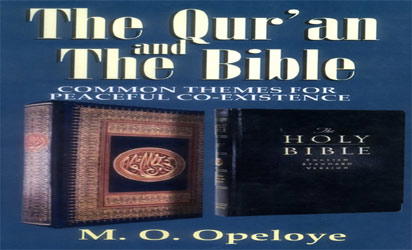
Book presentation tomorrow at the Nigerian Institute of International Affairs, NIIA, Victoria Island, Lagos at 11 a.m
Disclaimer
Comments expressed here do not reflect the opinions of Vanguard newspapers or any employee thereof.