Oscar Pistorius
(AFP) – A South African judge on Tuesday ordered Oscar Pistorius to undergo up to 30 days of psychiatric tests to establish if he is “criminally responsible” for killing his girlfriend on Valentine’s Day 2013.
Thokozile Masipa said the Paralympian sprinter should report to Weskoppies Psychiatric Hospital in Pretoria as an outpatient each workday morning and remain there until 4:00pm, starting May 26.
He will be tested to see “whether he was capable of appreciating the wrongfulness of his act or acting in accordance with appreciation of the wrongfulness of his act,” said Masipa.
Pistorius is accused of murdering 29-year-old model Reeva Steenkamp at his Pretoria home after a row. He says she was killed by accident after he mistook her for an intruder.
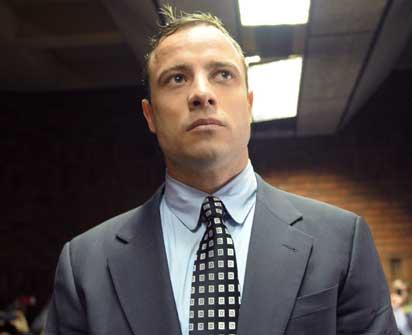
Following Tuesday’s ruling, Pistorius, wearing a grey coat, greeted his older brother Carl, whispered something and then embraced him in a deep hug.
As an outpatient, he will not stay in the hospital and undergo 24-hour observation, but visit for his interviews and tests — a practice experts have termed “unusual”.
The Paralympic gold medallist, nicknamed the “Blade Runner” for his prosthetic limbs, will be monitored by three psychiatrists and a psychologist.
The case is postponed until June 30 while the athlete undergoes testing.
– ‘Proper inquiry’ –
The psychiatrists’ final report may drastically alter the direction of the trial.
Pistorius’s defence team have sought to show that his violent reaction to a perceived intruder in his home stemmed from a deep-seated anxiety that began to fester after the amputation of his lower legs as a child.
During two months of trial, his lawyers have sought to portray him as manically obsessed with safety after a difficult childhood in which his fearful mother abused alcohol, and in the face of high crime levels in South Africa.
A psychiatrist last week testified he suffered from a general anxiety disorder.
The judge said a “proper inquiry” was needed to test whether Pistorius had a disorder which affected his capacity to distinguish between right and wrong in the situation which led to his lover’s death.
If he is found to have no capacity then the trial may be halted.
If he is found to have diminished capacity it could have a large impact on any possible sentencing.
If he is found to be of sound mind it would kick away a key pillar of his defence.
The decision to place him in outpatient care was to help speed up the trial that has greatly exceeded its initial three-week schedule, but critics say the assessment lacks rigour and amounts to preferential treatment.
“We don’t do outpatient assessments, because sometimes you need to know how a person is at night, how they sleep or don’t sleep,” said forensic psychiatrist Sean Kaliski, who works at Valkenberg Hospital, a psychiatric institution outside Cape Town.
“If you watch a person over 24 hours over a few weeks you get an idea how they interact with other people,” he said. “You learn a lot.”
Criminal lawyer Mannie Witz told AFP he was confident the athlete would be diagnosed with anxiety disorder.
“At the end of the day, he definitely has this disorder, and they’ll say that,” said Witz, who is not connected with the trial.
“It diminishes his responsibility, but not culpability, so it will lessen his sentence. I’ll be very surprised if they find anything else.”
Pistorius’s quick referral for evaluation also raised eyebrows in a country notorious for backlogs in the justice and public health systems.
“It is unusual because if you’re a normal man on the street sometimes they can wait a year or two before they get to a mental hospital and even get assessed,” said Witz.
“They languish in custody for many years.”
Disclaimer
Comments expressed here do not reflect the opinions of Vanguard newspapers or any employee thereof.